


Weather: All about this weather pattern due to hit the US southern plains – it does look like it may be slipping more to the east. If our forecast is right, Kansas would still be around 70mm behind normal for this time of the year – additionally, we see another very hot week, ie around 10°C above normal temps over the next week.
Markets
Israel didn’t accidentally let off a stray missile, they bombed the living suitcase out of Hezbollah in a massive 10 minute tirade. Understandably, this has put the likelihood of the Strait opening on the back burner – this is far from over.
Day Ahead – Australia
Softer without conviction – markets are exhausted without actually doing a lot. Even if you are doing smalls, the risk of getting the FX wrong, or running into another tweet is risky to say the least.

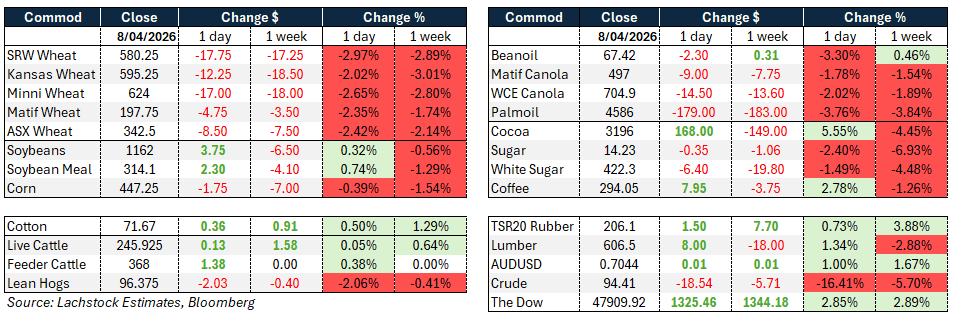
Global wheat: Chicago -17.75c, Kansas -12.25c, Matif -€4.75
The ceasefire announcement between the US and Iran dominated wheat trade on Wednesday, with the initial risk-off unwind hitting the complex hard at the open.
Unlike corn and beans, wheat never recovered, trading like a market caught long into the news. Kansas City showed a few brief flashes of resilience but ultimately followed Chicago lower.
Russian cash fell a dollar to $237 and implied volatility in Chicago May collapsed from 35.20 percent to 29.38pc, reflecting the deflation of the war premium.
Fund liquidation of long positions extended the week’s trend.
The market is now squarely focused on the rainfall system moving across the southern plains from Thursday through Sunday, with no private forecaster willing to make a call on totals just yet. If the rain comes in on the generous side, wheat will struggle to find a reason to bid.
North African harvests are approaching and world wheat cash values remain soft.
Thursday brings the April WASDE, with US wheat ending stocks expected at 923 million bushels versus 931 in March, though the market’s real appetite is for the May report.
Export sales tomorrow are expected at 75,000 tonnes old crop and 275,000t new crop.
Morocco is moving to close its milling wheat import window effective April 30 as its domestic harvest approaches, adding a timing squeeze for exporters.
Ukraine’s grain shipments since July 1 are running 31pc behind year-ago pace, with wheat down 24pc at 10.2 million tonnes (Mt).
Other grains and oilseeds: Corn -1.75c, Soybeans +3.75c, Matif Canola -C$14.50
Corn had a rough start, breaching its 50, 100 and 200-day moving averages overnight before clawing back to finish only marginally lower. The weaker US dollar kept South American grower hedges at bay and once the stops under the key technical levels were cleaned out the selling dried up.
Corn chose to follow beans higher rather than chase wheat lower, which says something about where the conviction lies.
Technically the market is fragile, with a close below 446 in May potentially triggering another leg lower.
Argentine corn production estimates continue to creep higher, and at current FOB levels Argentine and US Gulf corn are nearly equivalent as the world’s cheapest, while PNW corn remains the best value into Asia.
Thursday corn export sales are expected at 1.175Mt old crop plus 50,000 new crop. South Korea’s KFA and FLC both tendered for corn Wednesday, buying a combined 133,000t from optional origins at prices around $258-260/t cost and freight for July arrival.
Beans had an impressive recovery, finishing 22 cents above their overnight lows.
Meal led the way higher while bean oil sank with crude, leaving crush under pressure. The weaker Brazilian real kept growers on the sideline and the ceasefire, however fragile, prompted some speculation that a Trump-Xi meeting has better odds if the US is not actively at war with Iran.
EU soybean imports for 2025/26 are running 9pc behind year-ago pace at 9.74Mt through April 5.
Canola fell sharply in line with crude and broader vegetable oil weakness, with chart-based selling accelerating as May broke below its nearby range.
However, historically wide crush margins around C$350/t per tonne likely attracted end-user buying on the way down.
Indonesia’s energy ministry formalised its B50 biodiesel blending mandate timeline, targeting full implementation by 2028, which provides a longer-term supportive underpinning for palm and competing oilseeds.
Fertiliser availability remains a significant structural concern regardless of the ceasefire outcome, with one analyst noting the corn market’s fertiliser problem will not resolve until 2027 at the earliest given damage to natural gas infrastructure and logistics in the Gulf region.
Macro: AUD0.7044, Dow +1325.46, Crude -$18.54
The ceasefire announcement triggered a sharp macro response, with equities surging, the US dollar selling off hard and crude posting its worst single day since the infamous April 2020 session. WTI lost $18.54 to settle at $94.41, its first close below $100 for Brent in more than two weeks, while the Dow added over 1,300 points.
The ceasefire, however, remains deeply fragile.
Israel launched its largest operation against Hezbollah in Lebanon, targeting over 100 command centres within ten minutes.
Iran’s foreign minister stated the US must choose between ceasefire and continued war via Israel, and the Strait of Hormuz remained largely blocked with over 800 freighters stuck inside the Persian Gulf.
VP Vance is leading a US delegation to Islamabad for talks beginning Saturday, and offered a cautiously optimistic read, saying the straits are showing signs of reopening.
Oil analysts are divided, with some seeing the sell-off as overshooting given the many unresolved logistics and security questions, and at least one firm putting a 70% probability on WTI returning to $109 next week.
The Fed’s March meeting minutes struck a mildly hawkish tone, with the vast majority of participants noting that progress toward the 2pc inflation target could be slower than previously expected and that the risk of persistent overshoot had increased, in part reflecting higher oil prices.
The WSJ dollar index fell 0.7pc and the 10-year Treasury yield settled at 4.273pc. US farmer sentiment improved in March with the Purdue/CME Ag Economy Barometer rising to 127 from 116, though producers flagged a widening gap between short-term cost pressures and longer-term confidence.
Fertiliser cost concerns are intensifying, with nearly 60pc of corn growers surveyed by the NCGA more worried about 2027 availability than the current season, and CoBank estimating the diesel price spike alone could add $2,000 in fuel costs per farmer.
Local: Bids were softer in the west of the country yesterday with canola back A$15/t to $765 current season and back $22 new to $806, wheat was $328 and $358, barley $337 and $333 FIS Albany.
Prices in the east were a little more resilient, with canola $750 and new crop $785, wheat was $325 and $355, barley $312 and $321 track Geelong.
Cash markets were little changed as consumers absorbed the news — ceasefire headlines may calm sentiment, but the physical story hasn’t shifted, with Australia still running on pre-conflict fuel stocks and ongoing supply chain disruption likely to keep diesel tight and freight elevated, underpinning domestic markets.
Lentil bids remain around $700 delivered southern ports, with solid demand, although recent AUD strength is taking a bit of the edge off — still a large portion of the Vic crop to be priced with estimates only 30–40pc sold.