
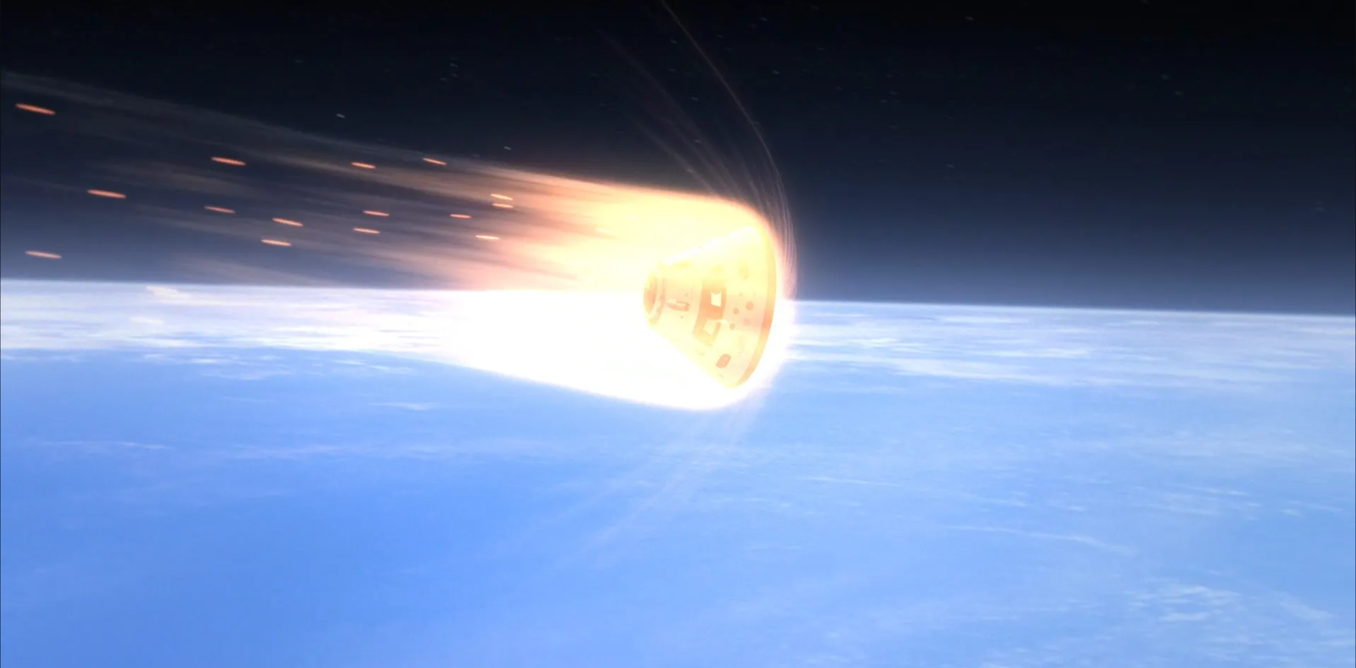
After successfully completing their mission to the Moon, the Artemis II crew are about to return to Earth.
The four astronauts set a new record for how far humans have travelled from Earth, reaching a maximum distance of 406,771 kilometres from our home planet.
Their journey back will culminate in a high-speed, hypersonic and extremely hot re-entry into Earth’s atmosphere before their spacecraft splashes down in the Pacific Ocean off the coast of California at roughly 8pm April 10 local time.
The re-entry will be the last challenge the crew will have to endure on their epic ten-day mission. It comes with many dangers – but their spacecraft is equipped with an array of technology to keep them safe.
A speedy re-entry
The Orion capsule carrying the Artemis II astronauts will be travelling at more than 11 km/s (40,000 km/h) when it reaches Earth’s atmosphere. This is 40 times faster than a passenger jet travels.
If we instead consider kinetic energy, which is the energy an object possesses due to its motion, upon re-entry the Orion capsule will have almost 2,000 times as much kinetic energy per kilogram of vehicle as a passenger jet.
Like any spacecraft returning home, it will have to slow down and reduce its kinetic energy to almost zero so parachutes can be deployed and it can land safely on Earth.
Spacecraft reduce their kinetic energy by performing a controlled re-entry through Earth’s upper atmosphere, where they use aerodynamic drag against the atmosphere as a brake to decelerate.
Unlike an aeroplane, which is generally designed to be aerodynamic and minimise drag forces to reduce fuel consumption, re-entering spacecraft do the opposite. They are designed to be as un-aerodynamic as possible to maximise drag and help them slow down.
This deceleration during re-entry can be extremely harsh.
Deceleration and acceleration are generally discussed in g-forces – or “g’s” for short. This is the deceleration or acceleration force divided by the standard acceleration we all feel from Earth’s gravity. A Formula One driver will experience over 5 g’s while cornering, which is close to the maximum g-forces a human can sustain without passing out.
Small, uncrewed re-entry capsules such as NASA’s OSIRIS-REx capsule which brought back samples from asteroid Bennu, just barrel into the atmosphere and rapidly decelerate. These entries occur very quickly, in less than a minute. But g-forces in that case can be upwards of 100 – fine for robotic vehicles, but not for humans.
Crewed vehicles such as NASA’s Orion capsule use lift forces to slow the entry down in time. This lowers the g-forces down to more manageable levels that humans can survive and makes re-entry last for several minutes.

The four Artemis II astronauts set a new record for how far humans have travelled from Earth, reaching a maximum distance of 406,771 kilometres from our home planet.
NASA
A very hot re-entry
The Orion capsule will re-enter the atmosphere moving at more than 30 times the speed of sound.
A shock wave will envelop the spacecraft, creating air temperatures of 10,000°C or more – about twice the temperature of the surface of the Sun.
The extreme heat turns the air that crosses over the shock wave into an electrically charged plasma. This temporarily blocks radio signals, so the astronauts will be unable to communicate during the harshest parts of their descent.
Making sure it’s a safe re-entry
Spacecraft survive the extremely harsh re-entry environment through careful design of their trajectories to minimise heating as much as they can.
The craft also carries a thermal protection system. It’s effectively an insulating blanket which protects the spacecraft and its crew or cargo from the harsh hypersonic flow occurring outside.
The thermal protection system is tailored precisely for the vehicle and its mission. Materials that can take more heat are put on the surfaces where the environment is expected to be harshest, and thicknesses are precisely adjusted too.
These materials are designed to glow red hot and degrade during the entry – but they will survive. The red-hot glow also radiates heat back out to the atmosphere instead of allowing it to be absorbed by the spacecraft.
This precise design is how Artemis is to able to pass through air at 10,000°C while maintaining a maximum heat shield surface temperature of only around 3,000°C.

An image of the JAXA Hayabusa spacecraft reentering Earth’s atmosphere on June 13, 2010, with the spacecraft bus burning up behind it.
NASA
Most spacecraft are protected by materials called ablatives. These are generally made out of carbon fibre and a type of glue known as phenolic resin.
These ablative heat shields absorb energy and inject a relatively cool gas into the flow along the surface of the vehicle, helping to cool everything down.
The ablative heat shield material used on the Orion capsule is called AVCOAT. It is a version of the material which protected the Apollo capsule when it returned from the Moon in the late 1960s and early 1970s.
While the Artemis I mission – an uncrewed test flight – was a great success, the heat shield ablation during re-entry was much larger than expected. Large chunks of material separated from the heat shield in some places.

The heat shield of NASA’s Orion spacecraft after the Artemis I mission.
NASA
After lengthy inspections and analysis, engineers did decide to go ahead with the same type of heat shield on the Artemis II mission.
They believe Artemis I lost chunks of its heat shield due to a pressure buildup inside the material during the “skip” part of its entry, where the spacecraft exited the atmosphere to cool down before performing a second entry where it landed.
For Artemis II, the engineers have instead decided to modify the trajectory slightly to still use lift, but include a less defined “skip”.
It is amazing to see what NASA and the astronauts have achieved on this mission so far. But like many others, I’ll be more relieved when I see them welcomed safely home on Earth.