
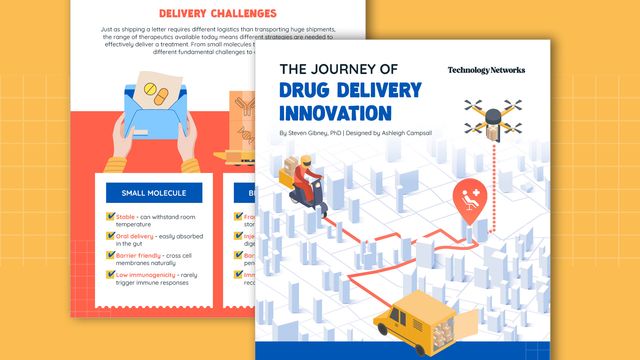
Infographic
Published: April 9, 2026
Written by

Science Writer
Technology Networks
Steven has a BSc in Pharmacology and a Masters in Bioscience from the University of Leeds, as well as a Ph.D. in Pharmacy from the University of Nottingham. After finishing his Ph.D. he spent two years working at an agency as a medical writer. Wanting to further develop his communication skills he joined Technology Networks as a science writer in 2023. In his current role, he is responsible for creating custom written content and also contributes to the development of digital content.
Credit: Technology Networks.
Drug delivery has undergone a remarkable transformation from basic oral tablets to sophisticated, targeted systems that deliver treatments with unprecedented precision. Today’s pharmaceutical landscape demands innovative approaches that can navigate complex biological barriers, preserve fragile therapeutic molecules, and release medications exactly when and where patients need them most.
This infographic explores the latest drug delivery strategies that can overcome these challenges—from nanotechnology and smart release systems to advanced administration methods that improve patient compliance and therapeutic outcomes.
Download this infographic to learn about:
Advanced delivery technologies that enable precision targeting across different diseasesInnovative administration methods that make treatments less invasive and more patient friendlyControlled release strategies that maximize therapeutic benefit while minimizing side effects across multiple disease areas
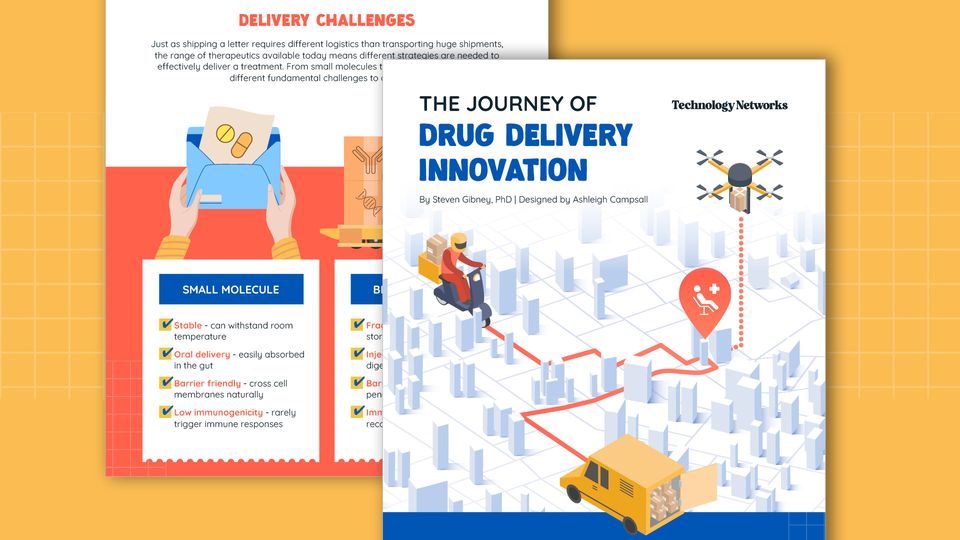
THE JOURNEY OF
Drug Delivery
Innovation
Drug delivery has evolved from simple oral tablets to sophisticated systems that
target specific cells and release medications precisely when and where they are
needed most. The earliest delivery methods focused on getting drugs into the
body, then controlling how long they stayed active; now the latest technologies
provide unprecedented therapeutic precision. This infographic explores the cuttingedge strategies and technologies driving modern drug delivery, from advanced
administration methods to nanotechnology.
By Steven Gibney, PhD | Designed by Ashleigh Campsall
Delivering therapeutics
across diseases
These advanced delivery technologies are transforming
treatment across multiple therapeutic areas.
These fundamental differences have driven the development of
advanced drug delivery methods.
CANCER
Targeted nanoparticles
and ADCs deliver
chemotherapy directly
to tumors while reducing
side effects.
DIABETES
Smart insulin delivery
systems respond to glucose
levels in real time.
REFERENCES
1. Aldawood FK, Andar A, Desai S. A Comprehensive
Review of Microneedles: Types, Materials, Processes,
Characterizations and Applications. Polymers.
2021;13(16):2815. doi: 10.3390/polym13162815
2. Chan AHY, Pleasants RA, Dhand R, et al. Digital
Inhalers for Asthma or Chronic Obstructive
Pulmonary Disease: A Scientific Perspective. Pulm
Ther. 2021;7(2):345–376. doi: 10.1007/s41030-021-
00167-4
3. Prausnitz MR, Langer R. Transdermal Drug Delivery.
Nat Biotechnol. 2008;26(11):1261–1268. doi: 10.1038/
nbt.1504
4. Fu Z, Li S, Han S, Shi C, Zhang Y. Antibody drug
conjugate: the “biological missile” for targeted
cancer therapy. Signal Transduct Target Ther.
2022;7(1):93. doi: 10.1038/s41392-022-00947-7
5. Li X, Li J, Wei J, et al. Design Strategies for
Novel Lipid Nanoparticle for mRNA Vaccine and
Therapeutics: Current Understandings and Future
Perspectives. MedComm. 2025;6(10):e70414. doi:
10.1002/mco2.70414
6. Hou X, Zaks T, Langer R, Dong Y. Lipid nanoparticles
for mRNA delivery. Nat Rev Mater. 2021;6:1078-1094.
doi: 10.1038/s41578-021-00358-0
7. Danhier F, Ansorena E, Silva JM, Coco R, Le Breton
A, Préat V. PLGA-based nanoparticles: An overview
of biomedical applications. J Control Release.
2012;161(2):505–522. doi: 10.1016/j.jconrel.2012.01.043
8. Hammami I, Alabdallah NM, Al jomaa A, kamoun
M. Gold nanoparticles: Synthesis properties and
applications. J King Saud Univ Sci. 2021;33(7):101560.
doi: 10.1016/j.jksus.2021.101560
9. Huanbutta K, Puri V, Sharma A, Singh I, Sriamornsak
P, Sangnim T. Rise of implantable drugs: A chronicle
of breakthroughs in drug delivery systems.
Saudi Pharm J. 2024;32(12):102193. doi: 10.1016/j.
jsps.2024.102193
10. Zhang A, Jung K, Li A, Liu J, Boyer C. Recent
advances in stimuli-responsive polymer systems for
remotely controlled drug release. Prog Polym Sci.
2019;99:101164. doi: 10.1016/j.progpolymsci.2019.101164
11. Almoshari Y. Osmotic Pump Drug Delivery
Systems—A Comprehensive Review.
Pharmaceuticals. 2022;15(11):1430. doi: 10.3390/
ph15111430
NEUROLOGICAL
CONDITIONS
Nanocarriers cross the
blood–brain barrier to deliver
treatments for Alzheimer’s
and Parkinson’s.
CARDIOVASCULAR
DISEASE
Controlled-release stents
deliver drugs locally to
prevent restenosis.
CHRONIC PAIN
Long-acting implants
provide sustained relief
without daily dosing.
IMPLANTABLE
DELIVERY SYSTEMS
Long-acting devices
can provide sustained
medication release
for months or years.
Examples include
contraceptive implants
and biodegradable wafers
for localized delivery of
therapeutics.9
These “smart” delivery
systems respond to
biological signals such
as changes in pH,
temperature, or
glucose levels.10
STIMULIRESPONSIVE SYSTEMS
OSMOTIC
PUMPS
These systems use
osmotic pressure to
deliver medication
at a constant rate,
independent of the
body’s pH or movement,
ensuring predictable
drug levels.11
Controlled release strategies
Controlling when and where drugs are released maximizes
therapeutic benefit while minimizing side effects.
Nanotechnology
Nanotechnology enables drug delivery at the molecular scale,
opening new possibilities for precision medicine.
These fat-based carriers
protect and deliver genetic
material and drugs. LNPs
were crucial to mRNA
COVID-19 vaccine success
and are now being
explored for gene therapy
and cancer treatment.6
LIPID
NANOPARTICLES (LNPs)
POLYMERIC
NANOPARTICLES
Biodegradable polymerbased carriers can be
engineered to release
their payload over
specific timeframes
and respond to tumor
microenvironments.7
GOLD
NANOPARTICLES
These versatile drug
carriers can be
functionalized for
targeted delivery and
used in diagnostics and
therapy. Their unique
optical properties unlock
novel delivery and
imaging applications.8
MONOCLONAL ANTIBODIES
These targeted proteins require delivery systems that
maintain their stability and enable subcutaneous or
intravenous administration. Antibody delivery has been
revolutionized by high-concentration formulations and
auto-injectors.
ANTIBODY–DRUG CONJUGATES (ADCs)
Combining the targeting ability of antibodies with existing
drugs creates precision therapies. ADCs like Enhertu link
antibodies to chemotherapy agents, delivering treatment
directly to cancer cells.4
PEPTIDE AND RNA THERAPEUTICS
Advanced formulations protect these fragile molecules
from degradation. Lipid nanoparticles successfully deliver
mRNA vaccines, while peptide modifications enable longer
circulation times.5
Biologics delivery
Delivering large, complex biological molecules requires specialized
approaches that preserve their structure and activity.
MICRONEEDLES
These tiny needles create
an array that penetrates
only the outer skin layer,
delivering vaccines and
medications without
traditional injections. They
are being developed for
insulin delivery and vaccine
administration, creating a
pain-free delivery method
that improves patient
compliance.1
SMART INHALERS
Advanced pulmonary
delivery systems can
target specific regions
of the lungs and deliver
both small molecules and
biologics. Next-generation
inhalers incorporate
sensors to track usage
and optimize dosing.2
Modern patches can
deliver molecules that
were previously too large
to cross the skin barrier
via techniques such as
ultrasound enhancement,
which uses sound waves to
temporarily increase skin
permeability.3
TRANSDERMAL SYSTEMS
Advanced administration technologies
Advanced delivery mechanisms are transforming how medications enter the body,
making treatments less invasive and more patient friendly.
BIOTHERAPEUTICS
Fragile – require cold chain
storage
Injectable only – cannot survive
digestive system
Barrier blocked – too large to
penetrate most tissues
Immunogenic risk – may be
recognized as foreign
SMALL MOLECULE
Stable – can withstand room
temperature
Oral delivery – easily absorbed
in the gut
Barrier friendly – cross cell
membranes naturally
Low immunogenicity – rarely
trigger immune responses
Delivery challenges
Just as shipping a letter requires different logistics than transporting huge shipments,
the range of therapeutics available today means different strategies are needed to
effectively deliver a treatment. From small molecules to biotherapeutics, there are
different fundamental challenges to overcome.
INFECTIOUS DISEASES
Microneedle patches
enable painless vaccine
administration.
AUTOIMMUNE
DISEASES
Targeted antibodies
modulate immune
responses with precision.
RARE GENETIC
DISORDERS
Advanced biologics and gene
therapies reach previously
untreatable conditions.