
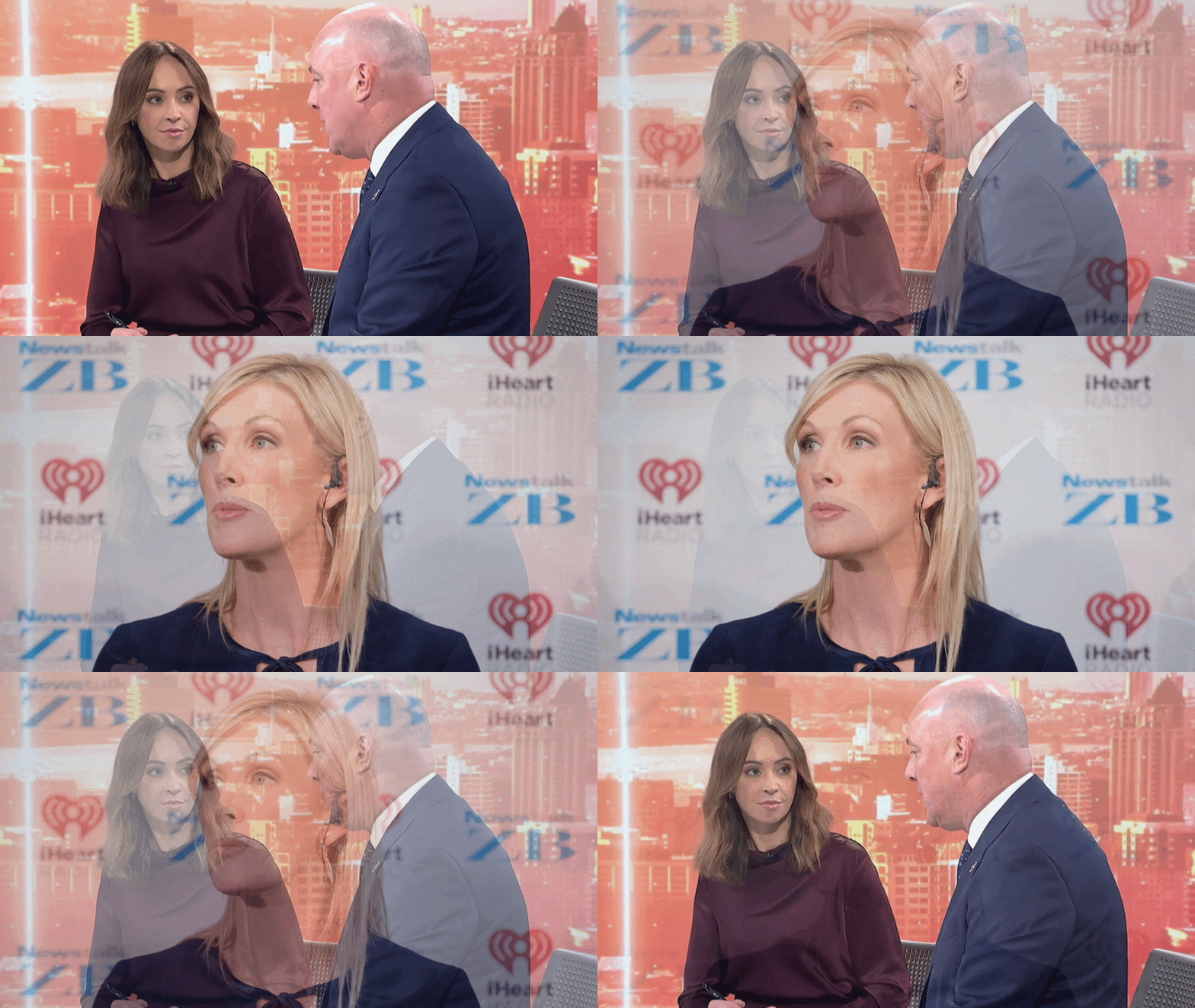
The arrival of John Campbell at the RNZ Morning Report microphone next week ramps up the scrutiny of Luxon’s Monday morning media interviews on TVNZ, Newstalk ZB and RNZ.
Luxon is normally in Auckland for the interviews: at TVNZ between 7am and 7.30am, before heading across the road to Mike Hosking on Newstalk ZB just after 7.30am, and then RNZ – normally over the phone – before 8am.
Smalley has particular expertise and knowledge of live TV and radio interviews – a quick scan of her CV shows she has worked with Hosking (at ZB), with O’Brien (at Today FM) and with Campbell (at TV3) and is likely to provide useful insights into each broadcaster’s approach, as well as more general communications advice and guidance.
The former foreign correspondent’s experience of Middle East issues will also be handy in a period of global instability.
Former broadcaster Rachel Smalley. Photo / Supplied
Smalley has been spotted in Parliament over the past two weeks, but most of her work is set to be focused on Auckland, where the Nats have a range of MPs, including Luxon, Mark Mitchell, Erica Stanford and Simeon Brown.
A spokesman said: “Rachel has joined the team as a senior communications adviser based in Auckland. The PM spends a lot of time in Auckland, and we have several senior MPs based there, so it makes sense to have a staff member on the ground to support them.”
The spokesman did not respond to a request for an interview with Smalley or follow-up questions.
In her first fortnight as TVNZ Breakfast co-host, Tova O’Brien’s two exchanges with Luxon have each created viral moments.
Two weeks ago, she asked Luxon if he had intentionally taken more of a leadership back seat as the fuel crisis heated up. “My job is the CEO,” he said. O’Brien responded: “Your job is the Prime Minister.”
This past week, Luxon stumbled through a response about the number of Māori National MPs in his Cabinet, citing James Meagher, who is not in Cabinet, and not mentioning Tama Potaka, who is. “Did you just forget about him?” asked O’Brien.
While O’Brien has been criticised by some about her original question, the reality is that the PM should have been able to easily bat it away. The coalition Cabinet has more Māori MPs than the previous Labour Government.
Breakfast host Tova O’Brien interviews Prime Minister Christopher Luxon. Photo / TVNZ
A year after a memorable and frustrating non-answer exchange with Hosking on Newstalk ZB, the PM is still sometimes guilty of not delivering a straight answer to a simple question, or he sticks rigidly to a response that comes across as corporate-speak.
He appears sometimes too tightly aligned to talking points – repeating them regularly – rather than responding naturally. His on-screen presence is often completely different to 1-1 interactions, where he is warmer.
Last month, in a piece for Newsroom headlined ‘Limping Luxon needs to listen to his advisers’, former United Future leader Peter Dunne wrote: “At a time when New Zealanders will be looking to their leaders for clarity and certainty in challenging times, it is vital – both for the public mood and the Government’s credibility – that Luxon’s communications are precise, unambiguous, and confident, rather than the rambling presentations they have sometimes become of late.”
PM Christopher Luxon is quizzed by Newstalk ZB host Mike Hosking. Photo / Michael Craig
On Heather du Plessis-Allan’s Newstalk ZB show this week, she and two commentators – senior journalist and media leader Carmen Parahi and Taxpayers’ Union head Jordan Williams – discussed Luxon’s media appearance on Breakfast.
“Heather, I was astonished … that you were more upset with Luxon than you were with your own,” said Williams. “I know it’s against the bro code or the journalist code to criticise each other.
“But I thought it was a gotcha-type thing that you’d expect from Radio Pravda – Radio New Zealand – not a serious journalist like Tova, and frankly, it’s just so 2019, this sort of racist approach.
“There’s lots to criticise the Nats for … frankly, I don’t think it’s this.”
Parahi described the O’Brien-Luxon exchange as “fun”.
“I loved it because I thought it was hilarious, and I loved the one from last week.
“My concern for Luxon is, does he have a Tova problem? Because he gets all red and he gets all flustered, and actually can he not just answer her question?”
She suspected there was a fear factor at play.
“You can see it in his face, it’s bright red. There’s no retention of keeping calm, not panicking, which is what he’s telling the rest of New Zealand to do around this fuel crisis.
“When I watch him with her, I always feel like he gets flustered.”
Govt’s stern letter to RNZ over finances
Public broadcaster RNZ has been put on notice about its financial performance – and its communications with ministers and the Treasury – in a sternly worded letter from the Government.
Shareholding ministers have told the public broadcaster that they want further savings “to be identified and realised to ensure RNZ’s long-term financial sustainability”.
RNZ has told Media Insider that it’s already well in hand with cutting its costs over the past 12 months, and since the Government reduced its annual funding by almost $5 million. It has detailed a range of cost-saving measures (see below) and says staff numbers sit at 342 – a 5.3% reduction on the previous financial year.
In a letter on behalf of shareholding ministers on March 20, Media and Communications Minister Paul Goldsmith commended RNZ over its audience growth but also made clear he wanted to see further improvement, especially in live-radio listening, and he specifically wanted to see Morning Report numbers reported in future.
He said ministers had asked for Morning Report’s data earlier, but that had not been reported back.
Broadcaster John Campbell starts as the new Morning Report co-host, alongside Ingrid Hipkiss, on Monday, in a renewed and intriguing breakfast media battle.
John Campbell. Photo / RNZ / Cole Eastham-Farrelly
In the shareholder ministers’ letter to RNZ chairman Jim Mather, Goldsmith notes the public broadcaster generated a $500,000 net deficit in 2024-25.
“Operating costs increased 16% year on year, with continued increases in FTEs, personnel and production and distribution costs,” Goldsmith wrote in the letter, released to Media Insider.
“It is a vital, ongoing expectation that RNZ delivers improved performance and represents a value-for-money investment for the Crown as owner. This includes right-sizing operations and increasing efficiency to mitigate reliance on cash reserves and the sale of land to fund operations.
“While some cost-reduction initiatives have been implemented, further savings need to be identified and realised to ensure RNZ’s long-term financial sustainability.
“Accordingly, ministers expect RNZ to provide a detailed plan outlining how it will implement savings, reduce overheads and improve its financial performance in the next business plan.”
The letter comes two-and-a-half months before Mather is due to vacate his position as chairman, along with two other long-serving directors, Irene Gardiner and Jane Wrightson.
Goldsmith said all Crown companies and entities were expected to maintain an efficient balance sheet, “ensuring the resources they utilise remain fit-for-purpose”.
“RNZ has advised that its cash and cash equivalents are committed to upcoming capital investments. However, RNZ has not provided its three-year capital expenditure plan to officials. We therefore expect you to provide a capital investment plan in the upcoming three-year business plan and to work with officials in an open and transparent manner on the investment plan and on an appropriate level of cash reserves.”
Improved audience reach
Goldsmith commended Mather on RNZ’s improvements in audience reach last year: with its own platforms and dozens of content-sharing partnerships (such as with the NZ Herald and Stuff), RNZ says its content reaches 83% of New Zealanders monthly.
The RNZ website has enjoyed strong growth over the past two years, especially in the wake of Newshub’s demise. It is now easily the third biggest New Zealand news website, behind Stuff and the NZ Herald.
Radio listenership has been more of a struggle, however, although there was an uptick in numbers in the two most recent surveys, later in 2025.
RNZ has also implemented some recommendations from a scathing review by former RNZ news boss Richard Sutherland, including the creation of a new executive role of chief audio officer. Experienced producer and journalist Pip Keane has filled the role.
RNZ still has a big challenge to get anywhere close to the radio listenership it enjoyed six years ago – and to get back ahead of commercial stations such as Newstalk ZB and The Breeze.
“We would like to see RNZ continue to set stretch audience targets, particularly regarding live radio listenership, in addition to balancing special interest programmes alongside those of wide appeal,” Goldsmith wrote.
In May 2025, he said ministers had requested RNZ add a measure for the listenership of Morning Report as a flagship live radio programme.
“This was not added. We reiterate our expectation that you set robust performance measures that provide public insight into operational performance and value for money, including measures for Morning Report and a cost-per-audience metric, in your 2026-27 SPE [statement of performance expectations].”
New Morning Report co-host John Campbell with co-host Ingrid Hipkiss. Photo / RNZ
Goldsmith said he appreciated the steps already taken since the Sutherland report, including the hiring of Keane.
He wanted to see RNZ provide a strategic issues letter, outlining further details on other plans that had been implemented. “We would also like to see the ‘audio plan’ that has been developed.”
Goldsmith also commended RNZ on improved trust results in 2024-25, saying he wanted to see the broadcaster continue that trajectory with “ambitious” goals in its next SPE.
“Trust in the media remains an important issue for shareholding ministers, and we continue to expect RNZ to lead by example and share its experience to strengthen the public’s trust in the wider media sector.”
‘No surprises’
The ministers have also told RNZ that it needs to improve the timeliness and effectiveness of communication with them. It is understood that there were some concerns that the Sutherland review was not shared early enough with officials.
“It continues to be crucial that we are kept informed on a ‘no surprises’ basis about how RNZ is giving effect to its strategic direction, and any significant matters.
“It is expected that these ‘no surprises’ updates are received in a timely manner ahead of the matter in question, with sufficient detail, and we would like to reiterate the ongoing importance of RNZ working effectively and communicating transparently with Treasury officials.”
RNZ responds
RNZ chair Jim Mather said he welcomed the annual letter of expectation. It was a key part of RNZ’s annual business planning and strategy work.
“It should set a high bar and challenge us to be ambitious in what we deliver for New Zealanders,” Mather said. “Indeed, it would not be effective as a letter of expectations if it wasn’t frank and ambitious.”
RNZ chief executive Paul Thompson (left inset) and chair Jim Mather.
He welcomed the minister’s recognition of RNZ’s successes with its growth in audiences and trust.
“As you can see, the minister is ambitious for RNZ to continue that audience growth. And frankly, so too is the board,” Mather said.
“The RNZ team has been working hard to develop its high-quality digital and radio content for our audiences. I am pleased to advise that RNZ’s audiences have continued to be strong in recent quarters.”
Mather gave an assurance that public funding was treated seriously and prudently.
“The operating costs referred to in the letter are for the year ending June 2025, when we were operating under an increased budget and had expanded our services.
“In the current financial year, we are absorbing a 7% funding cut and have reduced expenditure accordingly. RNZ has reduced discretionary ($2.5m), marketing ($0.4m) and commissioning spend ($1.5m), reduced capital expenditure with new initiatives to be funded through internal change ($2m) and removed a proposed healthcare benefit and performance-based payments ($1m).
“RNZ has focused its resources, controlled costs, and modernised the business. It has made significant savings and efficiencies while improving services.
“In terms of FTEs, as of 30 March, RNZ’s FTE was 342 – a reduction of 5.3% from the end of the last financial year. Looking ahead to the new financial year, RNZ will continue to live within its means and focus on providing value to the public through trusted content.”
He said RNZ spent 89% of its funding on front-line operations and 11% on “back office” costs. “And as a public media organisation, RNZ’s cost per capita spend is low compared with public media operations in other countries.”
The board had yet to finalise its statement of performance expectations; he expected it would be “open-minded to productive suggestions”.
TVNZ letter
TVNZ received a much shorter letter of expectations from Goldsmith.
He highlighted four key points for the TVNZ board to focus on: keeping the company profitable; building public trust; ensuring its new TVNZ+ digital capabilities were carefully managed; and delivering public media outcomes (including collaborating with RNZ to expand audience reach).
On finances, Goldsmith said he expected the TVNZ board to “run a profitable business, focus resources on revenue generation, minimise and control costs and deliver improved performance to increase TVNZ’s return on investment to the Crown as owner”.
On trust, he said the board had to “focus on building and maintaining public trust by ensuring content is accurate, reliable and balanced, while reflecting New Zealand’s values and serving the public interest.”
Unlike RNZ, a strategic issues letter was not a requirement. TVNZ operates as a Crown entity – it relies on advertiser (and soon, subscriber) revenue, not taxpayer funding.
John Campbell’s Morning Report debut
Incoming Morning Report host John Campbell has told RNZ that he is not concerned about being perceived by some people to be left-leaning or that the broadcaster has become “too woke” or “too left”, and that this is a reason it has lost listeners.
“I’m not worried about that … the kind of people who are saying that – we need to ask why they’re saying it, what their agendas are, who they are,” Campbell told RNZ Afternoons host Jesse Mulligan this week.
“I’ve spent so long doing this. I look back over my career … one of the examples I always give, possibly the interview that made people angriest, was Corngate when Helen Clark was Prime Minister.
“I remember Alex, my daughter, was little, and I was pushing her in a buggy through Three Lamps [the inner-Auckland suburb], and this person loomed out of frame, hovered above the buggy, and leaned in and said, ‘I pity you having him for a father.’”
Campbell later added in the interview with Mulligan: “I know that, when I interview somebody, I am faithful to the requirements of journalism, and that is to treat people fairly.”
He also gave another example of what he described as “perception bias” that now pervades many people’s views of journalists’ interactions with politicians.
He recalled interviewing Jacinda Ardern on TVNZ Breakfast, before receiving direct feedback later that morning in Grey Lynn.
“I was accosted by two people about 80 to 100m apart, a woman who accused me of misogyny for being so rude to her [Ardern], and a man who said – and forgive me, this is an offensive phrase, but I think it’s kind of apt – ‘Oh, here’s Cindy’s bitch. I saw you doing a really soft interview with her on Breakfast this morning.’
“Now they both watched the same interview. One of them thought I was really outrageously rude to her. The other thought I was an apologist for her, and you think, ‘Wow, they’ve seen the same thing, and that’s the world we’re dealing in now.’”
Campbell told Mulligan he always believed in speaking truth to power, but “the problem with that is that it’s a small circle of essentially powerful people having the same conversations over and over and over and over and over”.
“So if the powerful are speaking to the powerful, then the world isn’t changing.
“One of the things that I hope to do on Morning Report is also give a voice to the less powerful, to the powerless.
“That’s where my journalism has spent a lot of its time, particularly on Campbell Live, I think, and on Checkpoint too, you know, we did stunning work.”
Campbell and RNZ have declined Media Insider requests for an interview over the past several weeks.
Morning Report’s shorter, sharper interviews
Campbell revealed to Mulligan that he was working closely with new Morning Report executive producer Annabel Bania on shorter, sharper interviews.
Without advertising, RNZ naturally has more content airspace to fill each hour than, for example, its commercial radio rival Newstalk ZB.
That, however, can sometimes lead to long-winding interviews. By the very nature of commercial radio, ZB’s Mike Hosking is adept at sharp, more precise interviews.
“One of the things I’ve tried to think a lot about is greater precision in my questions,” Campbell told Mulligan.
“I think sometimes I can be guilty of fashioning the question while I’m asking it.
“One of the things that Annabel … is doing is she’s pushing the interviews shorter. So they’re now 4-5-6 minutes. On Checkpoint, we would do interviews that were 8-12-15 minutes.
“[At that length], you can kind of philosophise an experiment, and you can create a narrative arc, and you can lead someone in a direction. When the interviews are shorter, you’ve just got to be focused, [with] much more surgical precision.”
Breakfast bump – Tova’s first week
TVNZ has given a broad overview of its Breakfast ratings in Tova O’Brien’s first week, but declined to give a day-by-day breakdown.
“Breakfast’s first week with Tova on TVNZ 1 was up 6.8% on the previous week and up 6.3% on the prior year (average daily reach of 331.2k in 5+ and 78.1k in 25-54),” a spokeswoman said.
“On TVNZ+, Breakfast streams were up 13.1% in 5+ and 21.7% in 25-54 week-on-week.”
TVNZ had previously supplied Breakfast ratings late last year that showed average daily reach in October was 334,900.
Former judge David Harvey on media regulation overhaul
The Platform owner and host Sean Plunket and (inset) BSA chair Susie Staley.
One of this country’s sharpest legal minds and internet law specialists has proposed a new Media and Communications Authority to clear up the shambolic state of media regulation in New Zealand.
The existing Broadcasting Standards Authority’s controversial claim that it has jurisdiction over Sean Plunket’s online site The Platform has thrown into sharp focus the need for a clean-up of the regulatory framework for media and content channels in the digital age.
Newspapers, news websites and their related multi-platform content, including video, currently fall under the umbrella of the Media Council, a voluntary self-regulatory body.
Television and radio come under the BSA.
Throw in the Office of Film and Literature Classification and legislation such as the Harmful Digital Communications Act, which is administered by Netsafe and the district court, and you have a canine’s brunch – one notch away from a dog’s breakfast.
The BSA, in a move that may have hastened its demise, has claimed jurisdiction over The Platform, an online-only site. It says it will officially adjudicate a complaint after Plunket described Māori tikanga as “mumbo jumbo”.
It has forced the Government’s hand, with Media and Communications Minister Paul Goldsmith telling Media Insider last week that he would give firm direction on the media regulatory framework before the election, after further consultation with the Government’s coalition partners, Act and New Zealand First.
He would either scrap the BSA (which is what the coalition partners now want), maintain the status quo, or more clearly define the BSA’s oversight.
Internet law expert and former judge David Harvey. Photo / Jason Oxenham.
Dr David Harvey, a former long-serving district court judge who taught law and IT at the Auckland Law School for 18 years, says current regulation is fragmented amongst the four existing bodies with “overlapping, misaligned, and increasingly inadequate jurisdictions”.
Harvey, who prepared submissions on the BSA jurisdiction issue for another online site, Reality Check Radio, has produced a new paper, A Framework for Media Regulation in the Digital Age, and published it today.
He says his proposal addresses two related challenges.
“The first is the inadequacy of New Zealand’s current online harm regulatory architecture, centred on the Harmful Digital Communications Act 2015, which was designed for interpersonal harmful communications rather than systemic platform regulation,” he writes.
“The second is the broader fragmentation of New Zealand’s media regulatory landscape, which leaves significant gaps in coverage and creates inconsistencies that the digital convergence of media and communications has made increasingly apparent.”
He says a unified Media and Communications Authority would have three operational divisions: News Media Standards, Content Standards and Online Harm.
The News Media Standards would cover journalistic accountability and editorial standards, and would incorporate existing Media Council and BSA news/current affairs functions.
Content Standards would cover professional non-news content, such as internet-only broadcasters, on-demand audiovisual, and streaming services with a New Zealand presence.
The Online Harm division would cover a hybrid code-compliance and reactive-harm regulation of online platforms. It would incorporate and extend the HDCA framework.
A fully independent Communications Tribunal would be established to consider unresolved complaints, with appeal to the High Court.
“The framework’s central commitments are: freedom of expression as the default condition; harm, properly defined, as the threshold for regulatory intervention; strict separation between the state and the content of codes and standards; the use of industry self-regulation as the primary mechanism, backed by a credible regulatory backstop; and an independent adjudicative function vested in the Communications Tribunal,” Harvey writes.
The proposal should be understood in that light of what it was not attempting.
“It is not a proposal for censorship of online content or for state control over the press. Its foundational commitment throughout is to freedom of expression as the default condition of the New Zealand communications environment.”
Harvey has provided his paper to Goldsmith, Act leader David Seymour and NZ First leader Winston Peters, as well as Jenny Marcroft, who is under-secretary to the Minister for Media and Communications.
THE FULL PAPER:
NZME identifies new issues in workplace review
Media firm NZME – owner of the NZ Herald, Newstalk ZB, OneRoof and a suite of other newspapers and entertainment radio stations – says it needs to strengthen its practices and has “more work to do” to ensure staff feel safe and supported after an independent review into workplace culture.
A review summary and key actions, released to staff on Thursday, followed the departure of three senior managers from its OneRoof and ZM divisions late last year.
It highlighted a series of improvements needed across the business and also found “two other specific issues” in the company, beyond OneRoof and ZM.
READ THE FULL MEDIA INSIDER STORY HERE
TVNZ lease
Want to rub shoulders with Tova O’Brien, Jack Tame and Jeremy Wells? TVNZ is looking for new co-tenants for its central Auckland headquarters.
The fifth floor of the state broadcaster’s Victoria St building is up for lease.
TVNZ’s central Auckland headquarters. Photo / Bayleys
RNZ is already moving in later this year, with new studios and offices on the sixth and seventh floors.
“TVNZ is somewhat unique for a corporate in that we own our Auckland building, with a significant proportion of our operations taking place here,” a spokeswoman said.
“We’re a smaller organisation than the one that moved in over three decades ago. TVNZers have also embraced flexible working, so we don’t have the same space requirements we once did.
“We consolidated our operations across levels 1-4 in late 2024. We have leased two levels to RNZ (levels 6 and 7) and are looking forward to welcoming them into our building soon. We still have a floor free (level 5) that we will look to lease should there be an appropriate tenant to join us.”
Bayleys is marketing the property.
It describes the floor as “a rare opportunity to secure a high-quality, fully fitted workspace in a prominent CBD building offering scale, profile and amenity”.
It comprises approximately 1252sq m of office space.
MediaWorks radio ad referred to police
The Electoral Commission has referred MediaWorks to the police over an advertisement broadcast outside the election period.
“It is the commission’s view the ad was an election advertisement for a candidate, and its broadcast on three radio stations between October 2025 and January 2026 was a breach of the Broadcasting Act,” said a statement from the commission.
“The act states an election programme (advertisement) cannot be broadcast at any time on radio or television other than during the general election period, which runs this year from October 4 to November 6.”
Mediaworks has been approached for comment and more details.
Follow me!
If you’re a regular reader of Media Insider – or one of the other Herald columnists, journalists and writers – and you’re a signed-in Premium subscriber, there’s a nifty new button under our author names at the top of each article: “Follow author”.
By clicking on that, you’ll be sent to your inbox any new articles by that author as soon as they are published. Fancy.
Editor-at-Large Shayne Currie is one of New Zealand’s most experienced senior journalists and media leaders. He has held executive and senior editorial roles at NZME, including Managing Editor, NZ Herald Editor and Herald on Sunday Editor, and has a small shareholding in NZME.
Tags:
- arrival
- asks
- Broadcaster
- calls
- campbell
- commentator
- comms
- costs
- david
- does
- finances
- former
- govts
- harveys
- have
- Headlines
- help
- in
- insider
- John
- judge
- letter
- media
- morning
- mps
- National
- nats
- new
- News
- on
- over
- Overhaul
- paper
- pm
- problem
- rachel
- Regulatory
- report
- response
- retired
- RNZ
- rnzs
- role
- smalley
- smalleys
- stern
- timely
- to
- Top News
- Top Stories
- TopNews
- TopStories
- tova
- with