
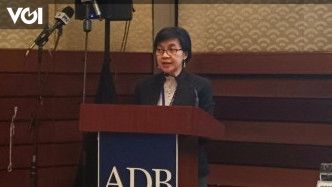
JAKARTA – The Asian Development Bank or ADB has cut its forecast for Philippine economic growth in 2026 to 4.4 percent, from 5.3 percent previously. This correction comes as the Middle East conflict is assessed to have begun to dampen the economic prospects of the Philippines and the Asia-Pacific region.
The Philippine News Agency (PNA) report, which was quoted on Friday, April 10, said that ADB in the April 2026 Asian Development Outlook report said that the Philippine economic growth is expected to improve to 5.5 percent in 2027. However, for 2026, the country’s economic growth is expected to remain stagnant.
ADB assesses that domestic demand remains the main support for growth, albeit at a slower pace. Business sentiment is also expected to remain cautious amid uncertainty due to the situation in the Middle East.
The pressure does not come from one side only. ADB said the potential for disruption of remittances from Filipino migrant workers, tighter financial conditions, and weakening investor and consumer confidence also weighed on growth. Remittances are expected to recover only after conditions in the region improve.
On the other hand, ADB noted that structural reforms in the Philippines have begun to open up opportunities for foreign investment. Some of them are changes to long-term lease rules for foreign investors, open data transmission access rules, CREATE MORE Act, and green lane initiatives. If implemented effectively and accompanied by regulatory improvements, this step is considered to support investment.
Public infrastructure spending is also projected to recover as the implementation of the budget improves. Meanwhile, the government’s fiscal program remains directed at consolidation in the medium term framework.
ADB estimates that Philippine inflation will rise to 4 percent in 2026, from 1.7 percent in 2025, driven by high global commodity prices. ADB Director for the Philippines, Andrew Jeffries, said the Philippine economy, which is highly dependent on imported fuels, will face challenges due to rising external risks.
ADB noted that average inflation was still 2.2 percent in the first two months of 2026, but jumped in March after the Middle East conflict worsened. ADB Chief Economist Teresa Mendoza said the rapid rise in world oil prices was quickly transmitted to domestic fuel costs due to the Philippines’ dependence on imports.
The Philippine government, said the ADB, has provided cash subsidies and fuel subsidies for vulnerable groups such as farmers, fishermen, and public transport drivers. The government is also moving to find oil supplies outside the Middle East. Inflation is expected to ease to 3.5 percent by 2027.
ADB also sees similar pressures in the region. Most of the developing economies in Asia and the Pacific are expected to slow down in 2026 and 2027. China’s economy is projected to grow 4.6 percent in 2026 and 4.5 percent in 2027, down from 5 percent in 2025. India is expected to slow to 6.9 percent this year from 7.6 percent in 2025, before strengthening to 7.3 percent in 2027. Pacific countries are expected to experience the sharpest slowdown.
ADB Senior Economist Jaqueson Galimberti said the two-week ceasefire gave little hope, but was still fragile. He warned that if disruptions in the energy market continued until early next year, regional growth could be 1.3 percentage points lower in 2026-2027, while inflation could be 3.2 percentage points higher. Another risk, according to ADB, also comes from the United States tariff shocks and tight global financial conditions.
The English, Chinese, Japanese, Arabic, and French versions are automatically generated by the AI. So there may still be inaccuracies in translating, please always see Indonesian as our main language.
(system supported by DigitalSiber.id)