
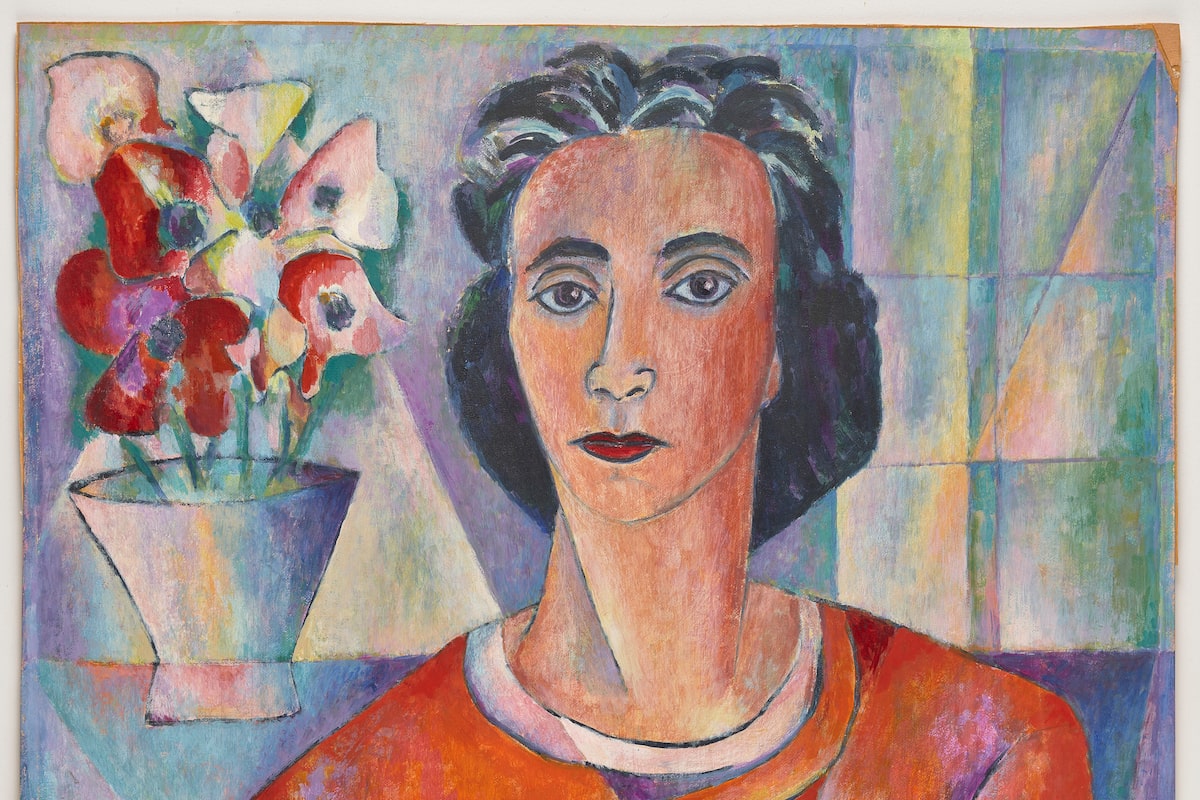
A self‐portrait of Edna Taçon.Estate of Edna Taçon/Supplied
In her day, abstract artist Edna Taçon was so well regarded she showed at the New York museum that later became the Guggenheim and mounted exhibitions in Toronto with Lawren Harris. Today, she is all but forgotten.
Art Gallery of Ontario curator Renée van der Avoird is working to correct that oversight with a small exhibition devoted to the artist’s collages, drawings and paintings from the 1940s. She discovered a single work by Taçon in the AGO’s holdings and, struck by a familiar last name, contacted the Ontario sculptor Carl Taçon. “That’s my grandmother,” he said. And so, van der Avoird began to discover both Taçon’s art and the sad story of family estrangement that may partly explain why she disappeared from view.
“It was a tricky balance to include some biographical information, not too much,” van der Avoird said. “But I think the power of the work is coming from who she was, her life experience and how art was really everything for her. She overcame so much to achieve the success she did.”
Taçon was born in Milwaukee, Wis., in 1905. Her father was a musician in vaudeville theatres, but after he died from tuberculosis, her mother was unable to provide for her. She was adopted by a Canadian woman at the age of 6 and grew up in Goderich, Ont. She was musical, studied in Toronto and became a professional violinist, travelling regularly to New York to perform concerts, but also made art on the side. The AGO show includes several lively collages of coloured and metallic papers that would have been made at her kitchen table.
In 1929, she married Ontario artist and art teacher Percy Taçon, but the marriage was troubled perhaps, van der Avoird suggests, because he was envious of her artistic success. The curator has studied family letters that show how by the time her two sons were approaching adolescence, she was spending months in a New York hotel not merely for work, but also as a means to escape abuse.
Edna Taçon’s Aurora, 1945.Estate of Edna Taçon/Supplied
Taçon began to exhibit her art in New York and Toronto in the 1940s. In New York, she showed at the Museum of Non-Objective Painting, encouraged by Hilla Rebay, the abstract artist and co-founder of what eventually became the Guggenheim Museum. The war years and their immediate aftermath were a time of cultural ferment in the city, partly fuelled by European emigré artists, and Taçon was an active participant.
In Toronto, in the days when department stores sold high art, she showed at Eaton’s, hanging her paintings against tall grey curtains just as they were displayed in New York. The Eaton’s shows included a two-person exhibition in 1945 with Harris, who shared her interest in abstract art that spoke to a spiritual or internal life. She also began to show at the Art Gallery of Toronto, as the AGO was then known, alongside Harris and other members of the Canadian Group of Painters – the successor to the Group of Seven – which she was invited to join.
The current AGO show includes several examples of this period: dynamic geometric abstractions where colourful triangles and parallelograms intersect with circles, crescents and more biomorphic forms, all hovering in deep space. They recall early 20th-century European experiments in abstraction and Taçon was the first Canadian artist to apply the term “non-objective” to her art, a form of pure abstraction that contained no reference to figuration or images from the outside world.
This approach was pioneered by early 20th-century Russian artists such as Kazimir Malevich and Wassily Kandinsky, who was allied with theosophy and its belief in seeking a higher realm. The art was also, in a way, an escape from the violent realities of two world wars and the Depression.
“It’s really about expressing your inner life. Edna calls it outbursts of the soul. It’s about finding ecstasy, and it’s really in line with Kandinsky’s theories, that are theosophical and spiritual,” van der Avoird said.
Untitled Abstraction, 1945.Estate of Edna Taçon/Supplied
She also sees a direct link with Taçon’s music.
“As a musician, there was this wonderful synergy between playing a piece of classical music that doesn’t necessarily reference a thing, and then working non-objectively in art. They really go hand-in-hand.”
Taçon’s marriage broke up in 1947 and she remained permanently in New York, while her sons stayed in Canada. Their father obtained sole custody and told them that their mother had abandoned them. He also made it difficult for her to return to Canada by threatening a bigamy charge against her when she remarried. She was finally reunited with her family when her granddaughter Claudia was born in 1979, but she died the following year.
By that time, she had abandoned abstraction. There had been a young artist at the Museum of Non-Objective Art who worked as a doorman, custodian and frame-maker; his name was Jackson Pollock. As his explosive brand of abstraction, dubbed abstract expressionism, took hold in New York, Taçon retreated from the non-objective and began painting flowers and landscapes. Van der Avoird includes only one work from this period in her show: a 1955 self-portrait that shows a proud figure holding a Siamese cat, intersected by geometric planes.
AGO reveals identity of woman in rare Black 18th-century portrait
Although the AGO did mount an exhibition of her work in 1988, Taçon’s central role in introducing modernism to Canada is largely forgotten. The curator figures that the trauma of her first marriage and her divided life were part of the reason.
“She was sort of split between Canada and the U.S. and didn’t have a solid footing in either country. That duality didn’t help her. If she had come back to Toronto and stayed here, maybe she would have had another legacy.”
The Guggenheim had acquired two of Taçon’s works in the 1940s but never properly catalogued them. When the AGO asked to borrow them for this show, the New York museum finally accessioned those works officially. Meanwhile, Paul and Susan Taçon, the artist’s now elderly son and his wife, have promised to donate to the AGO several works from the family collection. Edna Taçon’s legacy may yet be secured.
Edna Taçon: Verve and Decorum continues to Aug. 31 at the Art Gallery of Ontario in Toronto.