
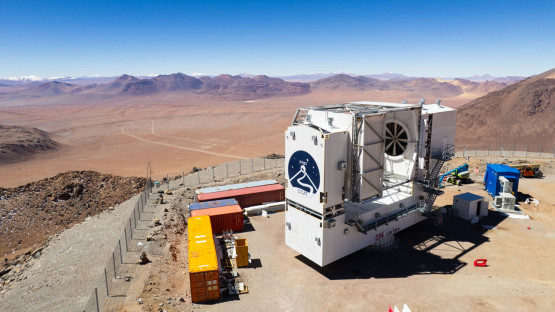
After formal presentations, attendees donned oxygen tanks – a requirement for the extreme altitude –and warm weather gear for a visit to the FYST site. Ascending the hairpin turns and unpaved road required four-wheeled vehicles, so participants had to go up in small groups, a masterpiece of coordination orchestrated by project manager Jim Blair.
The final switchback revealed the FYST logo on the side of the telescope, an unexpected glimpse that several attendees said they found deeply moving. From the top, visitors could look down on the volcanic mountain peaks ringing Cerro Chajnantor, a landscape shaped by tectonic forces in brown and black, with the ALMA array perched on the dusty plateau below.
The completed Fred Young Submillimeter Telescope overlooks the vast mountains and plateaus of Chile’s Parque Astronómico Atacama.
FYST is a project of the Cornell-led CCAT Observatory, Inc., a collaboration that includes Germany’s University of Cologne, University of Bonn and Max Planck Institute for Astrophysics in Garching, and a Canadian consortium of universities led by the University of Waterloo, in conjunction with Chilean astronomers through the University of Chile.
“When we first went there and realized what an exceptional site Cerro Chajnantor might be, submillimeter astronomy as a field wasn’t advanced enough for us to be able to build the telescope and its instruments. But now it is, and we have FYST to show for our patience and determination,” said Martha Haynes, president of the CCAT board and Distinguished Professor of Arts and Sciences in Astronomy emerita in the College of Arts and Sciences.
The telescope features an innovative optical design that allows astronomers to observe over a wide field-of-view in each exposure, enabling them to rapidly and efficiently map wide areas of the sky. Operating in the submillimeter wavelength range of light, FYST will create movies of the sky – “celestial cinematography” – in a part of the electromagnetic spectrum where this has never before been done.
At a height of 18,400 feet above sea level – higher than the Mount Everest base camp at 17,598 feet – FYST lies above most of the atmospheric layers that block submillimeter waves from reaching the ground. The Atacama Desert’s extremely dry air will provide exceptional views, without water vapor to obscure the signal.
Building a major new telescope at this elevation presented a significant challenge. Atmospheric pressure at the summit of Cerro Chanjantor is less than half what it is at ground level, which required construction workers, and all visitors to the site, to pass a strict physical examination and use continuous oxygen at the summit. The weather, too, proved difficult, with the low temperatures and frequent high winds.
Michael Niemack, professor of physics and astronomy in the College of Arts and Sciences, speaks at a conference prior to the inauguration.
FYST is named after Cornell alum Fred Young ’64, M.Eng ’66, MBA ’66, who has supported FYST since the project’s early days. In addition to his financial support, Young actively participated in the planning process, offering business and engineering expertise.
“As the time for celebration of ‘first light’ for the Fred Young Submillimeter Telescope nears, it is appropriate to recognize the inspiration for this world-class project,” said Young, referring to the first time a telescope is used to observe the sky. “Central to that is the vision developed in the last century by the late Riccardo Giovanelli and by Martha Haynes to exploit the unique potential for far infrared astronomy at what is, arguably, its best site on Earth.”
The telescope’s Prime-Cam instrument, designed by Michael Niemack, professor of physics and astronomy (A&S), can hold up to seven changeable modules, giving FYST unmatched flexibility as a platform for new technologies. The instrument will provide unprecedented spectroscopic and broadband measurement capabilities to address fundamental questions in astrophysics and cosmology. Duke University, led by Cornell alum Eve Vavagiakis ’14, Ph.D. ’21, partners with Cornell on Prime-Cam development.
The CCAT Heterodyne Array Instrument (CHAI), developed by the University of Cologne, is a high resolution spectrometer used to study the cycle of interstellar matter in the Milky Way and nearby galaxies. The large number of pixels, high sensitivity and choice of spectral lines available with CHAI will, for the first time, trace the flows of interstellar gas to probe how the process of star formation may vary in different galactic environments.
At left, Fred Young ’64, M.Eng ’66, MBA ’66, who has supported FYST since the project’s early days, talks with Pedro Correa, project manager of the Fred Young Submillimeter Telescope.
CPI Vertex Antennentechnik GmbH, in Duisburg, Germany designed and manufactured the telescope structure, including its drive and control systems. The company invested more than 250,000 hours in design, materials engineering, simulation, manufacturing, qualification and project coordination – contributing to the technological record-breaking achievements that make the system one-of-a-kind worldwide.
Because of the challenges of working at the extreme altitude, engineers first assembled the telescope in Germany. The team then disassembled it into large pieces and transported them by barge and then cargo ship to Chile. There workers trucked the pieces – the heaviest of which weighed 60 tons – up the mountain, a feat of careful coordination.
Linda B. Glaser is news and media relations manager at the College of Arts and Sciences.