
By Simon Lewis and Nandita Bose, Reuters
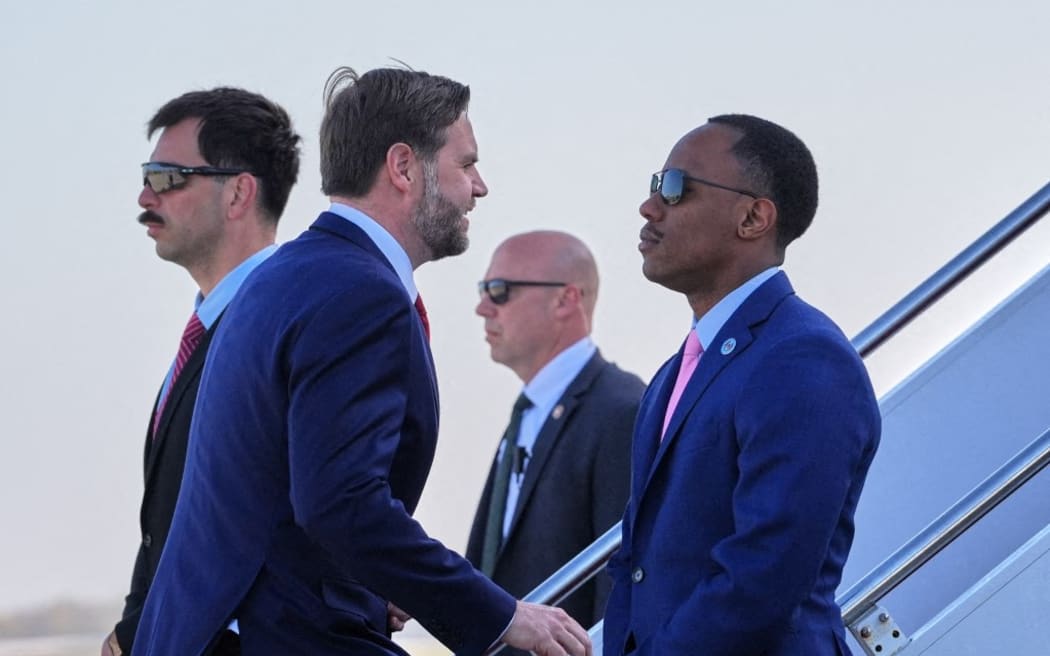
US Vice President JD Vance boards Air Force Two headed for Pakistan, to lead peace talks between the US and Iran, on Friday US time.
Photo: AFP/ Pool
Iran demands sanctions relief, and inclusion of Lebanon in ceasefire
White House reported to be sceptical over prospects for reopening Strait of Hormuz
Major gaps remain between the US and Iranian negotiating positions
A US team led by Vice President JD Vance has left for Islamabad for weekend talks with Iran, even as both sides accused each other of breaking commitments made to secure a temporary ceasefire.
White House officials said they were sceptical that the talks could immediately reopen the Strait of Hormuz, while Iran’s lead negotiators threw the talks into doubt by saying they could not even begin without commitments on Lebanon and sanctions.
Iranian parliament speaker Mohammad Baqer Qalibaf and Foreign Minister Abbas Araghchi said the ceasefire had to include Israel’s assault on Hezbollah in Lebanon and that Iranian assets blocked by sanctions must be released.
It was unclear whether those demands would scupper the Saturday talks, which would be the highest-level meeting between the US and Iran since the 1979 Islamic Revolution that began nearly a half-century of adversarial relations.
As Vance, along with President Donald Trump’s special envoy Steve Witkoff and son-in-law Jared Kushner, flew to Islamabad, the Pakistani capital was under an unprecedented lockdown, with thousands of paramilitary personnel and army troops on the streets. Pakistan hopes to burnish its credentials as a mediator while also seeking to project stability.
Iran has emerged battered from the conflict that began in late February, but – despite Trump’s declarations of victory – still able to strike its neighbours and disrupt shipping through the Strait of Hormuz.
The war has caused the biggest oil supply shock on record, damaging Gulf energy production and leading to inflation fears, warnings over food insecurity and the risk of a global recession.
Trump, ahead of midterm elections later this year, faces pressure to find an off-ramp from the conflict. He announced the ceasefire on Tuesday, just hours before a deadline after which he had threatened to destroy Iran’s civilization.
White House ‘sceptical’ over talks
Iran is wary of Witkoff and Kushner, who led earlier talks mediated by Oman just days before the US and Israel began a bombing campaign that killed many senior officials, including Supreme Leader Ayatollah Ali Khamenei.
Vance has limited experience in foreign policy and has been a sceptic of US interventions overseas.
Vance said before departing Washington on Friday morning that the US would “extend the open hand”, but would have to see if the Iranians would negotiate in good faith.
Two White House officials, who spoke on condition of anonymity to discuss administration deliberations, said the mood inside the White House heading into the talks was sceptical. The officials said Trump had come to accept that the Strait of Hormuz was unlikely to reopen easily, even if the talks produced some measure of success.
The US president was also unsure if the Iranian team had the authority to meaningfully negotiate, they said, explaining he believes Iranians see Araghchi as weak for pursuing diplomacy.
Iran insists that any ceasefire must also include Lebanon, where Israel has been battling Hezbollah, an ally of Iran.
Tehran and mediator Pakistan have said they understood that the temporary pause would also include Israel’s war in Lebanon.
Israel initially refused to cease its assault and on Wednesday launched a wave of strikes, killing more than 250 people.
Trump told Israeli Prime Minister Benjamin Netanyahu in a phone call on Thursday to lighten up on its attacks on Hezbollah, a source familiar with the matter said. Netanyahu later agreed to talks, set to be held in Washington next week.
Major gaps
Trump has said an Iranian proposal is the basis for the talks in Islamabad, although a 10-point plan put forward by Tehran shows little overlap with a 15-point plan Washington previously put forward, suggesting there will be major gaps to bridge.
Iran’s proposal includes demands for major new concessions, including the end of sanctions that crippled its economy for years, and acknowledgement of its authority over the Strait of Hormuz, where it aims to collect transit fees and control access in what would amount to a huge shift in regional power.
Washington wants Tehran to relinquish its stockpiles of enriched uranium, forgo further enrichment, give up its missiles and end support for regional allies.
The US team is also likely to call for the release of US citizens detained in Iran, according to a person familiar with the matter.
At least six Americans are detained in Iran, including jeweller Kamran Hekmati and journalist Reza Valizadeh.
Barbara Leaf, a former career diplomat who served as assistant secretary of state overseeing the Middle East during the administration of former President Joe Biden, said there was a “very high risk of return to escalation” between the US and Iran.
The Trump administration would be keenly aware of the pressure from energy supply disruptions and higher US gas prices, she said.
“Time is not on the administration’s side,” said Leaf.
“That’s what gives the [Iranian government] such a high degree of confidence that it’s displaying. It’s not entirely a false swagger.”
– Reuters