
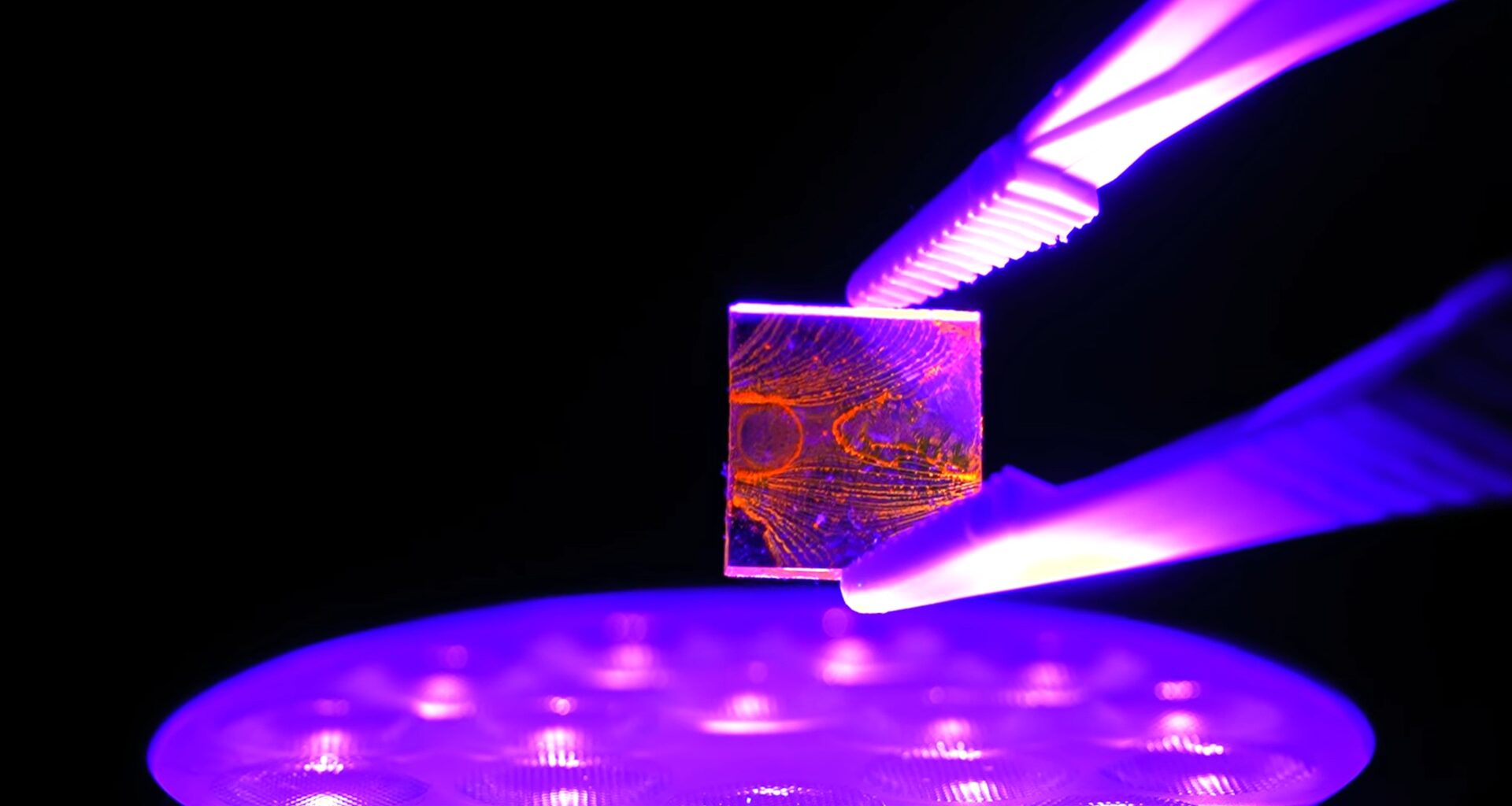
Researchers at Rice University have identified why a widely studied organic semiconductor behaves unpredictably with light, resolving a long-standing mystery and showing that tiny defects can improve its performance.
The team focused on 9,10-bis(phenylethynyl)anthracene, a model material used to study how energy moves through light-emitting systems.
Scientists had long observed two distinct absorption and emission signals in the material that existing theories could not fully explain.
To investigate, the researchers combined spectroscopy experiments with simulations to track how energy flows through the material.
Their results showed that the unusual absorption behavior arises from interactions between excitons, which carry energy, and charge-transfer states, where electrons move between molecules.
The dual signals, they found, were not anomalies but the result of two separate physical processes occurring simultaneously within the material.
Solving a light puzzle
“This was a long-standing puzzle in the field,” said Colette Sullivan, a doctoral student and co-author of the study.
“Once we connected the experimental results with theory, it became clear the two signals were coming from completely different processes.”
While this explained the absorption behavior, the researchers found something more unexpected when analyzing light emission. The lower-energy emission signal did not originate from the material’s uniform crystal structure, but from small structural defects.
These defects form when molecules arrange themselves into X-shaped pairs, creating localized regions where energy behaves differently. Instead of acting as flaws, these regions serve as energy traps that alter how light is emitted.
When defects boost performance
“These defects aren’t just imperfections, they actually create new pathways for energy flow, essentially turning apparent flaws into desirable features,” said Lea Nienhaus, associate professor of chemistry.
Further analysis showed that these defect sites enhance a process known as triplet-triplet annihilation, which allows materials to convert lower-energy light into higher-energy light. At the same time, they suppress competing pathways that would otherwise reduce efficiency.
This combination leads to improved energy conversion and emission, suggesting that structural disorder can be beneficial under the right conditions.
“Our work shows that material defects can actually improve performance, creating a target for materials engineering,” said Peter J. Rossky.
“By understanding how molecular structure, disorder and electronic interactions work together, we can begin to design materials where these effects are not just tolerated but deliberately used to control how energy moves.”
The findings challenge the conventional assumption that defects degrade material performance.
Instead, they point to a design strategy where imperfections are intentionally introduced and controlled to enhance functionality.
Such an approach could influence the development of more efficient systems for solar energy, optoelectronics and sensing technologies.
By tuning how molecules pack and where defects form, researchers may be able to engineer materials that better capture, convert and emit light.