
Less than a year since New Zealand’s government simplified its golden visa program, applications have surged more than 500% compared to the old system—with U.S. hopefuls making up nearly a third of the pool.
The Active Investor Plus visa, which offers a pathway to residency in exchange for a minimum NZ$5 million investment in businesses or government-approved funds, received 635 applications as of March 31, New Zealand Immigration reported last week. The revised visa program also allows foreigners to buy homes priced over NZ$5 million once the initial visa requirements are fulfilled. Generally, foreigners are not permitted to buy property in the country.
The application numbers dwarf previous figures. Between September 2022 and March 2025, Immigration New Zealand (reported just 115 applications under the more complex, old system.
MORE: The Most Expensive Home for Sale in New Hampshire Is This $20 Million Coastal Estate
“People everywhere are looking for [a backup plan],” said Mischa Mannix-Opie, director of client experience at Greener Pastures New Zealand, which guides clients through the country’s residency-through-investment pathways. “And those statistics are only going to keep going up. The previous policy was unattractive. The new one is easy to understand.”
The new program has seen 225 applicants from the U.S.—nearly a third of all visa-seekers, the government reported. A large percentage also came from China, with 104 applicants; Hong Kong, with 87; and Germany, with 46.
While global instability has accelerated demand, “it’s mostly New Zealand’s ‘pull’ factors that are motivating applicants,” Mannix-Opie said. “The main motivator is the lifestyle here. Political stability is a factor, and safety and security loom large. It used to be about gun laws. Now it’s about global safety.” (New Zealand has banned semi-automatic weapons and assault rifles since 2019.)
The visa application process can take up to four months, she said. Applicants have to prove their sources of assets and undergo a medical exam for visa health requirements.
“You then have six months to make your investment or commit your capital,” she said. “I have clients who applied for [golden visas] in Portugal and other European countries, and it took a lot longer.” The Active Investor Plus visa requires that an applicant’s funds stay invested for at least three years, Mannix-Opie said.
Even if they plan to buy a home, only about 30% of Greener Pastures New Zealand’s clients intend to stay in New Zealand permanently, Mannix-Opie said. “They want to have a base and an option,” she said. “They might use the home a few months out of the year.”
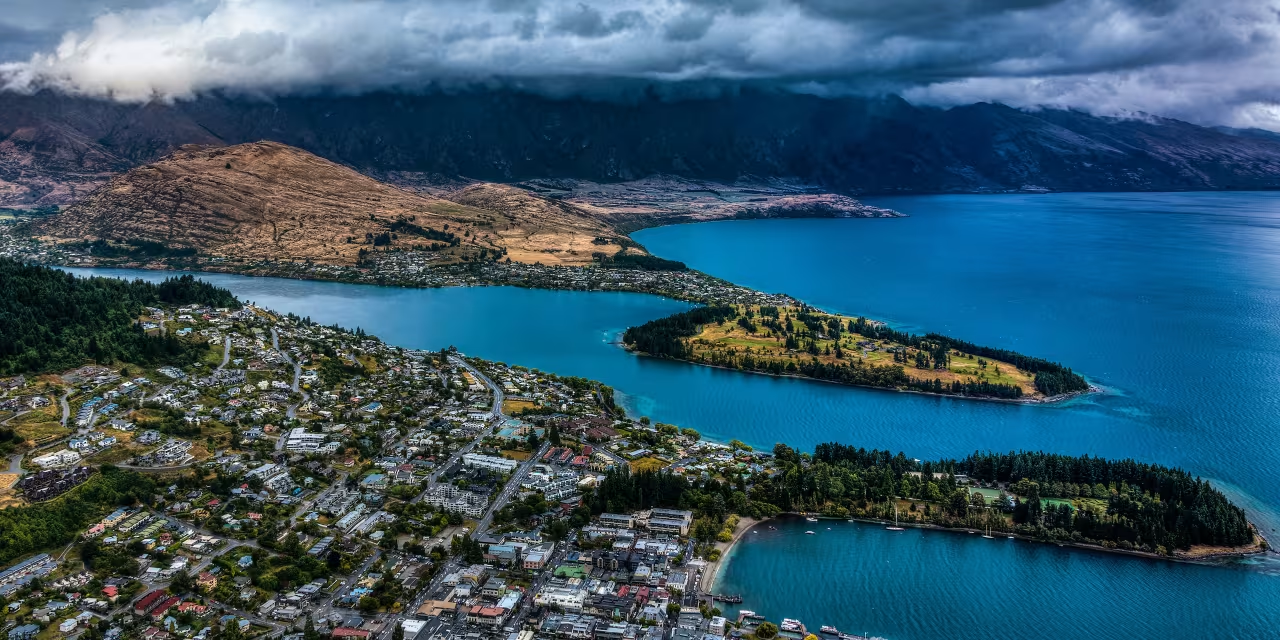
Auckland—New Zealand’s biggest city—has been a top choice for foreign home buyers, along with the lush Southern Lakes region, which includes Queenstown, according to Mark Harris, managing director and founder of New Zealand Sotheby’s International Realty.
MORE: Caribbean Islands Have Put Citizenship up for Sale. Why Applicants Might Want to Hurry.
“Most people inquiring now have genuine intent. They’re not just tire-kicking for interest’s sake,” said Harris, who is based in Queenstown. “Some listings are getting three or four inquiries a day from the U.S., which we’ve never seen before.”
Property inquiries from New York and Texas have nearly doubled year-over-year, Harris said; inquiries from states like Oregon and North Carolina, “not previously major drivers,” were also up by multiples, he said.
Savvy buyers who want more bang for their buck should house-hunt in areas other foreign buyers might overlook, Harris said. “There are pockets where NZ$5 million will go further than Auckland or the Southern Lakes. In Nelson, on the top of the South Island, NZ$5 million will buy you one of the best homes in the entire district. And in Christchurch, the South Island’s largest city, NZ$5 million will take you a long way. It’s fast-growing, post-earthquake, with great schools, beaches and the University of Canterbury.”
Despite the surging demand for high-end homes, “there has been no material effect on prices yet,” Harris said. “Sellers are still remaining relatively sensible. If anything, they’re holding their asking price rather than negotiating.”
As of February, the median house price in Auckland was NZ$1.01 million, up from NZ$770,000 10 years earlier, according to property consultants Opes Partners. The average price of a Queenstown property was NZ$1.92 million in February—the town has seen property prices increase an average 6.38% annually over the last 20 years, Opes Partners reported.
“This is a positive change for the market and the country,” Harris said. “Our experience with U.S. clients who went through the old process and got residency is that they acquired property through us, invested in New Zealand, supported local businesses and got involved in their communities. If we can encourage U.S. investors to look at New Zealand as an investment destination by offering the ability to buy a home, it’s a positive.”
Mannix-Opie agreed. “Our clients are not just bringing in money. They’re bringing in great human capital—their skills, networks, expertise and a real sense of wanting to get connected to New Zealand,” she said. “I love that it’s not just seen as a transactional visa. It’s a meaningful life change. People want to become a Kiwi. That gives me goosebumps.”