
Angels – earthenware angels, blood-red and glistening like things newborn. There are 28 of them in a room at the centre of Heide’s new survey of John Perceval’s work, John Perceval: All That We Are. Angels, daemons, musos, bomb victims, children – Perceval’s angels are unprogrammatic and uncanny in their mix of impulse and artistry. Did he make 50 of them? A hundred? Nobody knows. Their fingers and toes splay feelingly. Their eyes are cut-outs, blind, dark windows. Sometimes they open onto sky. Holes for noses, holes for ears: the angels are gappy, but their bellybuttons are filled, as if to say they are earthborn messengers. “Children are the real world,” Perceval said. The perspective of children, fierce and wild, he kept all his life in his work.
“Paralysed Boy of 15 Paints Like a Master” was the headline in the Melbourne Sun News-Pictorial in 1938. Journalist Zelie Pimlott found Perceval on the wide verandah of Stonnington’s after-care hospital among the wards of Melbourne’s polio epidemic. He had a reproduction Van Gogh on the wall by his bed. A year spent there, paralysed, in pain: his leg was paralysed still; he’d got back the use of his hands. In David Blackall’s 1999 documentary Delinquent Angel, Perceval remembered that year. “I hated hospital, but what could you do? So drawing, sketching was where I went, it was escape from pain … I found that I had this great gift. I couldn’t get enough of it…”
He’d been drawing ever since he could remember. Early memories took him back to his father’s farm in the wheatbelt. He was named Linwood South then. His father was silent, handsome, frightening; he docked the cats’ tails, killed the sheep himself. Linwood was not yet two, his sister Betty three, when their mother Dorothy caught the train to Perth to work at Boan Bros. At five, Linwood had three years with her. She wanted him to be a painter, but in 1931 she married William de Burgh Perceval and went to Melbourne. The kids went back to the farm, walking to their one-room school at Korbel; Linwood changed his name to John. “The horizon was forever out there … nothing there. It was overpowering; the child in me turned to a world close-up: the thickets, insects, things on the ground…”
At 12 John joined his mother in Melbourne; he took his stepfather’s name: John de Burgh Perceval boarded at Trinity Grammar, Kew. At 13, holidaying with a family at Point Leo, Perceval discovered their art books: Cezanne, Van Gogh, Modigliani, Gauguin. In a rush he started painting in oils, a dozen or so pictures, copies and self-portraits. All That We Are has a little oil painting, Self Portrait (1937), from this epoch. It shows the artist with his paints at a small desk, jammed at an angle against a corner of the picture plane, a tight corner counterpoised by the back corner of his tiny room. The self looks out at us from this box too small to hold what it contains. His shirt, impasto white, matches the windows’ impasto clouds – agitated impasto, a tribute to Van Gogh. The head is modelled finely, in modulated greys. The eyes are wary, but the painting’s fearless. Already Perceval knew how to create something unstable in the picture.
The army trained him in cartography, but Perceval’s landscapes refuse the cartographic eye … space warps as you look at them.
Then the polio, the trouble breathing, the fear that his hands wouldn’t work again. Pimlott noted his knowledge of painting from Rembrandt to Picasso, also the Mexican painter Diego Rivera. Perceval’s self-portrait illustrated the article: close-up and confrontational, but in reproduction the eyes are filled with shadow, dark shadows mark the nose and mouth, making the face a mask. “Someday John de Burgh Perceval will be more than a name to the Australian public,” wrote Pimlott.
All That We Are centres on the major works Perceval made in those 19 years after he turned 19, when he joined the Boyds at Murrumbeena, co-founded a pottery with Arthur Boyd and Peter Herbst, married Mary Boyd, had children, created his angels, painted his Williamstown port series and seething landscapes – all before he turned 40 and left for England. David Boyd described how it happened. “My brother brought him back from the cartographic survey … John was in the army then … I walked him and his girlfriend back to the station. John dismissed his girlfriend … said he’d fallen in love with Mary Boyd. ‘I’m getting myself discharged from the army and I’m going to live with the Boyds at Murrumbeena,’ he said.”
Generations of the Boyds lived at Open Country, the house and pottery Merric and Doris Boyd built in Murrumbeena. The place had been an orchard. New generations added shacks and studios among the trees: a blossoming pear, golden wattle, a tall pine the children climbed. There Perceval painted his stark and haunting Boy series of 1943, including Boy with Cat, Boy Discovering a Jack-in-a-box, Boy Beside a Fruit Barrow. In these, the boy’s eyes are filled with shadow, as is his mouth. That darkness closes horizon-emptiness – “nothing there” – inside the child’s world of “close-up things”. Max Harris, co-founder of Angry Penguins, called Boy with Cat “the first unequivocal masterpiece of Australian modernism”. “The scream in Perceval’s paintings is a silence,” he said.
At Open Country everyone met in the Brown Room for eating, arguing, sketching, painting, Bible readings and readings from literature: Dostoevsky, Chekhov, Turgenev. Albert Tucker gave Perceval and Arthur Boyd Max Doerner’s The Materials of the Artist and Their Use in Painting (1934). They experimented with tempera and resin, and Old Master biblical allegories. In 1944 Mary Boyd, 18, married Perceval. Perceval’s tender Flight into Egypt (1947) portrays Mary and their first child in its vision of the Holy Family. An angel has led them past a blossom tree into a garden. Behind them a path threads back into the past. Perceval’s biblical allegories are hallucinated genre scenes; they turn spatial depth into time. History is at the back; time presses up against the picture plane.
In those years, Perceval experimented with glazes. In 1926, when Merric’s pottery burnt down, one pot survived, blood-red, like that ancient sang-de-boeuf glaze Merric sought for years. Firehoses had tempered its glaze. Perceval thought of adding mothballs to the kiln to cut oxygen. He created a glaze “so beautiful and different,” he said, “I thought of those little red angels around the Virgin Mary” in Jean Fouquet’s panel in the Melun Diptych (circa 1452) – except “they look more like devils than angels”.
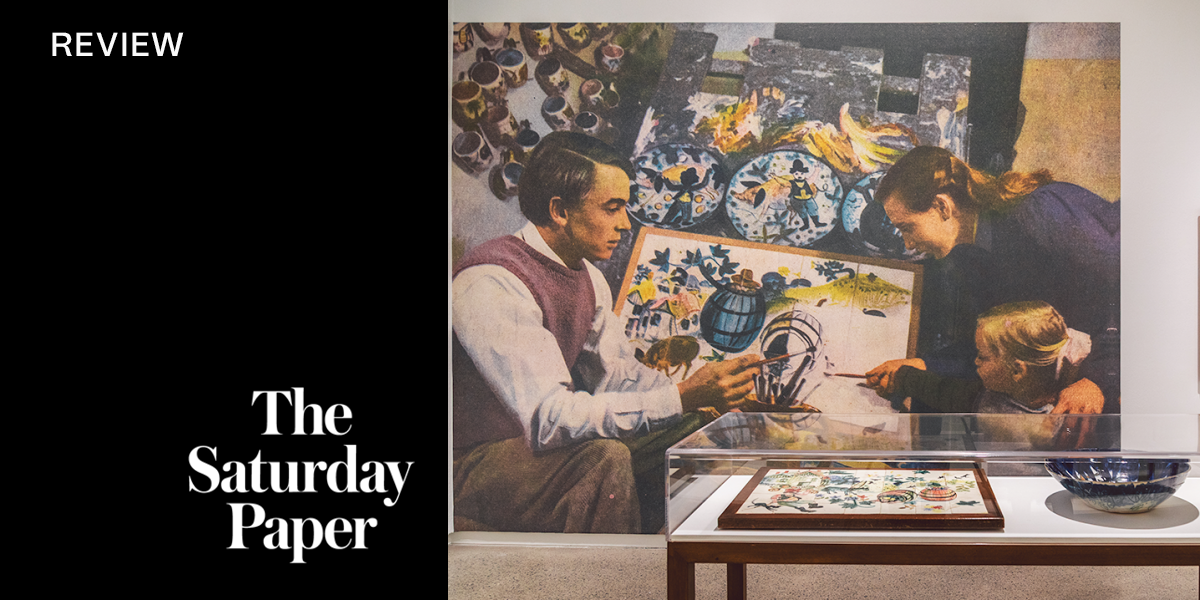
Kendrah Morgan’s curation of this exhibition is clear-headed and expansive. It includes Perceval’s playful bowls, pots and tiled tables, from the Arthur Merric Boyd (AMB) pottery collaboration. It shakes off old category logics dividing the “Heide Circle” from the Boyd family, the pottery craft from Perceval’s ceramic art, the ceramic art from his painting. It’s illuminating, because the messy, generative mix shaped Perceval’s art in this epoch. His feeling for ceramic sculpture plays out in his landscapes and Williamstown port paintings. They use gouts, clots, gougings in thick paint to sculpt in light. Even his shadows are added in splotches: he treats shadow as moment-to-moment vision, not constituent form. Perceval mixes colours on the canvas, incising them with restless tides or the sped-up growth patterns of leaves and grasses. On each side of these incisions, the paint frills; the colour-mix differs. As you stand in front of it, the picture’s surface seems to vibrate.
The army trained him in cartography, but Perceval’s landscapes refuse the cartographic eye. They don’t open imaginary distances, or own the place. He painted them on the spot, starting a few hours before sunset, drinking, tracking what he called “broken and suspended light… the abstract qualities of the bush itself”. He paints the landscape from multiple points of view; space warps as you look at them. Take The Cornfield (1959): in the left foreground is a patch of radiant ash-pale stalks, close-up, and dried black weeds; also a high vision out into those distances on the right, where a red dirt road snakes up the hill by a ploughed field. Black crows fly there like animation stills. Under them, is that the bride from Arthur Boyd’s series, sketched in paint, her arms outstretched, floating over the cornfield? Is that what he added, a decade after finishing the picture?
All That We Are marks the happiest years of Perceval’s career. Later, the alcoholism worsened. Mary Boyd got a place of her own, in England. Perceval committed himself to Larundel Mental Hospital, diagnosed with schizophrenia. Mary Boyd married Sidney Nolan. His partner, Cynthia, had ended her life in a dingy London hotel room. Somehow these exuberant paintings and blood-red angels survive it all.
John Perceval: All That We Are is at Heide Museum of Modern Art, Victoria, until July 12.
ARTS DIARY
MUSICAL Amplified: The Exquisite Rock and Rage of Chrissy Amphlett
Seymour Centre, Gadigal Country/Sydney, April 15-25
MULTIMEDIA Julius von Bismarck: This is not the storm
Australian Centre for Contemporary Art, Naarm/Melbourne, April 17 – June 14
CIRCUS Duck Pond
Heath Ledger Theatre, Whadjuk Noongar Country/Perth, April 12-18
VISUAL ART Ngura Pulka – Epic Country
National Gallery of Australia, Ngambri/Canberra, April 11 – August 23
EXHIBITION Worlds within Worlds
Queensland Art Gallery, Meanjin/Brisbane, until August 16
Last Chance
CERAMICS Golshad Asami: Rhythms of Home
JamFactory, Kaurna Yarta/Adelaide, until April 12
This article was first published in the print edition of The Saturday Paper on
April 11, 2026 as “‘Children are the real world’”.
For almost a decade, The Saturday Paper has published Australia’s leading writers and thinkers.
We have pursued stories that are ignored elsewhere, covering them with sensitivity and depth.
We have done this on refugee policy, on government integrity, on robo-debt, on aged care,
on climate change, on the pandemic.
All our journalism is fiercely independent. It relies on the support of readers.
By subscribing to The Saturday Paper, you are ensuring that we can continue to produce essential,
issue-defining coverage, to dig out stories that take time, to doggedly hold to account
politicians and the political class.
There are very few titles that have the freedom and the space to produce journalism like this.
In a country with a concentration of media ownership unlike anything else in the world,
it is vitally important. Your subscription helps make it possible.
Send this article to a friend for free.
Share this subscriber exclusive article with a friend or family member using share credits.

Used 1 of … credits
use share credits to share this article with friend or family.
You’ve shared all of your credits for this month. They will refresh on May 1. If you would like to share more, you can buy a gift subscription for a friend.
SHARE WITH A FRIEND
? CREDITS REMAIN
SHARE WITH A SUBSCRIBER
UNLIMITED
Loading…