
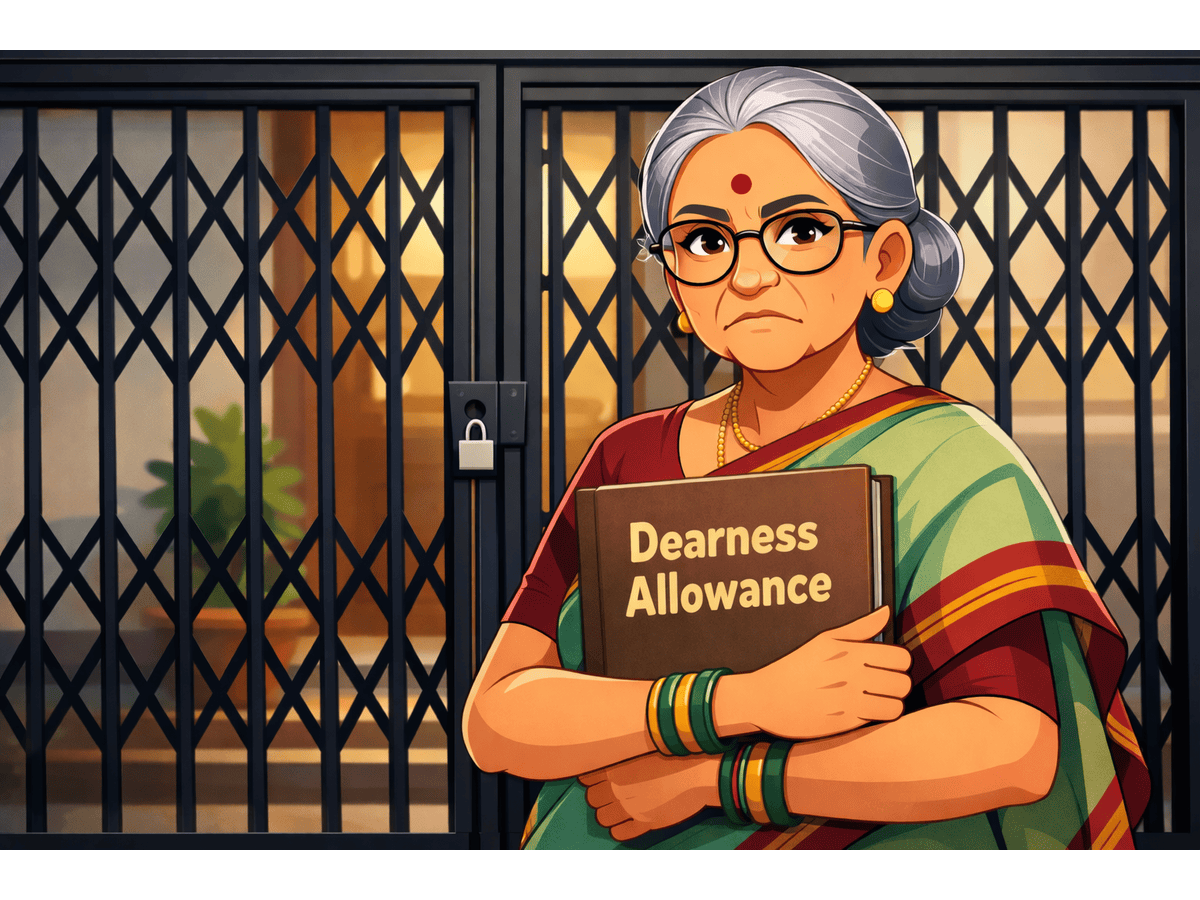
Smt Vana from Chennai was given her late husband’s job on compassionate grounds on April 20, 1974 and she also received the family pension for her husband’s services. Subsequently on May 31, 2001, she retired from her post of a selection grade assistant and got her regular pension also. So, she ended up with two pensions: the family pension and the regular pension.
Now, it is her specific contention that since her retirement, she hasn’t received any Dearness Allowance along with her regular pension. Therefore, she took legal action, asking the court to direct the company to pay her pension along with Dearness Allowance with effect from June 1, 2001, that is from the date of her superannuation.
However, the company’s lawyer strongly objected to her claims, stating in court that they approved both the family pension and the regular pension but since she had opted for pension commutation, they deducted a sum of Rs 862 from her monthly pension and has been paying the remaining amount of Rs 2,995 as pension, which includes the dearness allowance (DA).
The company’s lawyer argued that she has filed this case with a misunderstanding of facts.
On February 27, 2026, she lost her case in the Madras High Court as it was proved that she was already getting dearness allowance on both the family pension and regular pension. Therefore, she had indeed filed the case with a misunderstanding of facts.
Read below to find out what the Madras High Court said about dearness allowance on family pension.
Madras High Court: Rules say that for a single person, there cannot be two Dearness AllowancesRule 20A of the Tamil Nadu State Transport Corporation Employees’ Provident Fund:- “Rule 20.A-DEARNESS ALLOWANCE TO PENSIONERS
(i) In addition to the basic pension, the pensioners are eligible for nominal Dearness Allowance at the rates that may be determined by the Government of Tamil Nadu.
(ii)If a pensioner is re-employed under the Central Government or a State Government or a Government Undertaking or a Corporation or an Autonomous Body or a Local Fund in India or abroad, he shall not be eligible to draw dearness allowance on pension during the period of such re-employment. (iii) Dearness allowance is also not admissible during the pensioner’s stay abroad.”
The Madras High Court said that according to Rule 20A(ii), if a pensioner is re-employed under the Central Government or a State Government or a Government Undertaking or a Corporation or an Autonomous Body or a Local Fund in India or abroad, he shall not be eligible to draw dearness allowance on pension during the period of such re-employment.
Madras High Court said: “It clearly mandates a pensioner, while on re-employment cannot have any Dearness Allowance along with the salary.”
But, in the case in hand, Madras High Court said that since she was a family pensioner and was appointed on a compassionate ground, on the first blush, the above Rule may appear to be not directly applicable.
Madras High Court said: “But, the principle behind the above Rule is that for a single person, there cannot be two Dearness Allowances. The very concept of Dearness Allowance is based upon the effect of inflation upon an individual employee.”
Despite contrary position in law, she is getting dearness allowance on both family and regular pensionThe Madras High Court said that it is relevant to refer the judgment of the Supreme Court in Union of India and Others Vs. Rekha Majhi reported in (2000) 10 SCC 659, wherein the word “re-employed” was interpreted in such a way that the same would include first regular appointment in the service.
In the above reported judgment on a similar set of facts and mutatis mutandis, Madras High Court said that the Rules of Railway service, Pension Rules 1973, was held to be that the family pensioner on regular appointment in service is not entitled for a Dearness Allowance on his family pension.
But, in the case in hand, according to the counter statement, it appears that notwithstanding the Rule position, the company is paying regular pension and the family pension along with the respective Dearness Allowances.
For Ready reference, the relevant portion of counter statement is extracted hereunder:-
“8.I submit that the petitioner had claimed dearness allowances in family pension based on the G.O.No.112, Finance (Pension) department dated 24.03.2008 issued by the Government of Tamil Nadu. I state that above said G.O. relied by the petitioner would applicable only to the family pensioners of government department. I state that the petitioner is also receiving family pension along with dearness allowance from the Government for the service render by her husband in the transport department.”
She filed this case on a misconceptionThe Madras High Court said that according to the Rules, if a person is re-employed after retiring from a pensionable job, he/she will be eligible for Dearness Allowance to anyone of his/her pension amount as per Rule 20A of Tamil Nadu State Transport Corporation Employees Provident Fund.
But, she would contend that she has not been sanctioned Dearness Allowance to her regular pension amount. While looking at the counter statement, the company had stated that the petitioner had been receiving her regular pension along with Dearness Allowance from July 2001 to till date. In support of their contention, they have also submitted the records as to the pension payment details. According to the above Pension payment details, there is an entry with regard to the payment of pension along with Dearness Allowance.
Thus the Madras High Court said that she has filed this case without taking into consideration the commutation of pension amount, under misconception, she preferred the writ petition, as if she receives no Dearness Allowance for the pension.
Judgement:
In view of the above legal and factual position, this Court does not find any infirmity in the order of the authority. Accordingly, this writ petition stands dismissed. No costs. Consequently, connected MP is also closed.