
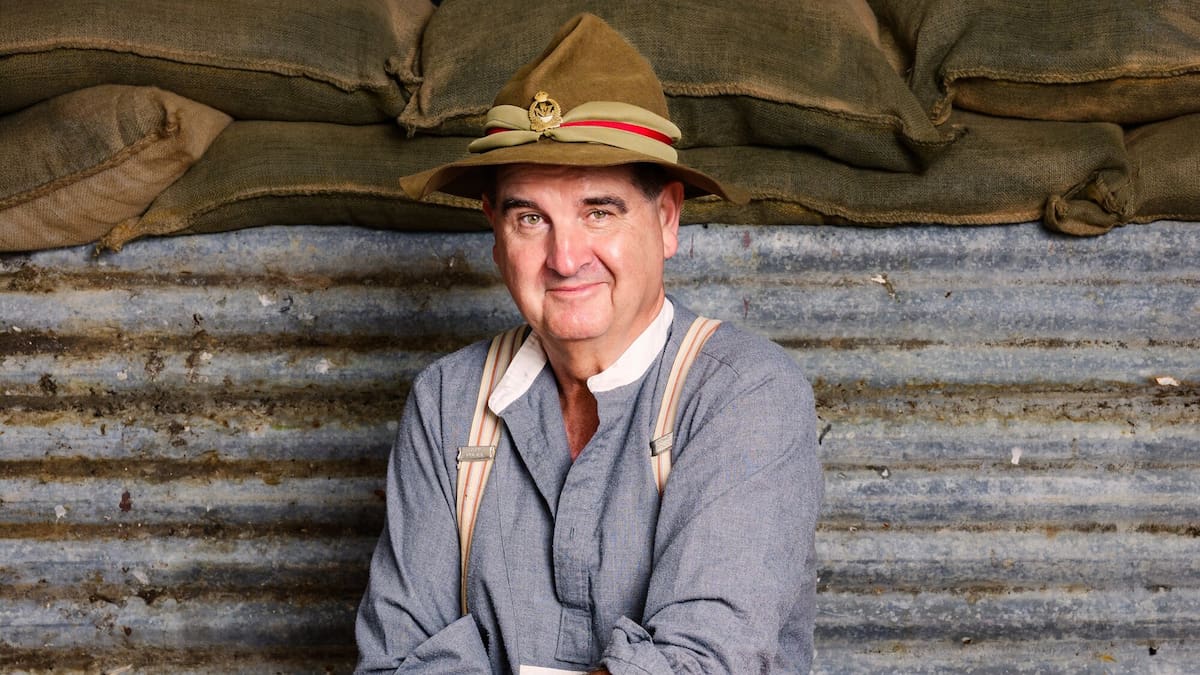
However, the roots of the play formed many decades earlier.
Wright developed his play Voices from Gallipoli by improvising nine characters, using a different hat each time for inspiration.
I’ve always been a bit of an amateur historian, especially around New Zealand’s involvement in both world wars. My maternal grandmother, born and raised in Waihī, lived in my family home when I was a child and often spoke about her brothers, Tom and Jack Kelly, who served at Gallipoli.
Both were wounded, repatriated back to New Zealand and died shortly after the end of WWI as a result of complications from their injuries. I grew up hearing this history and how deeply it affected that side of my family.
To mark the 100th anniversary of the landings at Gallipoli, in 2015, I was asked to narrate a television documentary about a group of students from a boys’ school in Auckland who’d been charged with the task of researching an old boy from the college who had served and died on the peninsula.
The boys travelled to Turkey with a film crew to find the men’s graves. I went with them at my own expense so I could narrate the documentary on camera and on site, rather than months later in an Auckland studio.
Anyone who has visited Gallipoli knows what a life-changing experience it can be. You don’t truly get a sense of what they were up against until you stand on that very shallow beach at Anzac Cove. Looking up at the cliffs, you realise that in a way the biggest “enemy” they were up against was the terrain – that and the fact that the British landed them on the wrong beach.
The documentary was called Our Sons, a reference to Mustafa Kemal Atatürk’s famous words inscribed on the Ari Burnu Memorial at Gallipoli: “Your sons are now lying in our bosom and are at peace. After having lost their lives in this land, they have become our sons as well.”
The memorial at Ari Burnu Cemetery, Anzac Cove, Gallipoli. Photo / Mark Mitchell
In 2022, I was taking an adult acting workshop, demonstrating a technique for exploring and developing a character through props. I used a stockman’s hat and improvised a monologue as a farmer who’d fought in WWI.
Many people were visibly moved by the performance and encouraged me to develop it into a play, which I did by improvising nine characters – using a different hat each time for inspiration.
The play was first performed under the working title The Gallipoli Monologues, and eventually became Voices from Gallipoli.
While the piece is informative, it’s not a history lesson. There are a lot of myths and misinformation about New Zealand’s Gallipoli campaign, which I attempt to dispel. One of the best comments I’ve had from an audience member is that “it’s like you put the humanity back into a history book”.
The people I portray on stage are a mixture of historical figures, family members, and characters I created from several real stories.
Among them, I play an 18-year-old boy receiving a heartfelt letter from his mother back home, an 80-year-old returned serviceman at an Anzac Dawn Service, an overworked doctor giving a briefing to a group of newly arrived nurses about the harsh realities of what they are about to face, and a laconic sergeant trying to teach his fresh troops hard-learnt lessons on how to survive.
I believe the themes in the play are still very relevant today, as we once again find ourselves living in tumultuous times.
Preparing for my upcoming season, I’ve found myself thinking about Winston Churchill’s quote: “Those who fail to learn from history are doomed to repeat it.”
Given the current conflict in the Middle East, the words spoken by one of my characters, whose eldest boy is in the North African desert fighting against the Germans, are now even more poignant.
“I remember the day he left. He stood in the kitchen doorway, and he said to me the exact same words I said to my father the day I left. He said, ‘Don’t worry, Dad. It’ll all be over by Christmas.’”
Voices from Gallipoli is on at Auckland’s Q Theatre, April 16-21.