
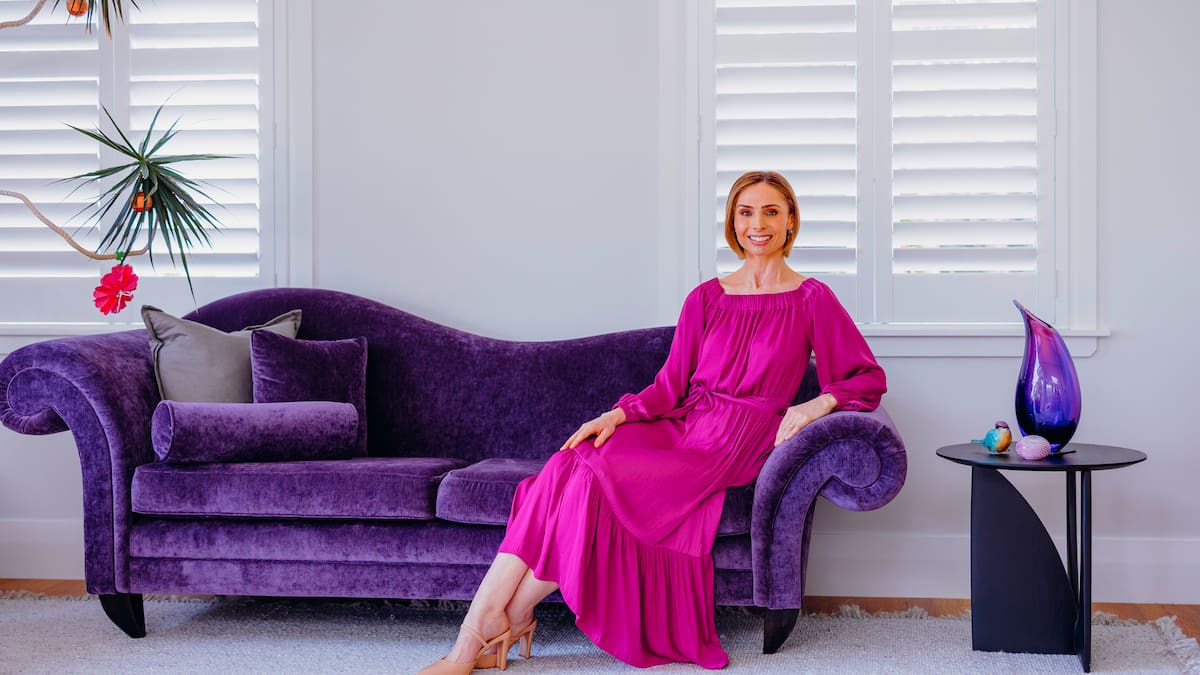
Karina is mum to twin toddlers, with her son showing signs of autism. Photo / Woman’s Day
When her son “Max” (not his real name) was diagnosed with severe autism at 19 months old, Karina was sent home with no plan or meaningful support. It’s a scenario faced by countless families. Autism affects around 26,000 Kiwi kids between the ages of two and 14. It’s a neurodevelopmental condition that influences cognitive, sensory and social processing, and presents in diverse ways.
Early on, Karina says she was positioned by doctors as an overanxious first-time mum who was unfairly comparing Max with his twin sister Matilda, who progressed in the 99th percentile of development.
“Comparison is the thief of joy, right?” says Karina, 45. “At that time, it was clear to me that my son was following a different path. He didn’t sleep, and he struggled to communicate and to play.
“What were everyday sensory experiences, like being out in bright sunlight, feeling the texture of clothing or visiting the supermarket, became completely overwhelming for him.
“But I was told repeatedly that I should ‘wait and see’ – that ‘boys are just different’.”
However, with a professional background in health, Karina saw the opportunity of that early window of brain development and knew in her gut that Max would benefit from having additional support.
When it wasn’t forthcoming, she stepped away from her career, did the research and built an individualised plan to give her son every chance to thrive.
“The evidence-based support my husband and I designed for him was never about fixing or correcting anything about Max,” she explains. “Life was simply harder for him than it needed to be. Autism is a difference, not a deficit.”
Max is now a “bright, chatty, engaging” 8-year-old and proof to his dedicated mum that early support changed his life’s trajectory.
“We were originally told that Max’s profile of autism doesn’t shift,” she explains. “He used to not be able to respond because he didn’t understand language and communication.
Max’s social transformation is extraordinary. Photo / Woman’s Day
“Well, last year, he gave his school speech on crocodiles – which he’s obsessed with! – and confidently made the finals.”
Another example of an outdated stereotype she’s found herself battling against is that autistic children aren’t interested in socialising.
When Karina sought guidance from a skilled professional around developing Max’s social skills, she was told that autistic children don’t like to play with others.
“I went to that professional specifically because my son had come to me and said, ‘It hurts my heart when I can’t play with the other children. I want to, but I don’t know how.’ He needed extra tools for that to happen.”
Max’s transformation – from a child at high risk of never speaking and struggling with forging friendships – is extraordinary.
“He’s thriving,” says his mum. “Max has friends, enjoys a number of after-school activities and is in mainstream primary school, in the same class as his sister.
“The thing I’m most proud of is my son is authentically himself. It’s such a gift that he feels safe and secure in who he is.”
Equally compelling is Karina’s own transformation. In going “all in” for Max, she lost her career, identity and her health. Yet she found purpose and a new understanding of what care, health, success and hope truly mean.
“I never imagined writing a book that was so personal,” she says of the part-memoir, part-call-to-action. “The hardest part of this journey was the isolation. It isn’t about feeling alone – it’s about feeling unseen. Managing the gap between what the child needs and what’s there to support them is completely overwhelming, mentally, emotionally and financially. That needs to change.”
So does Karina have time to eat oranges with two hands now? “Yes, they’re delicious!” she laughs. “It was a tiny thing, but it spoke volumes about the frantic reality of what life was like.”
All In: A Mother’s Journey Through Autism ($45, Bateman Books) is on shelves now. Follow Karina’s blog NeuroThrive at kmchardy.substack.com