
The road south from Colorado Springs is parched and quiet and for long stretches doesn’t look as though it leads to anywhere, let alone to one of the more storied and enduring artistic communities in the Southwest.
Taos, a mountain town nestled in the Sangre de Cristo range of the Rockies in northern New Mexico has been a beacon of creative escapism ever since Mabel Dodge Luhan, the banking heiress and memoirist, bought a 12-acre property there in the 1920s. Over the years, she hosted everyone from Georgia O’Keefe to Ernie O’Malley. The town already had an established artist’s colony and, just outside the town limits, the Native American Taos Pueblo, established in the 13th century.

It was starting to turn dark on the road over, which was lit only by the lights of the sporadic ranches set deep inland. One of those remote properties was decorated by an extravagant sign bearing tribute to Donald Trump. It was one of the few Trump signs I’d seen since leaving Washington. There could be few more powerful symbols of the New Yorker’s uncanny talent for tapping into the insecurities and dissatisfactions of even the most remote of American lives than this: a New Mexico homestead surrounded by magisterial natural beauty and, it appeared, straight out of the how-to manual for American manifest destiny.
“It’s irrational,” laughs Bill Nevins when I tell him about the ranch.
“But that doesn’t mean you can change his mind.”
Nevins is a New Yorker who drifted west, to Albuquerque, over 30 years ago. Like all the best Americans, he seems to have lived about a dozen lives while retaining an unspoilt brightness about tomorrow. He and his partner, Jeannie Allen, had been regular visitors to the town for years before moving “up” permanently last year. For pure solitude, they also have a cabin and 30 acres of unblemished mountain land out on Black Lake. “The deer will walk right up to ya,” he says.
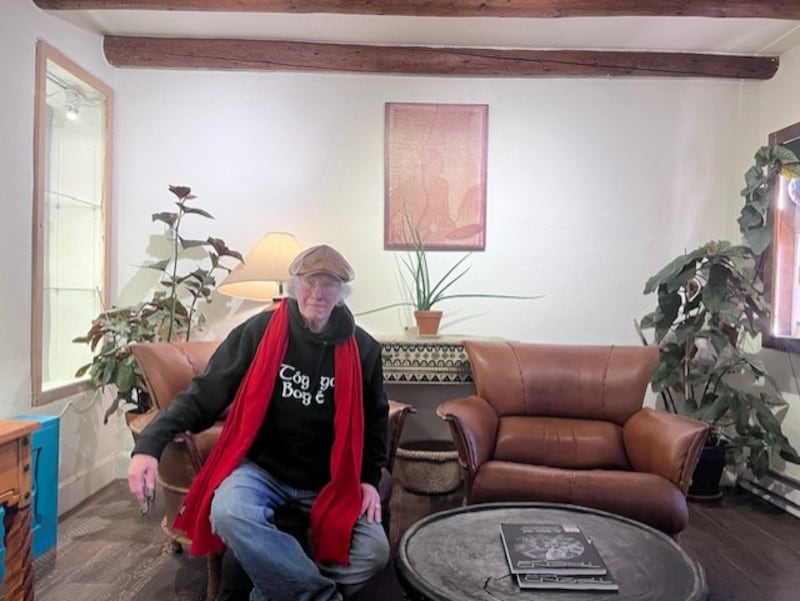 Bill Nevins: a songwriter, poet, teacher and an unrepentant graduate from the counterculture. Photograph: Keith Duggan
Nevins is a songwriter, poet, teacher and an unrepentant graduate from the counterculture with an abiding interest in Irish culture ever since he was told that his great-grandmother, Anna Kiely, from Cahir, Co Tipperary had sung Molly Malone to him while he lay in his cot in his parents’ house in New York.
“She lived until she was just about 102 or 103 and died tragically in a fire, in Stamford Connecticut. My grandmother was married to the detective commander of Stamford police.”
He tells me all of this when we meet in the Taos Historic Inn, one of the many adobe, or mudbrick, buildings in the town. It’s a retreat with a gorgeous retro neon sign over the front door and an open fire and live music each evening.
[ Along Route 50, a solitary stand against Trump’s immigration raidOpens in new window ]
The receptionist says locals treat the reception area near the bar as a kind of informal town livingroom. I want to ask Nevins about what it feels like to live here, almost away from it all amid monumental natural splendour, during such a turbulent time in the United States.
Taos is at once unfussy and rarefied; a winter sport destination whose streets are laden with art boutiques, designer cowboy wear and artisan gifts. Even in the gloom of February, it attracts visitors and it is teeming in high summer. People move slowly and are conversationally relaxed. It’s low-key and friendly and feels almost immune to the sense of low-grade anxiety emanating from the daily news.
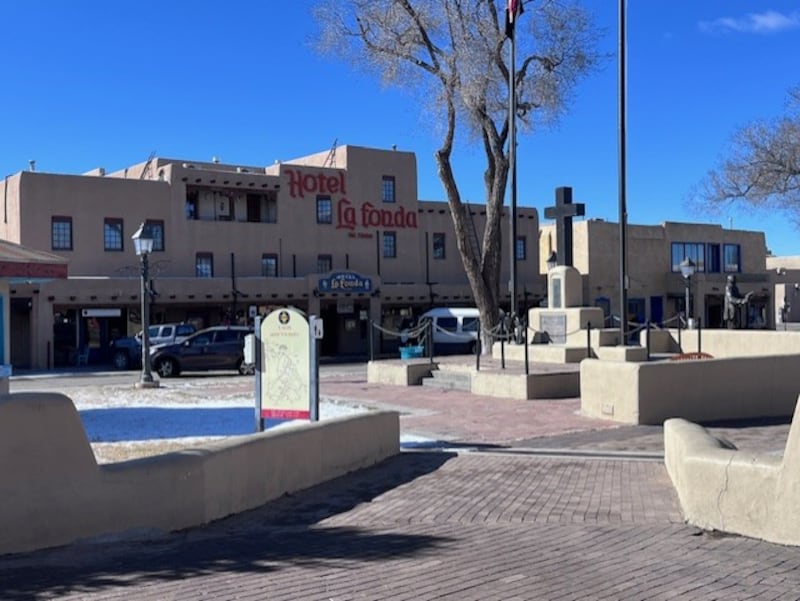 Taos, New Mexico. Photograph: Keith Duggan
“I feel almost embarrassed by the privilege of being here,” Nevins admits.
“We are protected for the time being. It is a little bubble. But. We’re scared. I won’t kid you. Of Ice [US Immigration and Customs Enforcement] coming and the fascists moving in. Although New Mexico is now a solidly blue state and the governor has taken measures to protect the state as much as she can. She cleverly activated the national guard herself. The Republican Party here is to the extreme right – ranching and some oil interest is their thing. If they were a little moderate they might have a chance. There’s been complaints from some folks that the artists just want to do their art. I’ve been trying to mobilise poets and musicians and others in New Mexico to do resistance work.”
Nevins has two daughters from a previous marriage, and grandchildren on the cusp of adulthood. He raised his family in rural New England because he was convinced, in the 1970s and 1980s, that social collapse was just around the corner and he figured his family could seek refuge in Canada, “if things went bad”.
“Now is the nightmare that we rhetorically, when I was considered a left-wing radical, felt was just around the corner. And now I feel that our prediction was right, we were just off in terms of time.”
We talk for a while about the difference between being young now and his formative years.
“I think it is very similar to what I hear about Ireland – that it is very hard for young folks to get up and running. I have two grandkids and I can see their struggle to strike out on their own.”
[ How a Kansas town still lives with the legacy of In Cold BloodOpens in new window ]
He tells me that his only son, Liam, was a US special forces member who, after several tours in Iraq and Afghanistan was killed in 2013 during a confrontation while serving on the border by a gunman wearing an Afghanistan police uniform.
“On the Pakistan border. He had been shot one month before on a night mission. He could have come back then. One of his staff sergeants came up to me at Liam’s funeral and said ‘look, man, I am the son of a b***h who got your son killed. I could have ordered him back to Germany.’ I said, ‘you know what: you would have had to put him in chains and drag him out’. So yeah. I miss him. Liam would say that he was so glad Obama got it [the presidency] because he could see the way it had been going in the years before that.”
“But to answer that question: I see my daughters and their children not giving up hope. Yet they are also realistic about what is going on. And thinking of how we defend ourselves. Not with guns. Because they have more guns. I think what has been happening in Minneapolis – just staunch peaceful civic protest – that’s the model for this country.”
Over his years in Taos, Nevins has become friends with people who live virtually off the grid, setting up home way out on the plains and making occasional raids on Taos for provisions and a night under bright lights.
Nevins enjoys solitude, too, but most of his projects are about building community. We talk for a while about the evolution of Taos. It has had its share of spectacularly violent incidents, from the 1847 revolt, when Mexicans and Pueblo Indians staged a rebellion against US forces, to the so called “Hippie-Chicano War” when the summer of 1970 was interrupted by a blackly violent series of confrontations between locals and the hippie communes flourishing across the Taos valley.
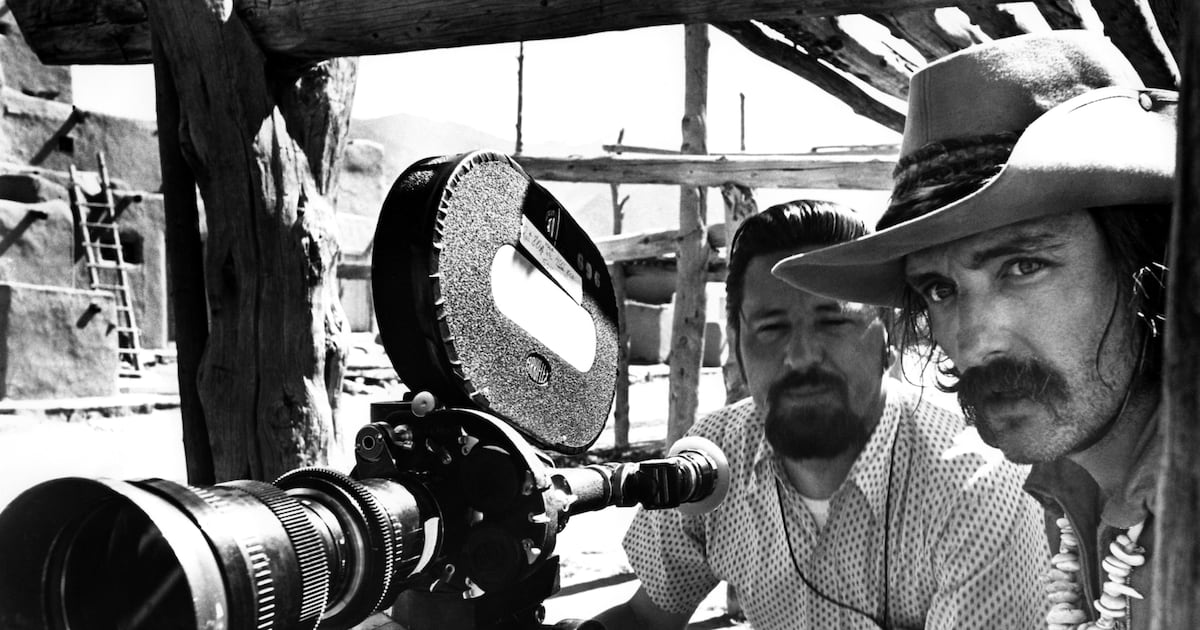
By then, Taos had found its way into the emergent story of New Hollywood, featuring as a key location in Easy Rider. Dennis Hopper, the director, was so taken with the town that he became its most notorious resident during the 1970s and its most feted retiree in the last years of his life.
“I personally did not,” Nevins says when asked if he encountered the actor before happily checking himself.
“Dennis Hopper was – oh I did! I did meet him, yeah. A few years before his death and he came back and the mayor of Taos gave him the key to the city and said all is forgiven. And he did an exhibit of photographs and I had a magazine going so I interviewed him. And I said, man tell me about Easy Rider. How did you get that great music in there? And he laughed and said Peter Fonda knew all these musicians and he just asked to use it. The only one who wasn’t that naive was Bob Dylan.
“You know, the Waterboys did a whole album about Dennis Hopper? They just played Santa Fe. Fantastic. After Easy Rider, Hopper set up a compound here and he had a machine gun mounted on the top of it. There was a level of paranoia there in the 1970s.
“But he was a gentleman by the time I met him. When he talked about the old days, he just laughed and said, oh my God. I was a bad boy. But he really was. There was so much cocaine and acid … he was fried for a time. But thankfully, he got it together.”
When Hopper died in Venice, California in 2010, his funeral cortege ended in Taos. He is buried in the Jesus Nazareno cemetery, down a side road about a mile outside the town. Few actors have managed to span the various reinventions of Hollywood with his distinction, from starring with James Dean to his unsettling turn in Blue Velvet.
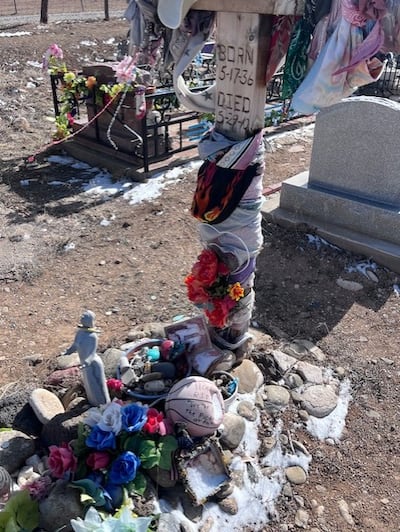 Dennis Hopper’s grave near Taos, New Mexico. Photograph: Keith Duggan
A deflated basketball rests on his grave in tribute to his role as a lovable, ruined basketball fanatic in Hoosiers – his lone Oscar nomination in a 50-year career. From a Dust Bowl-era farm childhood in Kansas to Taos grandee: it was a life.
In one of his last interviews Hopper recalled how he had found Taos, when driving around the valley with his production manager looking for film locations for Easy Rider. It’s a story that is illuminative of the appeal of Taos for many outsiders who arrive there and never quite leave.
Hopper had originally dismissed Taos when told it was full of artists and poets but his production manager took a wrong turn and they ended up in the town by accident.
“And this Indian guy came up to me as I was getting out of the car,” Hopper remembered, “and he says, ‘The mountain is smiling on you. I know where you need to go’.”