
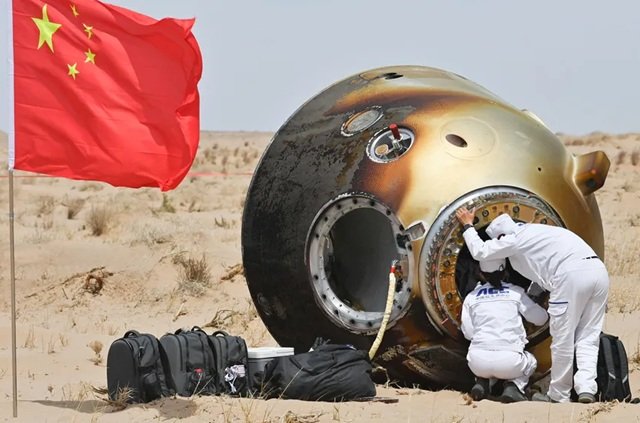
The splashdown of a US space capsule into the Pacific, parachutes unfolding as engineers cheered another apparent triumph, was widely presented in the United States as a symbolic victory in the renewed race for the Moon. Yet, according to an analysis published by Die Zeit, the celebration may obscure a more consequential reality: while Washington marks incremental progress under its Artemis program, China is quietly assembling the capabilities that could allow it to land astronauts on the lunar surface first. Similar scenes of controlled re-entry and ocean recovery have already been broadcast in China, though they attracted far less attention in Western media. The contrast, Die Zeit notes, is not in spectacle but in trajectory, with two space powers moving toward the same destination at different speeds and with fundamentally different systems behind them.
At the center of the competition is timing. The United States officially aims to return humans to the Moon in 2028 through its Artemis program, an effort designed to reassert leadership in deep space exploration and build a sustained lunar presence. China, meanwhile, has announced a goal of landing astronauts “before 2030,” a seemingly later target that many experts now consider potentially more achievable in practice. Die Zeit reports that several aerospace analysts believe the US timeline is optimistic given current delays in critical systems, including next-generation landers and advanced space suits. As a result, what once appeared to be a clear American lead has narrowed into a tightly contested race where schedule slippage could prove decisive.
China’s confidence stems from a series of steadily accumulating achievements. Over the past decade, it has built and continuously operated its own space station, Tiangong, which has maintained a rotating crew since 2022. Beyond Earth orbit, China has also completed multiple robotic lunar missions, including successful landings and sample-return missions. One of the most notable milestones came in 2024, when the Chang’e 6 mission returned material from the far side of the Moon, an accomplishment no other nation has achieved. Earlier missions demonstrated precision landings and rover deployments, reinforcing the perception that China’s lunar program is not experimental but operationally mature. Die Zeit highlights that these achievements are not isolated successes but part of a coherent, long-term strategy with clearly sequenced steps.
Looking ahead, China’s lunar roadmap is becoming increasingly ambitious. The upcoming Chang’e 7 mission is expected to explore the Moon’s south pole, focusing on permanently shadowed craters where water ice may exist, a critical resource for future human bases. At the same time, plans are being developed for crewed missions that could place Chinese astronauts on the lunar surface around 2029, a year that carries symbolic significance as the 80th anniversary of the founding of the People’s Republic of China. Observers cited in Die Zeit suggest that such a mission could even include the first Chinese woman on the Moon, with veteran astronaut Wang Yaping frequently mentioned as a possible candidate due to her experience aboard Tiangong. These plans, while not finalized, indicate a program that is already moving from exploration to settlement preparation.
Technological testing is also advancing rapidly. In early 2026, China conducted a key flight test of its new Mengzhou crew capsule, designed for deep space missions. The test validated emergency escape systems and high-altitude recovery procedures, both essential for crew safety in lunar missions. At the same time, the Long March 10 rocket, intended to carry astronauts beyond Earth orbit, completed high-altitude trials, demonstrating controlled descent and landing capabilities. China has also been testing its lunar lander, Lanyue, in simulated gravity environments, successfully practicing descent and touchdown sequences. Die Zeit notes that these developments mirror historical milestones from the Apollo era, suggesting a deliberate strategy of incremental but tightly integrated engineering progress.
By contrast, the US Artemis program is facing a more fragmented and technically complex path. The architecture relies on the Space Launch System rocket, the Orion crew capsule, and privately developed lunar landers from companies such as SpaceX and Blue Origin. A key challenge lies in the plan to refuel spacecraft in orbit, a capability that has never been demonstrated at the required scale. SpaceX’s Starship, central to NASA’s lunar landing strategy, has not yet reached full orbital maturity despite multiple test flights, while Blue Origin’s lander remains under construction. The result, Die Zeit reports, is a system dependent on a chain of technologies that must all succeed in sequence before a landing can occur, increasing both risk and potential delay.
Structural differences between the two programs further shape their trajectories. China’s space efforts are concentrated within a single large state-owned aerospace corporation, supported by military-style organization and centralized decision-making. This structure allows for tight coordination across engineering, manufacturing, and mission planning. NASA, by contrast, operates through a distributed network of contractors spread across the United States, with major components outsourced to private firms competing for contracts. While this approach encourages innovation, it also introduces complexity and scheduling challenges. According to Die Zeit, this divergence in organizational design may be as important as the technology itself in determining which country reaches the Moon first.
As the competition intensifies, warnings from analysts and officials have grown more explicit. Think tanks such as the Rand Corporation have described China’s lunar trajectory as “realistic and on schedule,” while NASA leadership has acknowledged the possibility that Beijing could arrive on the Moon ahead of the United States. At the same time, political decisions and budget constraints in Washington have added further uncertainty to Artemis timelines. Whether this amounts to a true “race” or simply parallel programs with overlapping goals remains debated. Yet, as Die Zeit concludes, the symbolic stakes are undeniable: the first flag planted in a new lunar era will be read not just as a scientific milestone, but as a statement of global power in the 21st century.