
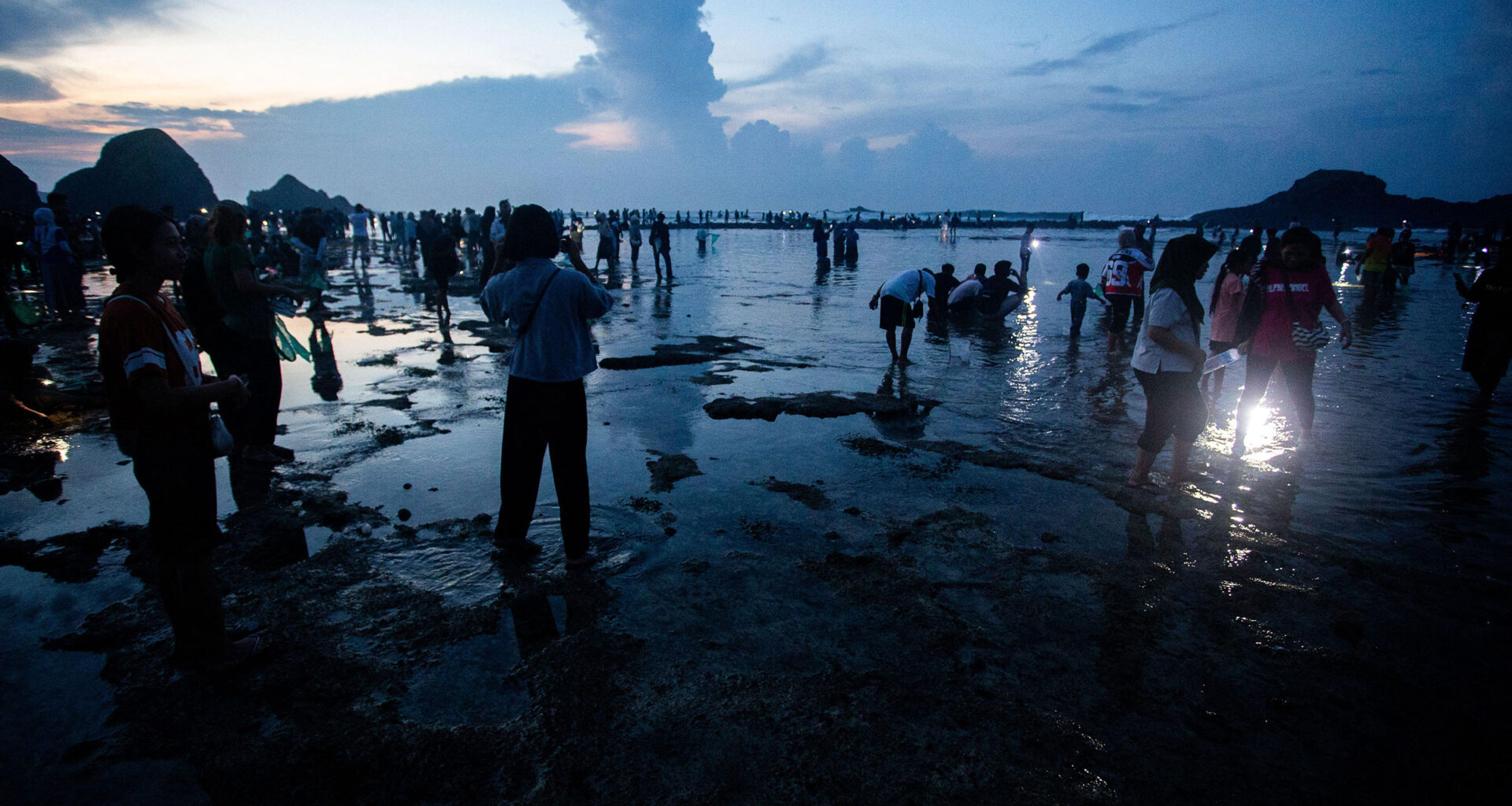
The stakes are high; the guides’ predictions are announced over the radio, drawing thousands of people from up and down the coast on buses, motorcycles, and bikes to Loré for a worm-calling ritual. A designated person lights a torch and scatters burning embers over the reef to attract the animals to the light, then others chant to the worms. Finally, people wade into the water to scoop the animals into specially made baskets. The spiritual guides haven’t told Mondragón what clues they use to anticipate the worms’ arrival, but they’re usually right. “The locals knew exactly when it was going to happen—I mean, almost to the minute,” says Schulze, who attended the Loré festivities in 2018 with Mondragón.
Further east, in Vanuatu, Vusqal’s community likewise watches for environmental signals to gauge the worms’ arrival. When the leaves of the wehr tree—the oak species Casuarina equisetifolia—turn reddish-brown in October, “that’s the sign we are nearly ready to harvest,” explains Vusqal. Seeing a particular seabird circling over Wasaga Village is another clue. After noticing these signs, locals begin a countdown based on the lunar cycle: On the night of the sixth day after the moon first becomes visible in daylight, they know it’s time. “That’s when the palolo worm will swim to us,” says Vusqal.
After families gather and collect the worms—at this point a fishy-tasting mix of epitoke remains, eggs, and sperm—they carry baskets back to the village. They wash their harvest and collect the rinse water, which they use to treat fever, scabies, wounds, and other ailments. Then they wrap the strained palolo in leaves and bake it in underground earth ovens with hot rocks and coal. That way “it can last for weeks,” Vusqal says. Importantly, they give some palolo to other communities of Vanua Lava; in return, they receive meat from wild pigs and other hunted animals. “We use it for trading and also to keep our relationship … between us and them,” Vusqal says.
Just as the palolo forms a key link between communities, it also creates a critical bond between the fertility of the ocean and that of the land: On nearby islands, locals use water from the palolo-rich reef to fertilize crops. Similarly, people in Loré scatter worms onto the soil of cornfields. “It’s really important that you fertilize the soil with it because it renews this marine and terrestrial relationship,” Mondragón says.
Islanders elsewhere attribute different symbolic meanings to sea worms, says anthropologist Cynthia Fowler from Wofford College in South Carolina, who wrote a 2016 book about people’s interactions with sea worms in Sumba, an island in Indonesia. (There hasn’t been a systematic study of the sea worm species harvested there, but they likely include palolo worms.) There, the appearance of the invertebrates—which locals call nyale—represents the return of the sea worm goddess, a beautiful Sumbanese woman who became a deity after throwing herself off a cliff to escape pursuit by suitors. In parts of Papua New Guinea, the palolo harvest is linked to the return of spirits from the underworld, forming a link between the living and the dead. Fowler marvels at how sea worms retained their cultural importance as contemporary Pacific Islanders’ ancestors spread across the Pacific. “Even though the patterns vary, there’s still this heightened symbolic significance,” she says.
The palolo harvest is also critical to keeping time itself going. Not long after the November spawning on the island of Loh in Vanuatu, summer solstice dawns in the southern hemisphere and the sun reaches its lowest position on the horizon. According to Mondragón, locals believe the sun risks getting stuck there and that the palolo harvest is critical to ensuring the sun returns northward. People chant as they flip the animals from worm-catching nets into food baskets. The ritualistic transformation from animal to food is said to turn the sun back in the sky, Mondragón says. “That’s meant to be a really important ritual which will anticipate the intended movement of the sun back to its northern horizon.”
In parts of Vanuatu and Fiji, the rise of the palolo reminds people of the upcoming cyclone season. It’s a sign that people must prepare by building or repairing traditional cyclone houses made out of forest plants and storing up food and drinking water. As climate change intensifies tropical cyclones, Kelso expects that such reminders will become increasingly important.
Some experts worry that young people aren’t learning ecological timekeeping from elders as more move to other regions to find work and become less interested in traditional practices. There are also anecdotal reports in Samoa and Fiji that palolo worms themselves are declining, perhaps because of coastal development or ocean acidification, though Vusqal blames people who aren’t respecting traditional harvesting practices. Still, Mondragón believes that ecological-calendar traditions are largely holding strong in the southwestern Pacific and that resilience to climate change is one of many reasons to protect these ancient calendar systems. “These are forms of traditional knowledge that—it seems to me—are going to continue being relevant,” Mondragón says.
While many Pacific peoples measure time in the weeks, days, and hours leading up to the palolo harvest, they often stop counting the weeks afterward and only observe the lunar cycle, allowing time to relax back into months. As the cyclone season comes and goes and the wet season shifts back into dry, Vusqal’s community will once again wait for the leaves of the wehr tree to brown and the palolo-heralding seabird to return. Meanwhile, inside the coral rubble on the reef bottom, the palolo worm will once again regenerate its epitoke, waiting for the right moment to return to its people.