
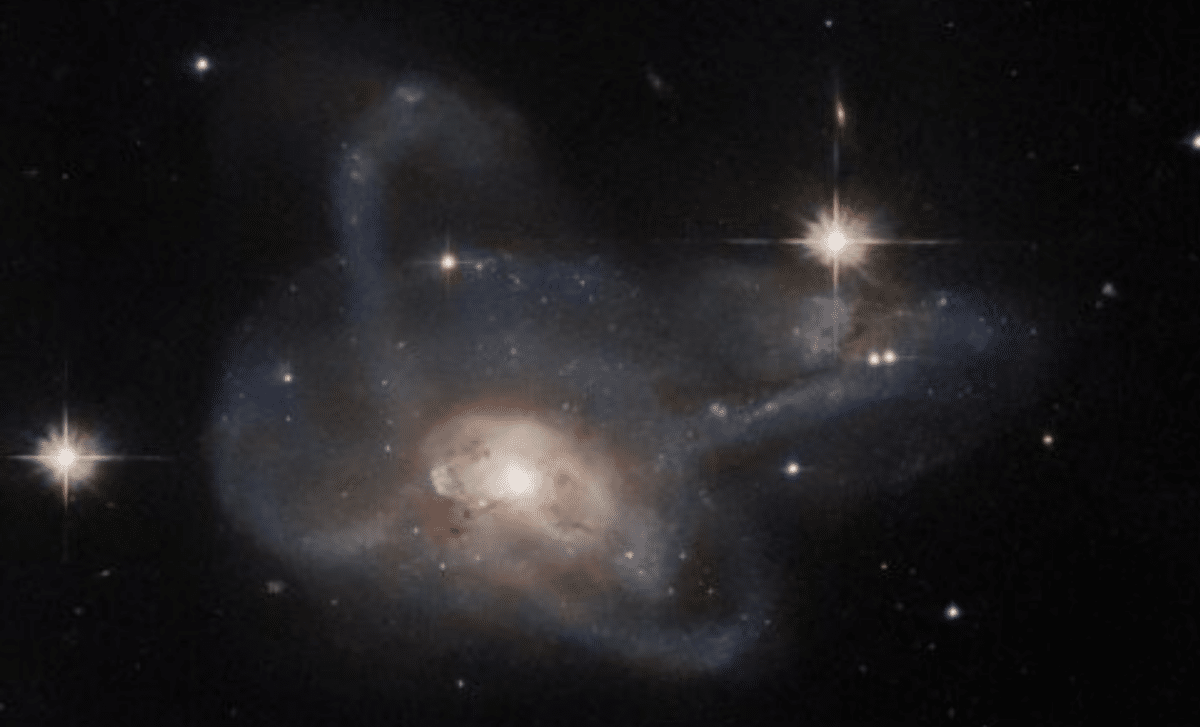
Astronomers have identified clear evidence of a recent merger between two supermassive black holes (SMBHs) in the galaxy NGC 4486B. This rare cosmic event, detailed in a new study published in The Astrophysical Journal Letters, sheds light on the aftermath of such a cataclysmic collision. The discovery, which upends previous assumptions about galaxy evolution, reveals an off-center black hole and unusual stellar motions, offering an unprecedented glimpse into the forces at play during the violent merger of these cosmic giants.
The Curious Case of NGC 4486B
At first glance, NGC 4486B may appear as a quiet galaxy, tucked away in the vast Virgo Cluster. However, beneath its tranquil exterior lies a cosmic mystery that is now being unraveled by cutting-edge research. The supermassive black hole at the galaxy’s center, weighing in at a staggering 360 million times the mass of our Sun, is not where astronomers expect it to be.
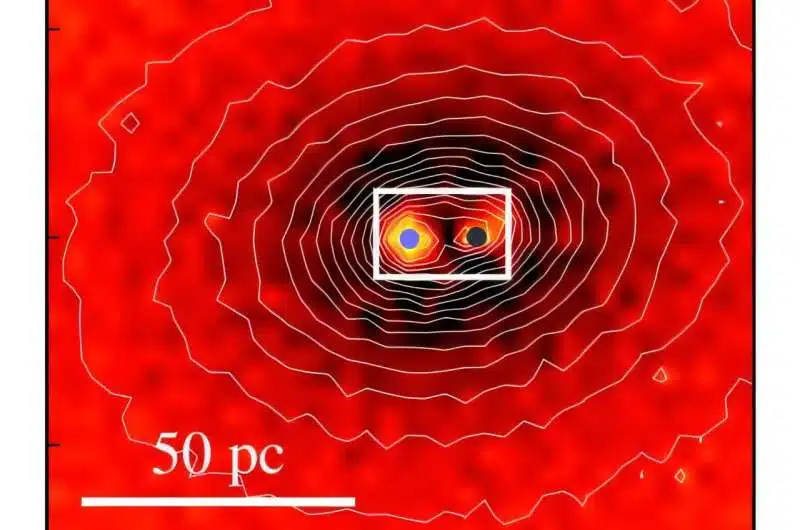 Unsharp-masked WFPC2/F555W image of the double nucleus in NGC 4486B, showing two peaks separated by ∼12 pc. Credit: arXiv (2025). DOI: 10.48550/arxiv.2512.14695
Instead of sitting neatly in the galaxy’s center, it resides about 20 light-years off-center. This abnormal positioning, revealed through detailed observations from NASA’s Webb Space Telescope, suggests that a cosmic collision has left its mark on the galaxy’s structure.
The Aftermath of a Black Hole Merger
The cause of this displacement appears to be the merger of two supermassive black holes, an event that has sent shockwaves through the galaxy’s stellar system. In fact, the galaxy’s strange behavior matches the patterns expected after such a merger, including unusual stellar motion and a curious light pattern in the nucleus of the galaxy.
“NGC 4486B appears to be the first system exhibiting multiple observable signatures of a recent SMBH merger,” said Behzad Tahmasebzadeh, a key researcher involved in the study published in The Astrophysical Journal Letters..
The merger, which took place not long ago in cosmic terms, has left the black hole with a residual kick that continues to disrupt the galaxy’s equilibrium.
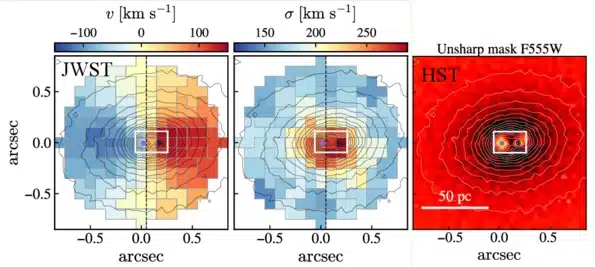 Kinematic maps of NGC 4486B showing the locations of the two peaks of its double nucleus. [Adapted from Tahmasebzadeh et al. 2026]
This “kick” phenomenon, a direct consequence of the uneven gravitational forces during the merger, explains why the black hole remains displaced. As the two black holes spiraled toward each other, they released a burst of energy, which caused the merged black hole to recoil. This powerful push resulted in the black hole being ejected from the center of the galaxy, dragging along part of its stellar disk. The discovery has provided astronomers with a rare opportunity to study the aftermath of such a collision in real-time.
A Look Back at the Evidence
Astronomers used a variety of tools to piece together the puzzle of NGC 4486B’s unusual behavior. The Webb Telescope’s high-resolution imaging revealed two bright peaks in the galaxy’s nucleus, a feature that had been noticed in Hubble images from the 1990s. These peaks, far from being caused by dust or a star cluster, are now understood to be the result of the gravitational influence of the displaced black hole. One of the peaks aligns with the faster-moving stars, further corroborating the theory of a recent merger.
Additionally, the motion of stars within the galaxy revealed an intriguing pattern: stars near the displaced black hole were moving much faster than those on the opposite side, suggesting an ongoing disruption. This phenomenon is known as a “gravitational-wave kick,” and it aligns with theoretical models predicting the behavior of black holes after a merger. Using simulations, the research team estimated that the black hole is moving at a speed of around 210 miles per second, a significant but not extreme velocity for such an event.