
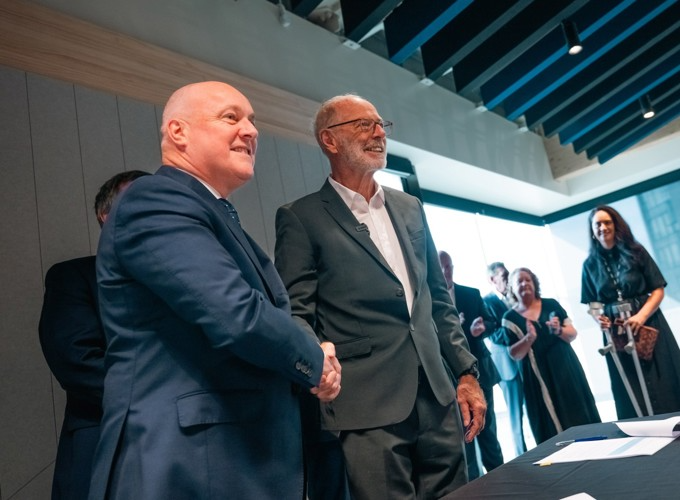
On Friday, the government and the Mayor of Auckland celebrated the signing of a ‘City Deal’ for Auckland, the first such arrangement in the country. But is it really that much of a deal for our city, or just another empty handshake?
 The Government’s media release is headlined ‘Landmark Auckland deal to unlock city’s potential’, and the Mayor strikes a strong tone about this ‘major win’:
The Deal sets out how Government and Auckland Council will work together to unlock our biggest city’s potential, boosting economic growth and improving living standards across New Zealand.
Prime Minister Christopher Luxon says Auckland has huge potential for growth that the whole country can benefit from.
“Auckland is New Zealand’s economic engine room. This Deal is about getting that engine room firing on all cylinders so that we can lift incomes, create more jobs and make Auckland, and therefore New Zealand, more prosperous.”
Auckland Mayor Wayne Brown says it’s another major win for Auckland.
“This is a new way of working that establishes shared accountability, recognising the size and significance of Auckland – we are more like an Australian state than any other local authority in New Zealand,” says Mayor Brown.
“The Deal better reflects Auckland’s contribution to the national economy. It’s clear; when Auckland does well, New Zealand does well.”
And:
The Government already has a range of tools and groups that interact with local government, such as NZTA co-funding for local roads, Urban Growth Partnerships and Crown funding for significant projects.
“So, this Deal isn’t about reinventing the wheel and creating another layer of bureaucracy. It’s about coordinating across Government into one place so that it’s easier to work together and invest together to get stuff done. The new Ministry of Cities, Environment, Regions and Transport will play a key role here.”
Key commitments of the Auckland City Deal include:
Establishing a long-term partnership between Government and Auckland Council, including regular meetings between the Prime Minister, Ministers and the Mayor. There will also be a senior official from both Government and Council who will be accountable for delivering on the Deal.Reviewing Eden Park’s ownership and operating model, recognising Eden Park as the national stadium, and contributing $5 million each toward relocating Auckland Cricket to Colin Maiden Park.Investing in the redevelopment and roofing of the Auckland Tennis Centre to support international events.Developing a strategy for innovation precincts in areas such as the Fisher and Paykel precinct and around University of Auckland’s flagship innovation centre in Newmarket (including MedTech-iQ); and strengthening Auckland’s global trade and investment links.Jointly developing a destination and major events strategy to grow tourism, events, and hospitality in Auckland.Establishing a coordinated 30-year transport strategy for Auckland, with priority projects reflected in the Government Policy Statement on Land Transport 2027 including the North-West Rapid Transit project, Botany to Airport public transport, Mill Road, and CRL level crossings.Working together on the additional Waitematā Harbour crossing project, time-of-use charging, and more efficient transport network management.Introducing a new Crown uplift funding tool for mutually-agreed, high-priority projects. The Crown will consider contributing funding for projects where the Council raises new funding significantly above current Long-Term Plan and BAU funding levels (e.g., from council asset recycling or targeted rates).Working together on Predator Free 2050, Pest-Free Auckland, the Auckland Indigenous Biodiversity Strategy, and restoring the biodiversity of the Hauraki Gulf.
Mr Bishop says [the] Deal highlights four particular growth areas where the Government and Council will work together to drive jobs and growth.
“In Drury, Government and Council will work with private developers on coordinated infrastructure planning to support major housing growth, including new schools and a hospital alongside local infrastructure investment.
“In the Maungawhau–Kingsland–Morningside corridor, Government and Council will collaborate on zoning changes, infrastructure planning and urban development opportunities associated with the CRL.
“In the city centre, a revitalisation plan will open up opportunities for housing and business growth, including further residential upzoning and a potential new primary school.
“At the Airport, Government and Council will work with Auckland Airport on a plan to improve surface access to this major trade, freight and employment hub.”
The Deal contains no funding commitments, and most of the things included in it are either things that should be happening already, or things the government says it will simply consider supporting. A plan to get a plan.
So where’s the value?
Perhaps even more concerning is that – despite the Mayor’s relentless protestations about ‘Wellington’ meddling in local matters – it appears this Deal gives central government even more of a say in how Auckland develops. This is a continuation of what we saw with the Auckland Transport reforms.
The Summary of Commitments contains some good examples of this.
Under a section called ‘Partnership for Growth’, it notes:
To ensure a long-term, integrated partnership between the public and private sector and long-term planning that is robust and stable, the following commitments form the basis of the Deal:
At least three meetings per year between the Prime Minister and the Mayor.Regular meetings between the Mayor and senior Ministers to share views on policy settings for matters that affect Auckland (with each minister determining cadence between monthly to biannually).
So the Prime Minister will only commit to a meeting once every four months with the mayor who represents a third of the population of the country and leads the nation’s “economic engine room”?
And meanwhile, ministers get to individually set the cadence they want (which could go either way)? That hardly sounds like a ‘partnership’.
When it comes to transport, we get the following commitments:
Joint Commitments
Auckland Council and Central Government will use the new legislative transport planning and decision-making mechanisms to jointly determine the nature of the transport priorities for Auckland. This will be achieved via the first iteration of a 30-year transport strategy, that contains a 10-year indicative investment programme.
Both Auckland Council and Central Government agree that the Deal transport priorities are:
Level Crossing removals.To progress the delivery of Auckland’s Rapid Transit Network, including as initial priorities progressing the Northwest Busway and Botany-to-Airport.Smaller-scale initiatives to reduce congestion and make the transport system more efficient (including dynamic lanes).Freight and trade connections to the Airport and Port.NZTA will progress route protection and securing of the designation for the Mill Road corridor Stages 2 and 3.
Central Government will work closely with Auckland Council on other major transport projects in the Auckland region, including:
Waitematā Harbour Connections project.
Central Government will work with Auckland Council to explore Auckland specific settings for key mode and behaviour tools, such as parking charging, Express lanes, dynamic lanes, and priority bus lanes and tolling. Central Government will work with Auckland Council on appropriate Central Government oversight to ensure such charges are not excessive given this may include a right to tax.
Central Government will work with Auckland Council to consider better integration of the operation and delivery of the city’s transport network, including local roads, state highways, Auckland Airport and the rail network. For example, coordinated control and operation of traffic signals between council and NZTA roads. This includes seeking to clarify roles and responsibilities.
Auckland Council Commitments
Lead delivery of targeted interventions that improve network performance quickly and cost-effectively.Auckland Council will partner with the Crown on funding for transport through funding sources including rates, IFFA, targeted rates and developer levies.
Central Government Commitments
In GPS 2027 the Crown will reflect the agreements in the CRD including the priority transport projects (North-West Rapid Transit project, CRL grade separation level crossings, Botany to Airport public transit and Mill Road) unless changed by the jointly agreed 30-year transport plan with the indicative 10-year investment plan or the NLTF prioritisation process. The NZTA Board will be responsible for approving funding from the NLTF.Central Government and Auckland Council will agree to the allocation of net revenue raised from time of use charging to be used for transport projects and activities jointly agreed by Central Government and Auckland Council in line with legislative requirements.Central Government will continue to progress legislation to support greater use of tolling. All new roads, including the Auckland roads of national significance, will be assessed for tolling to support investment in their construction and maintenance. Auckland Council will be consulted on each relevant tolling proposal in line with statutory requirements for public consultation.
There’s nothing in there that is new, which is fine. But what is concerning is there is no guarantee of any funding for any of those projects that are considered a priority. The ‘priorities’ will be included in the next Government Policy Statement – but with funding decisions left up to the NZTA.
In other words, this is exactly what we’ve had before with the Auckland Transport Alignment Project (ATAP). You may recall that through the various iterations of ATAP, projects became priorities, funding commitments were made by the government of the day, and those commitments were included in the GPS of the time – but were then never delivered on by the NZTA.
It’s hard to see how this will be any different, especially given how vague these priorities are.
Perhaps some of the most interesting parts of the deal are those that relate to Eden Park and the City Centre. Both are part of what is labelled a ‘Place Based Partnership’.
Eden Park
The Eden Park aspect sits within the Maungawhau-Kingsland-Mornside CRL Growth Corridor. It includes this commitment:
Auckland Council and Central Government will develop a coordinated urban development programme for the Maungawhau–Kingsland–Morningside CRL Growth Corridor, enabling a shared vision for the area. This will include considering sequencing of level crossing removal.
As part of the agreement on housing changes, the government has required the Council to provide even more housing in this general area. But I think this is the first time I think it’s been made clear that the government will get to be involved in coming up with an urban development programme for the area.
For Eden Park, the commitments include looking to change how the stadium is governed and developing the No. 2 ground.
Looking to develop the No. 2 ground is included in the agreement
City Centre
There have been suggestions for a while of a ‘refresh’ of the City Centre Masterplan. We were already concerned – based on comments from the mayor – that this would see a bigger focus on making it easier to drive to and through the city. Now, it seems central government will get a greater say in how our city centre develops:
Auckland Council will work with Central Government to prepare a revised city centre action plan that provides a single consolidated plan for investment in the city centre, including specific initiatives for further investment and clear points of collaboration between Central Government and Auckland Council.
On the positive side, perhaps the city centre will finally get a school, something definitely needed to support the growing city population. And reading between the lines, perhaps a new central library too.
Central Government (Ministry of Education) will work with Auckland Council on the potential feasibility of a primary school in the City Centre. This will:
Include Auckland Council investigating potential suitable buildings (including building that it owns, such as the central library).Outline what property or other support Auckland Council may be able to contribute.
This work will occur following an updated analysis of need and an assessment of whether the need indicates a requirement for a new primary school and/or for further investment in the current school network. This assessment will include the city centre, city fringe and the CRL stations of Maungawhau and Kingsland.
In short, less of a deal, more of a disappointment. Economist Shamubeel Eaqub expresses pretty similar thoughts in a fairly scathing LinkedIn post with a very eloquent image attached [emphasis added, image below]:
The Auckland Deal is centralisation dressed up as devolution. Auckland is the only region that contributes more tax than it receives in central government spending. A fiscal and economic powerhouse. And yet the Deal treats local governance as if it barely matters.
Devolution must be built on a shared purpose: better outcomes through reach, responsiveness, performance. Three levers to devolve: political, fiscal, administrative. Extent ranges from shared jurisdiction to paternalistic control.
The Auckland Deal agrees to projects that would have happened anyway, forces meetings that should have happened anyway, and makes it easier for central government to practice new policies on Auckland before rolling them out nationally.
…..
Devolving responsibility without power or funding is a recipe for failure. When delivery falls short, the losers will push back, and the Council will carry the blame. Wellington washes its hands. A familiar and irresponsible approach that has led us to this local democracy cul-de-sac.
This Deal sets a precedent: a poor model of devolution for the strongest council. Every other council will be offered the same template with less leverage.
Spot the ‘economic engine room’ of the nation. What would a fair City Deal actually look like? Image via Shamubeel Eaqub/ LinkedIn.
What’s your take on this City Deal? The deal of the century, vapid disappointment, or something in between?
Today’s header image is from Auckland Council’s article about the City Deal in Our Auckland.
Greater Auckland’s work is made possible by generous donations from our readers and fans. We’re now a registered charity, so your donations are tax-deductible. If you’d like to support our work you can join our circle of supporters here.
Share this