
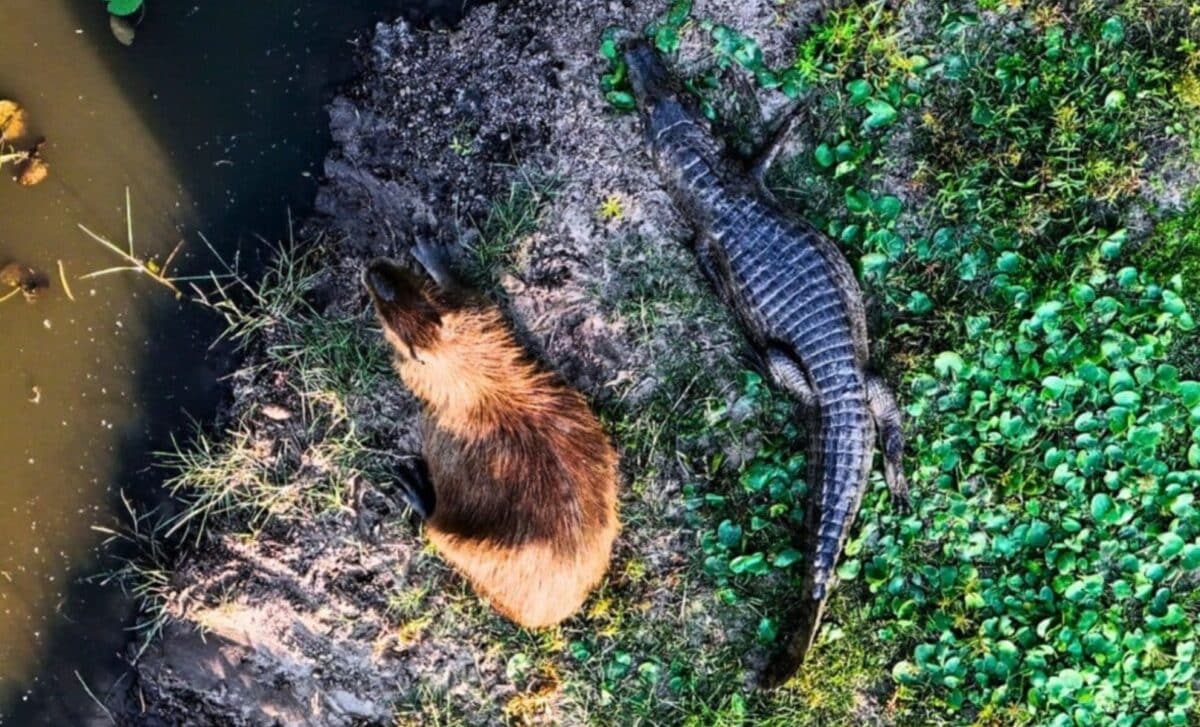
Capybaras, the world’s largest rodents, share South American waterways with caimans without regularly becoming prey. Researcher observations confirm adult capybaras are rarely targeted by the crocodilians despite overlapping habitat and close proximity. The two species have been documented sleeping beside one another in the wild.
The primary deterrent is the capybara’s physical capability to injure a predator. Dr. Elizabeth Congdon, a capybara researcher and associate professor at Bethune-Cookman University, told IFLScience that attacks by caimans are uncommon when other food sources exist. “Capybaras have big, sharp teeth. Combined with their body size, I think they are just not worth the trouble and risk of injury,” Congdon said. A single bite from a capybara could leave a caiman with wounds that impair future hunting ability.
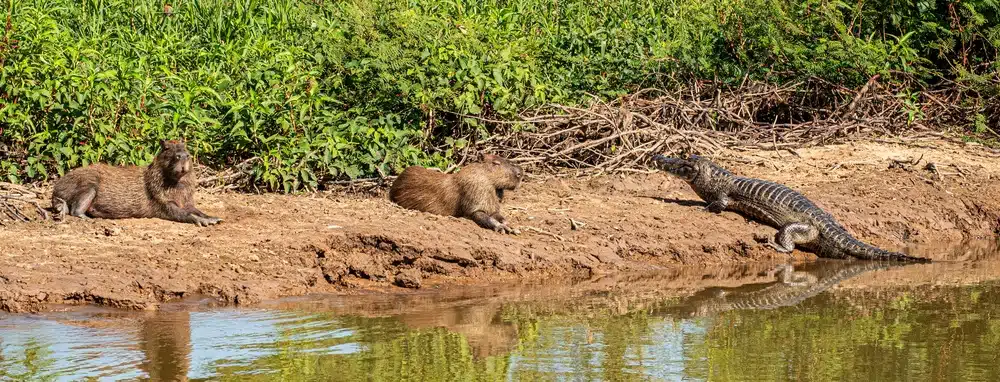 Capybara laying down on a riverbank with a Caiman approaching in the Pantanal, Brazil web banner header. Image credit: Shutterstock
Adult capybaras reach weights exceeding 45 kilograms and possess strong incisors capable of inflicting significant damage. The species, Hydrochoerus hydrochaeris, grows up to 1.3 meters in length and can weigh up to 79 kilograms. The lesser capybara, H. isthmius, reaches about one meter in length and weighs roughly 28 kilograms. Both forms inhabit forests and wetlands from Panama to Argentina, with the larger species ranging from Venezuela to northern Argentina and throughout the Amazon River basin.
Physical Adaptations Strengthen Defense
Capybaras (Hydrochoerus hydrochaeris) possess several traits that improve survival in predator-rich environments. Their webbed feet and sensory organs positioned high on the head allow them to remain mostly submerged while scanning surroundings. The animals can stay underwater for up to five minutes, which aids escape from aquatic threats. They are short-haired brownish rodents with blunt snouts, short legs, small ears, and almost no tail.
The rodents are semiaquatic and prefer habitats near lakes, rivers, and swamps. They swim and dive readily and commonly enter water to elude predators such as jaguars and anacondas. Their daily rhythm involves feeding in the morning and evening while spending most of the day resting under cover along riverbanks. This predictable pattern places them directly in caiman territory throughout their range.
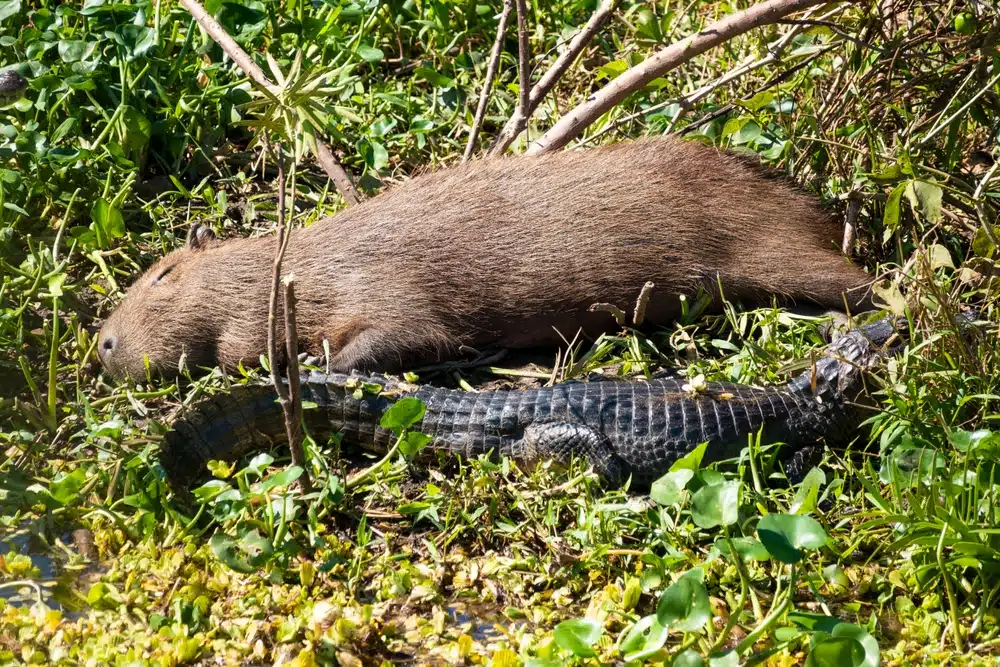 Capybara laying down sleeping with a Caiman in Brazilian wetlands, Pantanal, Brazil. Image credit: Shutterstock
Dr. Congdon emphasized the rarity of predation events involving adults. “It is rare, especially when there are plenty of fish and easier prey to handle than a capybara. I have seen them in the wild sleeping next to each other,” she told IFLScience. Caimans appear to calculate that the energy expenditure and injury risk outweigh the nutritional reward.
The exception involves juvenile capybaras. “The exception is the babies. Babies are snacks for lots of things, even birds of prey,” Congdon said. Young capybaras face threats from ocelots, anacondas, harpy eagles, and caimans. The mortality rate among juveniles remains considerably higher than among adults who have reached full size.
Social Behavior Adds Protection
Capybaras rely on group dynamics to reduce vulnerability. They form herds that can include more than a dozen individuals. Members take turns standing guard while others feed or rest, which lowers the chance of surprise attacks. They associate in groups along the banks of lakes and rivers.
The species uses a range of vocalizations including chirps, whistles, and purrs to maintain contact and warn of danger. Barros and colleagues documented the vocal repertoire of captive capybaras, identifying distinct calls tied to specific contexts and functions. Scent marking helps define group territories and maintain cohesion. Macdonald and others examined the anatomical and chemical aspects of scent marking among capybaras in a 1984 study.
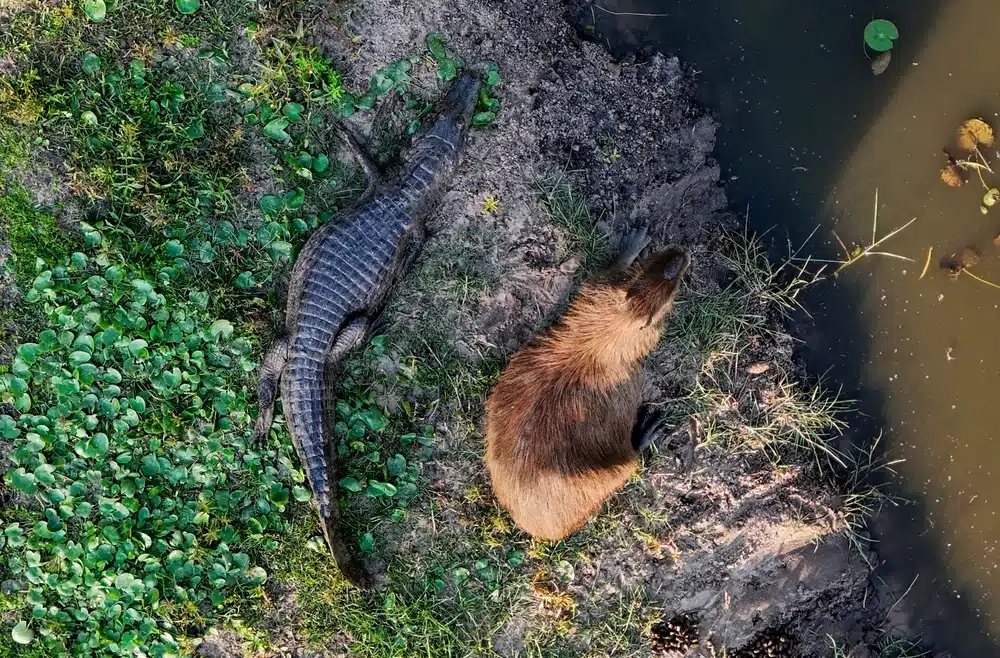 Caiman and Capybara from drone view at Esteros del Ibera, Corrientes, Argentina. Image credit: Shutterstock
Congdon’s published research includes a study on female mate choice and group dynamics in the Journal of Mammalogy, available through Academia.edu. The work examined how capybara social systems influence group stability, reproduction, and dispersal patterns. Herrera and Macdonald previously documented that dominant males achieve greater mating success, establishing the male-dominated framework within which female choice operates.
Human Encroachment Creates New Conflict
While capybaras coexist with natural predators, their interactions with humans have produced different outcomes. In 2021, residents of Nordelta, an upscale development near Buenos Aires, reported increased capybara sightings. Gardens sustained damage, pets faced confrontations, and fences proved ineffective barriers. The animals moved through neighborhoods without apparent fear of human presence.
The Nordelta community was constructed over natural wetlands that previously supported capybara populations. As development expanded and fragmented habitat, capybaras began moving back into altered landscapes. Conservationists identified urban sprawl and habitat loss as primary causes of the conflict. The animals sometimes become pests in cultivated areas by eating melons, grain, and squash.
 Capybara and jacare caiman on shoreline, Pantanal, Brazil. Image credit: Shutterstock
Capybaras are legally protected in several South American countries yet also hunted and farmed commercially. The animals are edible and used for food in various parts of South America. The smaller species is often hunted, whereas the larger species is typically ranched for meat and hides, which are made into leather goods. Both are classified as species of least concern by the International Union for Conservation of Nature and Natural Resources.
Diet and Digestive Efficiency
Capybaras are vegetarian and feed primarily on grasses and aquatic plants. They spend most of the day resting under cover along riverbanks. Their diet consists of available vegetation, which in cultivated areas includes melons, grain, and squash crops.
Research published by Congdon in Zoo Biology examined digestive physiology in captive capybaras. The study documented how the animals efficiently extract nutrients from fibrous plant material. This digestive efficiency enables survival on low-quality vegetation, providing an advantage in environments where resources are limited.
The female capybara bears a single litter of three to eight young each year. Gestation takes approximately 100 to 110 days. The reproductive rate supports population stability despite predation pressure on juveniles.
Caiman Species Distinction Matters
The crocodilians sharing habitat with capybaras are specifically caimans, including the yacare caiman. Caimans differ from true crocodiles in size and behavior. The observed coexistence involves caimans rather than larger crocodile species.
Caimans generally prefer fish and smaller prey when available. The risk assessment that deters them from attacking adult capybaras reflects a calculated hunting strategy. Injury from a 45-kilogram rodent with sharp incisors could impair a caiman’s ability to hunt in the future. Herrera and Macdonald’s 1993 study on aggression, dominance, and mating success among capybara males documented the competitive dynamics that shape group structure.
Dr. Congdon acknowledged that caimans may hunt capybaras when circumstances demand it. “This isn’t to suggest that capybara are never on the menu for caimans when times are tough,” she said, but the occurrence remains uncommon.