
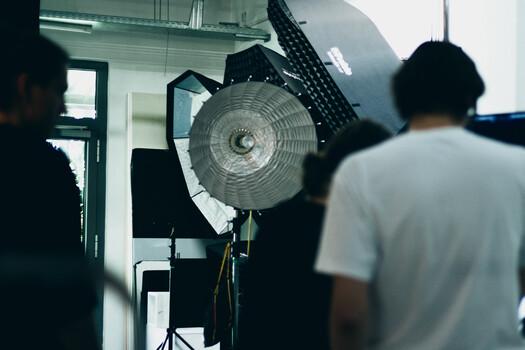
If you could only have two lights for the rest of your career, what would they be? Having used everything from the sun to niche ’80s modifiers that predate dinosaurs, I can swear by two light modifiers: the Briese Focus.2 77 and 180.
Shooting in fast-moving environments, I have learned to work very quickly with light. I do not have a single setup memorized, yet I am able to come up with a lighting setup 16 times a day. Such flexibility and speed can only be achieved with lighting that is able to keep up with the pace. I am not talking about easy-to-build softboxes, or the almighty hard reflector. I am talking about lights that can change their character by simply adjusting the focus. A large light able to go from spot to flood is irreplaceable on set.
It might not be the fastest thing to set up, but it delivers an outstanding light quality that is quite hard to replicate. Of course, I am talking about Briese lighting, and the two lights that I have on set the most are the Briese Focus.2 77 and Briese Focus.2 180. Combined, they are probably the most versatile lighting duo out there. The small 77 is perfect for lighting faces, and the 180 serves as a fill, key, and everything in between.
Speed vs. Quality of Light
Briese has a multi-step setup process. As much as I love the reflector, you do have to know how to set it up, especially for the first time. It is more complex than a softbox, but after doing it a few times, I can do it in my sleep. The setup is intuitive and logical. Some might say that the setup is overengineered, but I am a huge fan of that. I would rather have something overengineered that will not break in the near future. For example, I could not help but notice the decrease of quality in light modifiers from many manufacturers. Softbox fabrics are thinner and less reflective. The metal in hard reflectors is only getting thinner and easier to bend, and so on. While taking longer to set up, a Briese is much faster to operate during shoots, as you can create different light just by changing the focus. There are countless shoots that I have done with just a Briese Focus.2 77 or a 180. Below is an editorial shot on a single 180, for example.
Why the 77 and 180?
They are the older-generation Briese reflectors, first created in the ’90s. The new 115, 130, and the newest Briese Beauty reflectors are even more versatile, but they deserve a review of their own. The reason I stick by the Briese Focus.2 77 and 180 is simply because they are available to rent just about anywhere. If a rental house does not stock the reflector you need, it is more than possible to have one shipped directly from Briese to you.
The 77
The Briese Focus.2 77 is a small Briese — it is a reflector that I own as well. It delivers a beautiful portrait light and is portable enough to travel with. It is easy to use on location, as it is quite small. I use the Briese Focus.2 77 in many capacities, ranging from full body to close-up portraits. When focused, this light delivers a hard-ish result that has deep shadows and even highlights. Add a diffuser, and you can even this out somewhat. It is perfect for those times when you need to create a dramatic image, as there is only a 1.3-stop difference between the center and 3 m away. It makes for a focused light, but not so dramatic as to be an editing problem. When you defocus the reflector, it brings out its softer characteristics and creates an even illumination. As such, I am able to light a full-body image fairly evenly just by changing the distance slightly. A few things remain the same, though: overall quality of light, details, and reflections. Because I am simply changing the softness of the light, I am able to retain the specularity of it regardless of which position I choose. The Briese Focus.2 77 has been great for shooting jewelry and just about anything shiny. While changing the light on the face, I retained the details in the clothing and accessories. This makes for an image with a lot of volume and dimension, which is far better than having a flat result.
The 180
The Briese Focus.2 180 is like a large Briese Focus.2 77, but at the same time also really different. It can be a fill light, as it is just about the softest specular light out there, and a great key, as it is incredibly directional when focused. It is a jack of all trades. When I am not able to bring my Briese Focus.2 77 with me, I will rent a Briese Focus.2 180 and do the whole shoot on it alone (and some fill sometimes). I rarely use it fully focused, as it is just a bit too contrasty for my taste. However, I often work between positions 2 and 8. When fully focused, the Briese Focus.2 180 creates a 5-stop difference over a 3 m range, meaning that the light is really powerful in the middle and almost black on the sides. At medium, it gives a 3.5-stop difference, meaning that you retain background detail while highlighting your subject. When in flood, there is even illumination, making it a great soft light with the signature crisp Briese quality it is known for.
The 77 and 180 Together
It is a luxury to have a Briese on set to begin with. Having two Briese reflectors is beyond luxury. Shooting in Briese studios is, by that logic, a paradise. On my most recent editorial shoot, I once again used the Briese Focus.2 77 and 180 together. I was able to change the light quality from one to the other in a snap, which let the team work faster than ever, and my assistant had a lot less work moving light stands and so on. All this on a single Profoto Pro-8a generator.
Together, the Briese Focus.2 77 and 180 are able to create just about any lighting scenario you want for fashion photography. I tended to use the Briese Focus.2 77 as the key and fill with the Briese Focus.2 180. As the set was quite large, I did set up a few heads and hard reflectors to brighten up the scene, but those were hardly used.
For example, in this image, the model wears a look from YSL’s AW 25 collection. The look has a lot of subtle textures and quite a lot of variation. The coat is dark blue, the belt is black, while the skirt is beige. Add to that the need to create a dramatic image, and the only solution quickly becomes a Briese Focus.2 77 and 180 combo. I used the Briese Focus.2 77 to illuminate the head and top of the outfit, while the Briese Focus.2 180 was left to fill in the details and make sure that all textures are visible, all while keeping a dramatic mood.
You might say that this result is possible with a few softboxes and V-flats. You would be absolutely right. This is possible without a Briese and with a lot of light sources. The only question is how long that will take to get right, and whether the model will have the freedom to move as much. Professional sets have huge teams, and the last thing a bunch of people want to do is wait for the light to be ready. Light is crucial for photographers, yet clients rarely understand the importance of it and just want it done fast. Having two light sources only means that you keep things simple and mobile. Moreover, the way Briese light falls off allows the model to move much more freely, which lets you have more variety in the images.
Power Usage
A very important factor that every photographer must consider is the power efficiency of their modifiers. I am not talking about using too much electricity or being eco-friendly on set. I am talking about speed and flash usage. The lower your power, the faster your flash recycles, the more shots you can take. The lower your power, the longer your capacitors and flash tubes will last. Everything has a lifespan.
Softboxes are some of the most inefficient light modifiers out there. For example, I am often pushing 1,200 W through my softbox, if not more. At the same time, I can get a better and higher-quality result at a lower power by using a Briese. I never have had to go beyond 250 to 300 W on a Briese. Only in huge studios do I have to push to 1,000 W, and at that point, I am lighting a huge scene.
Although I have incredibly fast Profoto packs in my studio, I prefer to use them at lower powers, as it prolongs the lifetime of the capacitors, flash tubes, and so on.
If you want to sharpen your understanding of how different light modifiers affect quality, fall-off, and mood, Fundamentals of Lighting is a great resource to explore alongside hands-on testing.
Quality Over Profit
Last but not least, I swear by the Briese Focus.2 77 and 180 for a very different reason: the decreasing quality of products all over the world. Brands sacrifice quality for even more profit.
Briese takes a different approach and is probably one of the few companies that still keeps a quality-over-profit philosophy. Arri, Avenger, Matthews, and Dedolight are some other brands that I love and swear by. They all have one thing in common: they are household names in the movie industry. A Briese is something you could pass down generations (assuming you replace the flash tube). It is like a 1980s Ford F-250 that you got from your grandfather. Funny enough, the Profoto Pro-5 from 1980 is also a product like that. I have a Pro-5 in my studio, which still works (unlike three broken Pro-7a units and one broken Pro-8a). But I digress — we are, after all, living in the times of planned obsolescence, and my iPhone 17 is proof of that.
Closing Thoughts
Owning a Briese is a bit like owning a Rolls-Royce, although it does not need to be like that. For example, where I am currently based (Germany), there are a few used ones going for EUR 2,000, which is 50 percent cheaper than a new similar-sized offering from Profoto. I have put my money where my mouth is and rent Briese all the time. It is not the cheapest rental out there, but at an average cost of USD 150 per day, it is quite manageable. Most productions do have that money to spend on rentals.