
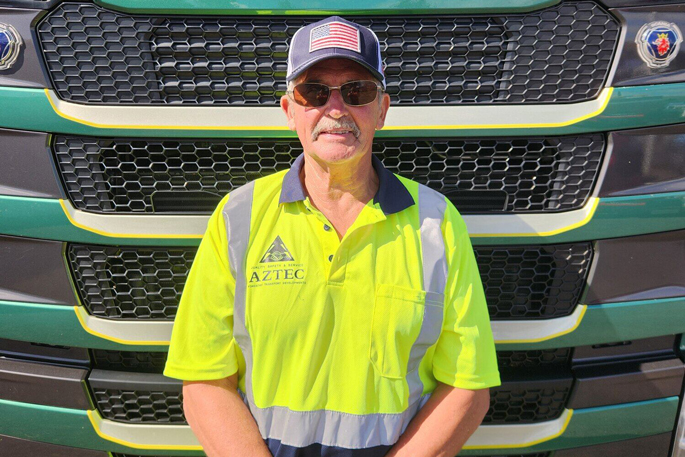
At 15 years old, while seeking a diesel mechanic apprenticeship in Petone, Wellington, Peter Phillips scored 100% on the aptitude test from the New Zealand Motor Corporation.
He was the first person to achieve a perfect score, demonstrating a keen mind for problem‑solving and an ability to see the bigger picture.
He was offered his diesel apprenticeship, and a long career full of innovations and improvements followed.
His “day job” as a contract cartage operator and later a logging driver for Kinleith, NZFP, and then Carter Holt Harvey, continued from 1970 to 1997.
For the past 28 years, he has been the director of his own company, Aztec Forestry Transport Developments, which has about 90 contract logging truck drivers.
One of Peter’s more recent innovations won the Implementation of Innovative Technologies or Mechanical Solutions Award at the 2025 Central North Island Wood Council Forestry Awards.
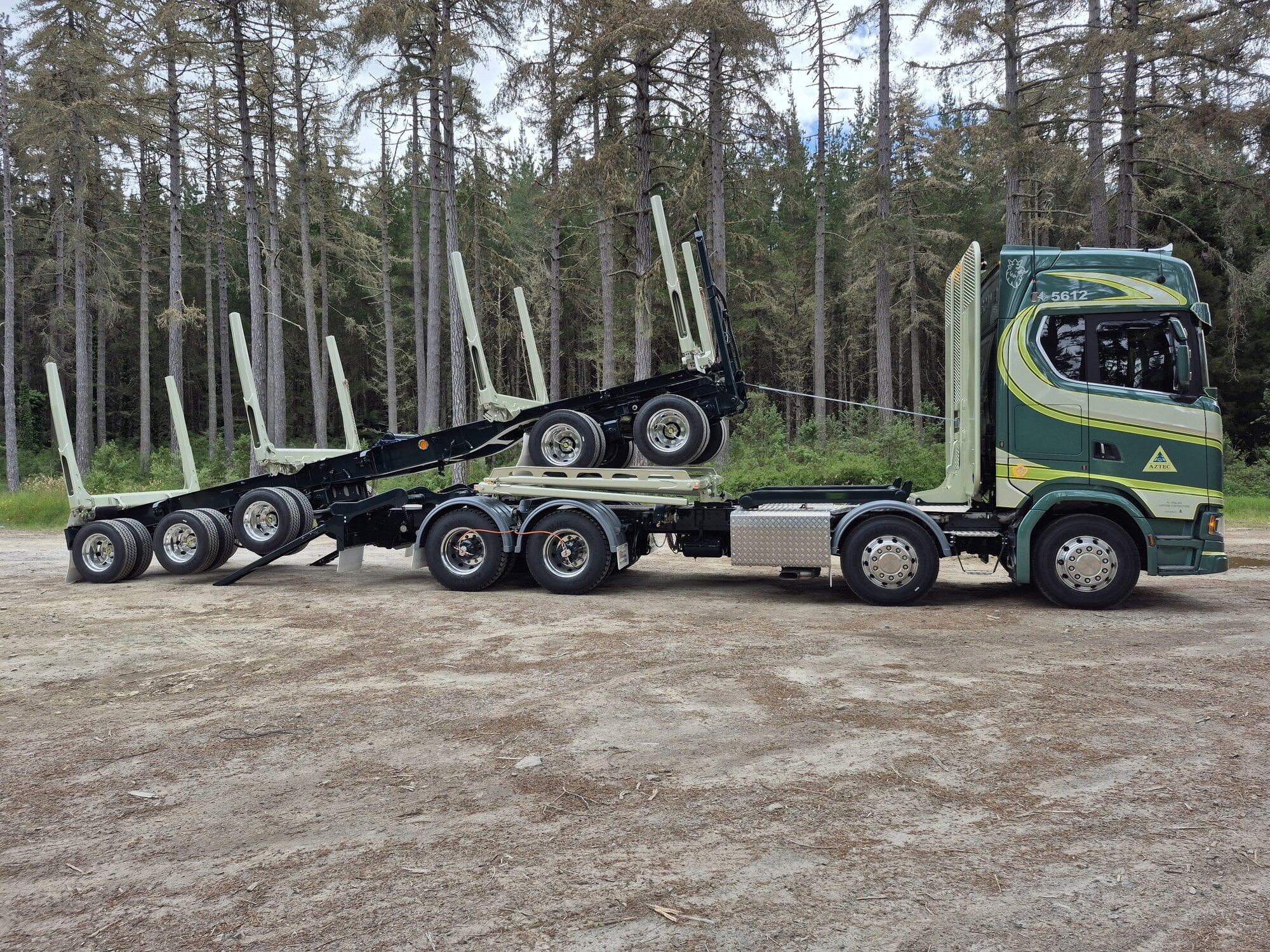
The Safe-T-Loader, a solution that eliminates third party trailer lifting. Photo / Supplied
Development
“In mid‑2024, Peter was attending a Key Supplier Distribution meeting with Manulife Forest Management when the National Health and Safety Manager, Glen Coleman, challenged the group to come up with a solution that would eliminate third‑party trailer lifting-i.e., the use of loaders, excavators, and gantries to lift logging trailers on to logging trucks,” says Aztec Forestry Transport Developments Health and Safety Manager, Paul Squire.
The challenge followed a series of third‑party lifting incidents in which trailers had been dropped. At the time, there were no alternatives for lifting on‑highway logging trailers other than Australian‑designed and manufactured systems, leaving the log transport industry reliant on a high‑risk method that had previously failed.
For Peter, the challenge immediately sparked his engineering instincts, leading him to develop an idea to winch logging trailers on to logging trucks.
“Along with Patchell Engineering from Rotorua, I worked on the project and we both invested substantially in it,” Peter says.
Peter acknowledges Manulife Forest Management’s strong support of the Safe‑T‑Loader project from design through to implementation — particularly their “hugely beneficial bowtie risk assessment sessions.”
“The unit is capable of functioning as a standard nine‑axle unit in the forest and can be disconnected from the truck and placed on a skid to allow rear loading,” Peter says.
Peter has incorporated many innovations and safety features into the design, including environmental considerations; the use of Dynamica nylon rope; a “brake‑away system”; wireless remote control; a winch rope quick‑release system; rotating safety lights independent of the truck’s main power source; and the creation of a standard operating procedure for the trailer‑loading process.
Innovations
In the 1970s, Peter worked in Rotorua repowering trucks by installing modern Detroit Diesel engines – his first major experience with the forestry industry.
“Companies were seeking greater horsepower as load sizes increased. Detroit Diesel engines could be fitted into trucks such as Kenworth, Mack, International, and Fuso.
2025 Central North Island Wood Council Forestry Awards, Implementation of Innovative Technologies or Mechanical Solutions Award winner Peter Phillips, left, and Brandt Construction and Forestry Director of Sales, Phil McKenzie. Photo/ Supplied
“It’s very technical, as you have to design new engine mounts, transmission mounts, exhaust systems, cooling systems, and air‑intake systems to accommodate the Detroit engines, then manufacture and fit the parts.”
As part of the repower process, Peter created a horizontal thermostat housing to replace the traditional vertical design. This innovation was sent to Detroit Diesel in the United States, where it was used as a pattern for future rebuilds.
1990s onward
Peter entered the 1990s with two Foden S108 eight‑wheelers that he had purchased new and continued contracting for NZFP.
During this time, he and Ian Patchell of Patchell Engineering in Rotorua developed the use of Koni shock absorbers in logging trailer suspensions — the first in the country to do so. These shocks improved roll stability by lowering the static roll threshold.
“We always had trouble with Foden radiators failing, so I diagnosed the problem and designed a new, lower radiator cross‑member and changed the top radiator control mount from a rigid dog‑bone system to a metalastic rubber‑bush system.”
Not only was this approved by the New Zealand Foden dealer, but engineers also travelled from the United Kingdom to inspect it. Today, all new trucks include Peter Phillips’ radiator cross‑member design.
The Multi‑Multi unit
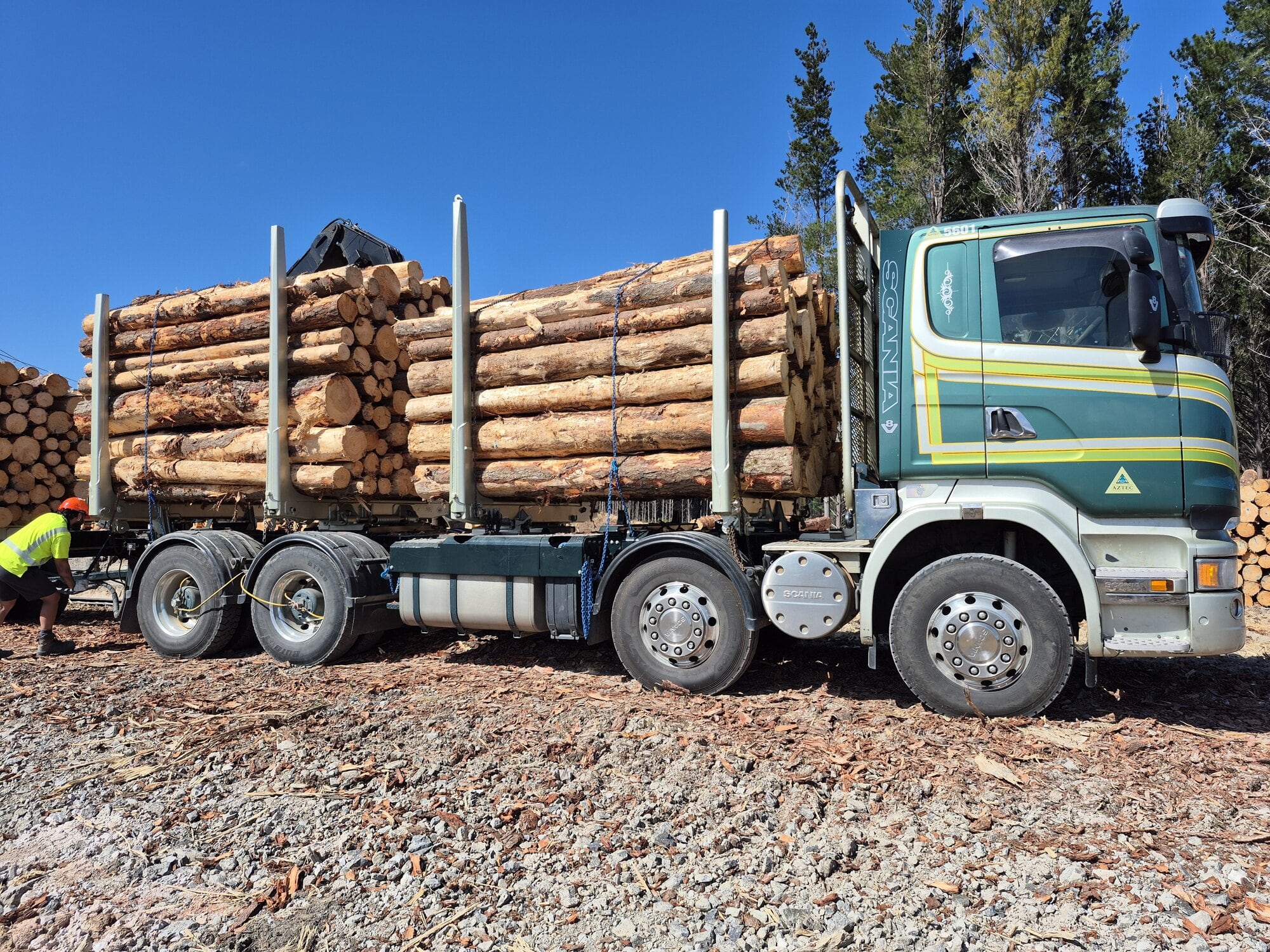
The recent development of the Multi‑Multi truck came after a client requested that all logs be delivered in 3.1‑metre lengths, eliminating the need for chainsaw work onsite.
Peter worked with one of Aztec’s owner‑drivers to modify his truck so it could carry two packets of 3.1‑metre logs on both the truck and the trailer.
This required two additional sets of bolsters on the truck that could slide to accommodate various log lengths. After re‑engineering the truck deck, completing certification, and conducting testing, the unit is now fully operational.
Peter has made a significant contribution to innovation through his passion, commitment to the forestry industry, and outstanding problem‑solving ability.