
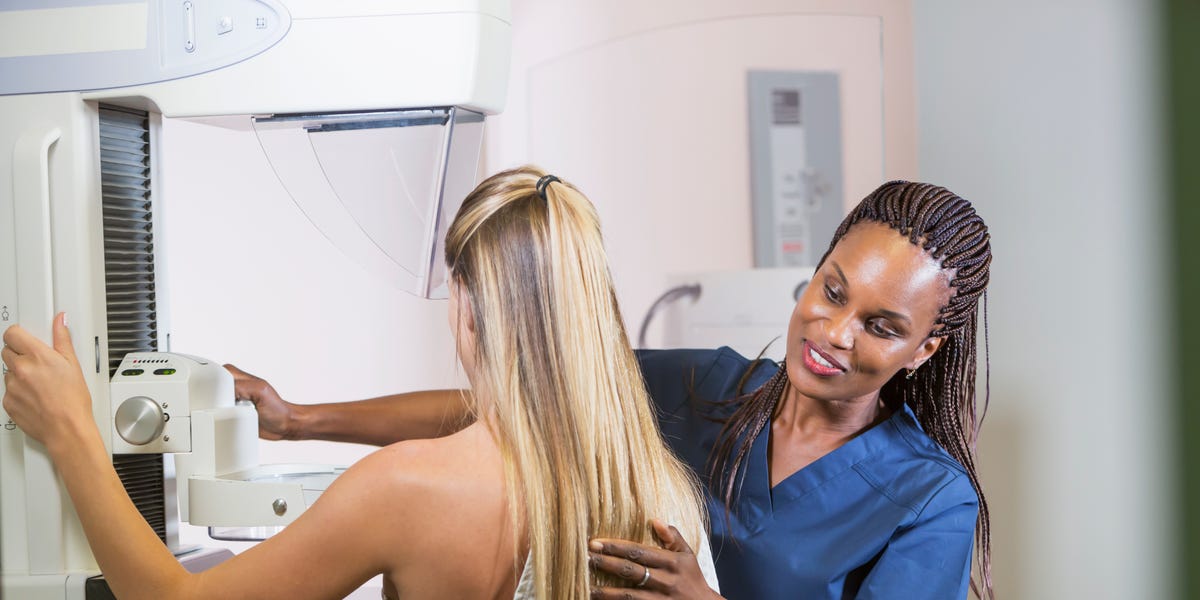
When my mom was diagnosed with breast cancer early last year, our entire family was gobsmacked. She had zero family history of breast cancer, and no genetic mutations that we knew of. We didn’t know to be worried about this, because we never thought she would get it.
According to the American Cancer Society, the average woman has a 1 in 8 chance of getting breast cancer at some point in her lifetime. And 85 percent of women who get breast cancer have no family history of the disease, just like my mom. (Who has been cancer-free for a year now!) Clearly, there’s something else that affects breast cancer risk, and existing tools and guidelines just aren’t catching it.
But that may soon change. Today, the National Comprehensive Cancer Network (NCCN), a not-for-profit alliance of 33 cancer treatment centers in the U.S., announced a major new update to its breast cancer guidelines. The organization, whose recommendations influence national guidelines and treatment protocol, now says women should be eligible for what it calls “AI-powered mammogram risk assessments” starting at age 35. The goal: to more accurately predict patients’ unique risk of breast cancer, and adjust their screening protocols accordingly.
“Traditional screening asks a simple question: ‘Do you have breast cancer right now?’” says Dorraya El-Ashry, PhD, the chief scientific officer of the Breast Cancer Research Foundation (BCRF). “The new AI-based approach asks something far more powerful: ‘What is your risk of breast cancer in the next five years?’”
Connie Lehman, MD, PhD, a professor of radiology at Harvard Medical School, helped develop one of the artificial intelligence (AI) tools that would be used. She’s the CEO of Clairity, Inc., the first FDA-approved AI platform that can predict a woman’s five-year risk of breast cancer based solely on her mammogram. (Clairity has received funding from the BCRF.) The new NCCN guidelines add further legitimacy to the work she’s been doing to find a more accurate way to predict women’s breast cancer risk. “I pinch myself that all this work and all the science and all this research is actually coming into clinical practice,” says Dr. Lehman, who has been working on the technology since 2016.
But what do the new guidelines mean for you right now, and how does this tech work? We asked Drs. Lehman and El-Ashry for the details.
What’s Behind These New Guidelines?
For the average risk woman, current national guidelines recommend getting regular mammograms starting at age 40. The problem is, many “average risk” women are potentially high risk, even if they don’t meet the established criteria. “Historically, these were women with a very strong family history of breast cancer on either the mother or father’s side, and women who had a genetic mutation like BRCA,” says Dr. Lehman. Having those particular women get advanced screening at a younger age has detected cancer earlier and saved lives, she says. But again, the vast majority of women who get breast cancer don’t have any family history or inherited genetic mutation, she says.
Another limitation is that other clinical risk assessments, such as how many pregnancies a person has had, whether she breastfed, and whether she’s in menopause, were developed using data from white European women, says Dr. Lehman. Even breast density, a subjective measure of how much fatty tissue is in the breast, is an imperfect measure of breast cancer risk.
The changing age of breast cancer patients also played a role in this guideline update. “With breast cancer incidence rising at double the rate for women under 50 as compared to women over 50, identifying women at high risk earlier has never been more imperative,” says Dr. El-Ashry.
How Do AI-Powered Mammograms Work?
Under the new NCCN guidelines, a patient may get a mammogram when they’re 35 to establish a baseline risk assessment. That mammogram would get run through an AI image-based breast cancer risk model. The model now available is Clairity Breast, which was developed using hundreds of thousands of mammograms from women of many ages and races around the world. Clairity Breast analyzes the breast tissue shown in a patient’s mammogram and calculates that person’s five-year risk of breast cancer as a percentage, says Dr. Lehman.
Depending on the risk score, you will get more personalized screening recommendations. Per the NCCN guidelines, a person with average risk (under 1.7 percent) will likely stick with the existing standard screening recommendations. But someone with a higher score might consider yearly mammograms along with an annual breast MRI, Dr. Lehman says—even if they don’t meet the other traditional risk criteria like age or family history.
To be clear, this technology does not diagnose. “We’re not telling patients they have cancer. We’re saying, ‘You’re in a different category of women, and we want you to be screened earlier and more frequently,’” says Dr. Lehman. Yes, women are often told they need additional or more frequent screenings. But those decisions are based on the above-mentioned criteria (like age, family history and breast density), which have limitations and flaws. Here, the decision is based on your unique risk, which is determined by looking at data extracted and analyzed from your mammogram by an incredibly smart, sophisticated algorithm. The upshot is that more women might find that they could benefit from additional screenings.
It’s proving effective, too: Studies show that AI mammography tools are as accurate (and sometimes even more accurate) than traditional risk assessment tools. Clairity’s AI model is also more precise at predicting risk than just breast density, according to a study Dr. Lehman presented at the annual meeting of the Radiological Society of North America last year. (It has yet to be published in a peer-reviewed journal.)
Can I Get One of These Mammograms Now?
Not yet. Clairity is the first (and currently, only) FDA-approved tool available to patients right now, and only in Massachusetts. Dr. Lehman says the company is working to expand to more locations, with launches planned this year at clinics in Colorado and Georgia. There are around seven or eight other AI mammography tools in development, she adds, and those are likely to be submitted to the FDA for approval in the future.
Insurance access is another hurdle, Dr. Lehman says. While she’s optimistic that healthcare providers will see the value in covering this tool, there are still snags to work out. For now, she says patients who can access Clairity’s tool will have a self-pay option of under $200.
The just-released recs from the NCCN are an important first step toward increased adoption of this tech and future insurance coverage, adds Dr. El-Ashry. And as more clinics start to use it, other influential organizations—like the American Cancer Society or the US Preventive Services Task Force—may factor AI-powered mammograms into their own guidelines, too.
“In a few years, AI-based mammogram risk assessments will become the norm,” Dr. El-Ashry predicts. “Women who are 30 years old today will have an entirely different experience by the time they turn 35.”
Member Exclusive: Read Our Trending Wellness Stories

Jessie Van Amburg is a health journalist with over a decade of experience covering mental and reproductive health for some of the top media brands in the country, including SELF, Well+Good, Glamour, Women’s Health, TIME, and Wondermind. She lives in Beacon, NY with her husband and cats, and is passionate about ’90s television shows, climate justice community organizing, and the Real Housewives of Beverly Hills.