
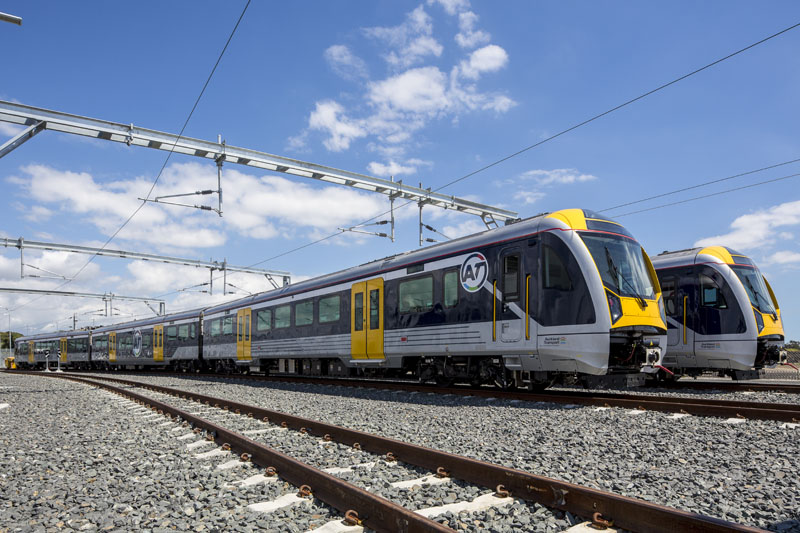
Yet another (not unexpected) fossil-fuel supply crunch is here. It will continue to affect everything in our economy. And be painful. But it should also, at last, shift discussion and action much more strongly towards reducing our structural dependency on fossil fuels where we can.
This time it’s different
These shocks have occurred in the past – they are inherent to the system – but this time is different in significant ways.
Even if we can escape an interruption of supply (which is by no means certain), it seems likely that a structural repricing is already underway, especially for diesel.
That means significant cost increases in the foreseeable future for diesel-dependent systems like road and rail freight, and also for any Public Transport (PT) systems that have been slow to convert to homegrown electrons.
One huge difference this time is that we have new technologies to lessen this dependence in key areas. And these are competitively priced, especially now we can all understand the risk and uncertainty of the current model. I’m talking about renewables for generation, batteries for storage, and electrification of our transport systems and vehicles.
It’s not just the price that’s competitive, but the value, because electrification has so many co-benefits. Any plan to reduce diesel dependency is identical to a carbon reduction plan, which also happens to be a plan to reduce other harmful emissions and damaging noise, and thus a plan for greater quality of life in general, especially in our cities.
This fact is elegantly outlined here, I strongly recommend reading this, in fact I deleted paragraphs of this draft post as Ember says it so much better and more authoritatively:
From The New Twin Fossil Shock, 14 April 2026, a good read at Ember
The electrifying potential
Cities and countries that have been taking action to reduce their climate-changing transport systems are wisely out ahead of the current disarray. So that’s what we’ll look at here.
Public transport, plus cycling and other light personal travel modes, will play a critical role in reducing fuel consumption while enabling continuation of business and maintenance of public wellbeing.
Across the country, you can already see a rise in ridership showing up in the data, without the benefit of any preemptive action by authorities. Here’s how the recent uptick looks for Auckland:
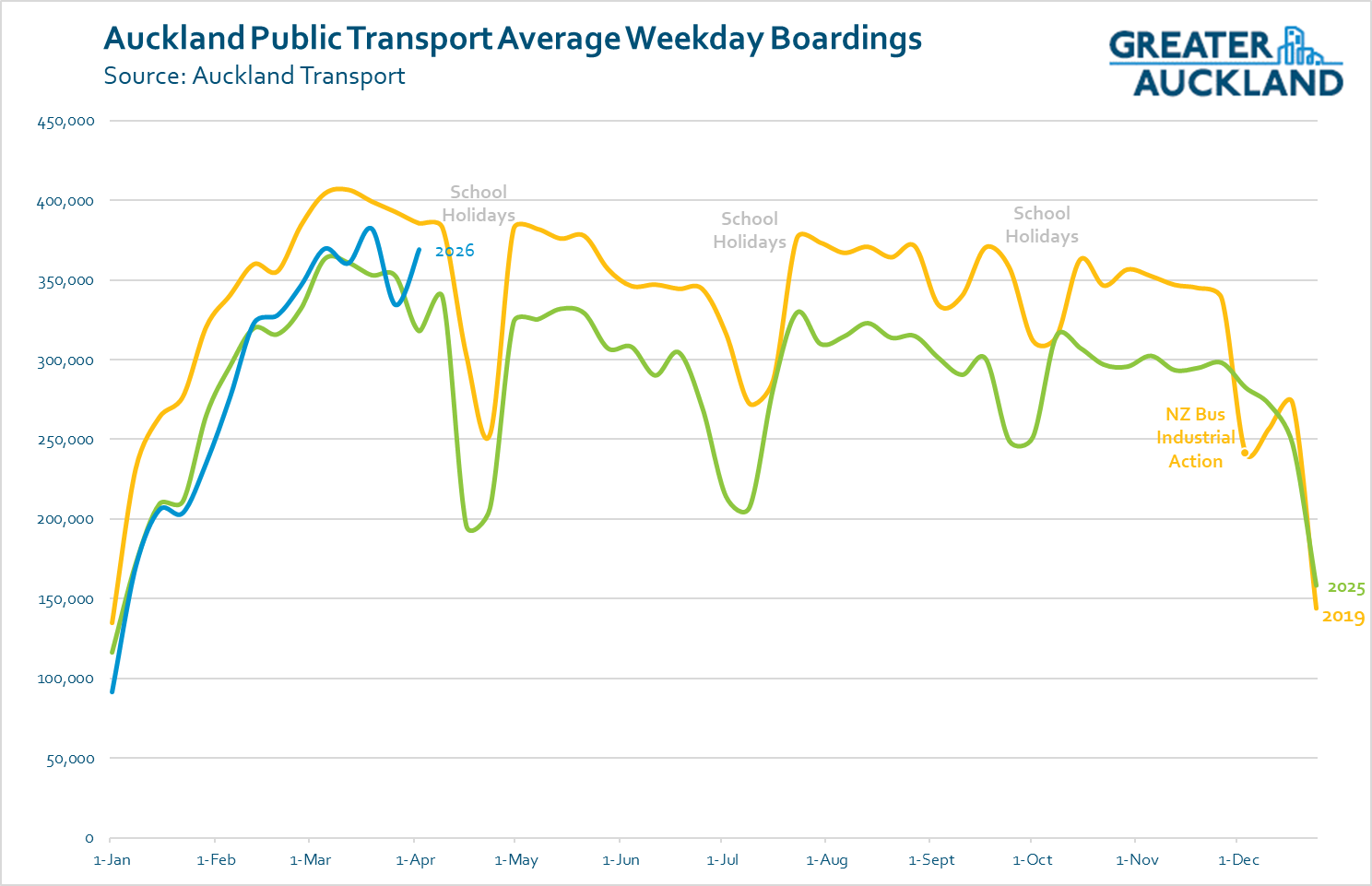
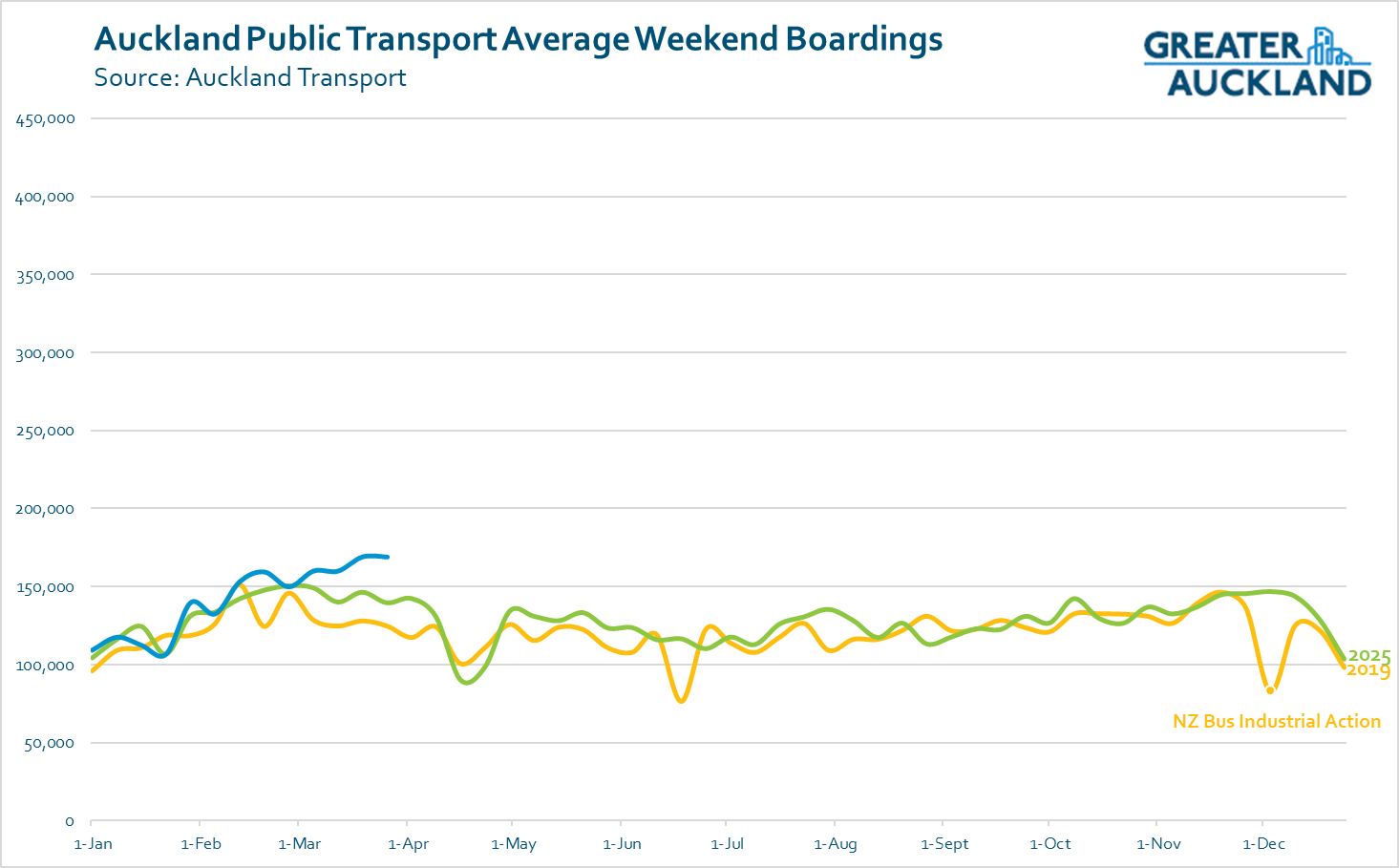
However the return of work-from-home has the potential to reduce this. I think it is important to note that this is not a pandemic, commercial, educational, and social connection remains as valuable as before. It would be good to see a government campaign urging the use of alternatives over hiding in your bedroom for this crisis.
There even could be some interesting outcomes if the crisis deepens, places well connected by PT, like city centres could even boom? Perhaps at the expense of the more auto-dependent malls?
Of course, there is always a risk of a negative feedback loop in a full-blown supply emergency: given PT systems operate on diesel, if more services are desired, more fuel will be required.
We will have to cross that bridge when we come to it, but it raises the question: how are we going with de-dieseling public transport? How does the near future look? How free, overall, are our public transport networks from disruptions to liquid fossil-fuel supply? And how are we going at reducing carbon and other emissions?
First, the good news
Both of the country’s urban rail systems (Auckland and Wellington) are fully electrified, and a number of smaller provincial towns have recently converted their entire bus fleets to battery-electric operation, which has them feeling pretty good right now.
Two diesel-free systems: Wellington’s electric Matangi passing the nearly complete Te Ara Tupua walking/ biking path. Photo: Patrick Reynolds, January 2026
I approached Auckland Transport for some local data on this, and they were especially helpful. We’ll get to that data soon, but first check out this chart showing the electrification of the national bus fleet, made by Ben Taylor (via Bluesky).
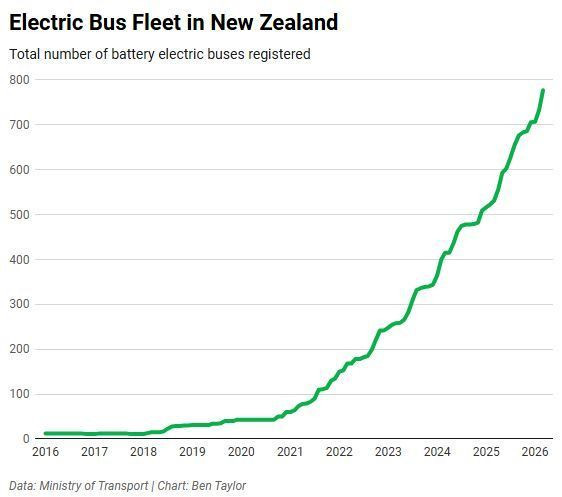
Going by the numbers, currently just over a quarter of the country’s PT bus fleet (777 out of a total 2844) is electric. But the even bigger point about this chart is the direction of travel. That wiggly hockey-stick line is the tell-tale signifier of disruption, in this case the good kind of disruption.
And this is a result of conscious policy choices. Note how the line bends up from 2021? In January 2021, the previous Labour-led government made good on an election pledge and mandated that all new buses for PT must be 100% emission-free from 2025, with transition of whole fleets to be complete by 2035.
Incidentally, this one of the few climate and energy transition regulations that hasn’t been actively reversed by the current government. Possibly because no supplier now offers diesel buses in New Zealand – thus showing the power of technology change supported by regulation.
An example of the positive impact can be seen in Nelson, where Mayor Nick Smith is rightly proud of his city’s transition to electric buses and the resulting doubling of ridership. In the post below from 31 March, he extols the benefits to health, wellbeing, and resilience, and estimated annual savings of $600,000 in diesel costs avoided.
Nick Smith, Mayor of Nelson, Facebook post 31 March 2026.
And a more recent post from 6 April reports ridership continuing to grow:
Nick Smith, Mayor of Nelson, Facebook post 6 April 2026.
As far as I can find out, public transport fleets are now 100% electric in Nelson, Invercargill, Mosgiel and Palmerston North, and soon Timaru – and ridership is growing with them.
Other cities are catching up:
In Otago, by October this year 77% of 106 buses will be electric, heading to 100% by 2028.Christchurch has 71 e-buses out of 310 (~23% of the fleet), aiming for full transition by 2035.Wellington, with the second biggest bus fleet in the country, reports 119 electric buses out of 482 – that’s around 25% – and is aiming for 100% by 2030.Waikato, with a fleet of 111, has I believe 2 e-buses, and plans to fully transition by 2035.Bay of Plenty has a fleet of 202, but no information on electrification on their website.
However in much of the country these wins are dwarfed by the decades of underfunding which means services are often absent, however they might be fuelled. Good to see that getting some attention here.
Intercity
The situation is even worse between cities, because of a massive funding gap in our PT provision system, which only funds services across regional boundaries by exception. Witness the absolute charade Te Huia has to pass through to get a normal amount of subsidy and unlock its economic benefits.
(Ed: And dare we even mention the InterIslander ferries, which are becoming an international reputational issue as well as a bugbear for New Zealanders just trying to get from one island to the other?)
With both flying and driving getting more difficult and expensive, it is time the inter-regional public transport anomaly gets fixed, and the best way to do that is to normalise public funding mechanisms. There’s a good campaign on this by The Future Is Rail.
Which brings us to…
Auckland: a big bus opportunity…
With around 1350 buses in the fleet, and growing, this is the big dog to transition.
Currently about 25% of the Auckland fleet is electric, with more e-buses on their way, raising the proportion to 33% by August this year, and by July 2027 we will get to 44%.
The Auckland fleet is a lumpy one to change, because the vehicles are renewed when contracts are renewed, enabling new depots to be electrified supporting additional routes.
…and a ferry predicament
Ferries are the real problem child in Auckland’s PT system, as they truly neck down the stinky stuff, especially in proportion to the number of passengers they carry.
On some routes, diesel consumption is as high as 4 litres per passenger, with one outlier at a thirsty 12l/pax. (I haven’t seen figures for Waiheke as it is not within the city’s public transport system, maddeningly).
It is fair to say that the more gas-guzzling services will be the first to be paused if the diesel supply crunch gets worse – although not the key Devonport route.
(There are also some low-ridership buses that consume over 3l/pax, and these may also come under the microscope if supply is seriously affected.)
Some good news is that two fully electric and two hybrid ferries are about to enter service, which shows the wisdom of our city investing to address climate and other concerns.
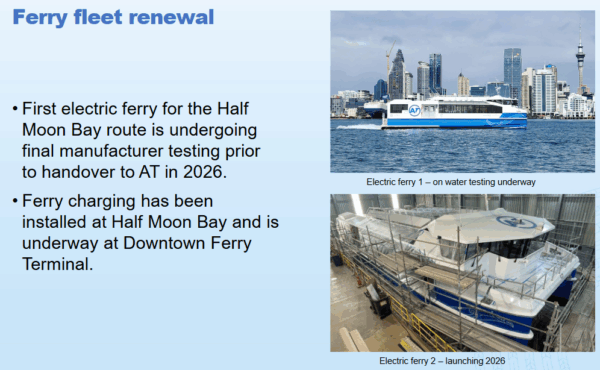
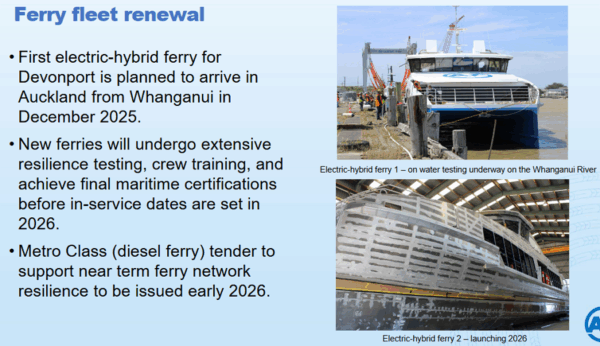
However: AT has also just ordered four brand new 100% diesel ferries. Why? Because the current government refused to co-fund these vessels if AT specified any other propulsion technology. Which is as incomprehensible as it depressing.
Auckland is a harbour city, we need to be using our blue highway, but that just won’t work if we are forced to use increasingly expensive, toxic, and outdated technologies. It just blows up the operating costs, and makes most services unviable. Stick that in your rates cap and smoke it.
How much diesel have we already avoided?
I asked AT if they could provide figures on the amount of diesel already avoided through fleet electrification, and they kindly sent me the chart below.
It is quite complex, and it would be good to get the raw data as I think it could made more legible.
Anyway, the key bars are the top two. These show the quantity of diesel (in millions of litres) that was not burnt in the public transport sector in Auckland since the electrification of the rail system and the introduction of e-buses.
The bus system has grown throughout this period, first with somewhat more efficient buses, and now through 100% battery-electric systems. So the orange bar (diesel, bus, avoided) will grow, gradually eating the navy blue one (diesel, bus, actual), until it is eventually replaced.
The four new electric/hybrid ferries will make a small dent in the purple bar (diesel, ferry, actual) – but unless there are significant policy changes on the water, diesel consumption won’t change much.
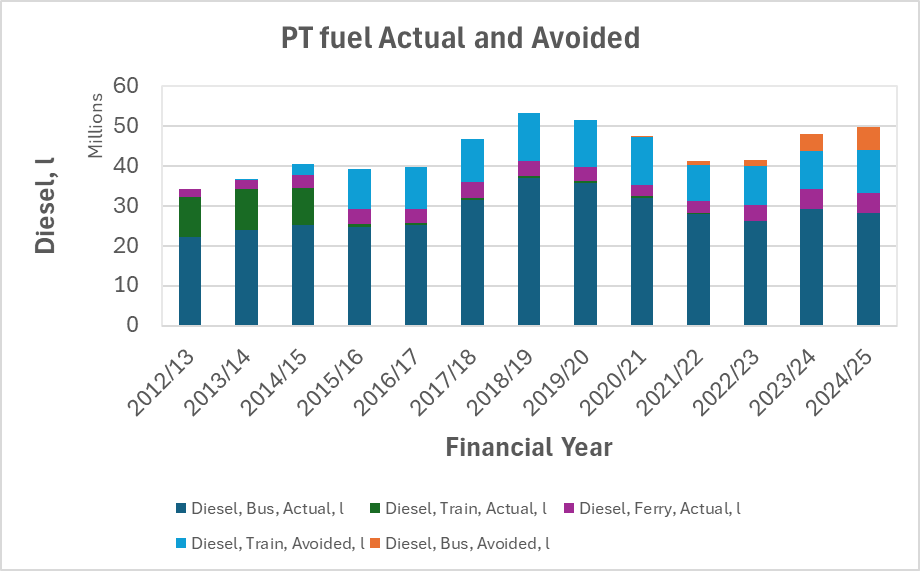
It would be interesting to do another version of this chart showing the number of passengers, or even better, passenger kilometres. As the rail system recovers from the rebuild disruption and CRL ridership growth kicks in, we can expect the blue bar (diesel, train, avoided) to grow consistently, especially by the per-passenger metric.
Remember too, the cycleways are playing their part in replacing fuel-powered driving journeys – and also, in relieving public transport at peak times especially.
This is the stealth mode, which AT should be making more of a joyful noise about at every opportunity.
The latest city-wide cycle counter data available from AT is February, so we can’t graph the March impacts yet (to match the observed activity). But here’s the city centre cordon bike count, to the end of February 2026. The return to form after early COVID interruptions is pretty clear.
City centre cordon cycle counts to February 2026: spot the recovery, and the trend.
The NW cycleway, Auckland’s busiest weekday bike route, running alongside SH16 towards Te Atatū, around 5.50pm on Thursday 9 April. The new normal. Image: Jolisa Gracewood.
The point of this post is to pull together some numbers about the energy transition in public transport, and to get those numbers out there, so we can all see the value of prudent investment in change.
It increasingly seems that the very broadness of the benefits of electrification somehow makes it harder for traditional evaluation models to confirm the case for change.
It is so obvious that we should invest in public goods that have an abundance of convergent benefits. Such bang for buck! Of course!
And yet our legacy systems – ye olde business cases and predictive models – seem almost designed to discount these incredibly effective policies.
Still, at least we can all finally see how vulnerable to disruption these complex and distant supply chains are. And one of the key benefits of electrifying transport – independence from that system – is surely front of mind, now and forever.
From The New Twin Fossil Shock, 14 April 2026, a good read at Ember
For the avoidance of doubt, perhaps from now on we should preface all references to fossil-fuels with the word “intermittent”, as a reminder of fragile that system always was. And to remind us we can free ourselves, and our future, from those worries.
Greater Auckland’s work is made possible by generous donations from our readers and fans. We’re now a registered charity, so your donations are tax-deductible. If you’d like to support our work you can join our circle of supporters here.
Share this