
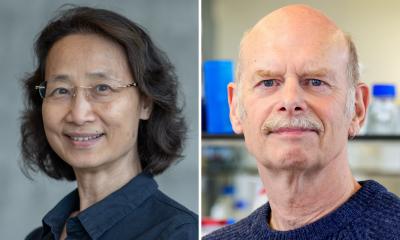
Dr. John van der Oost
Image courtesy of Guy Ackermans/WUR
The explanation for ThermoCas9’s selective behavior lies in the way it binds to DNA. Before a CRISPR system cuts DNA, it must first attach to a short recognition sequence next to its target, known as the PAM (Protospacer Adjacent Motif). ThermoCas9 is unique in that its PAM sequence includes a human methylation site, meaning it can contain a methyl group. “The CRISPR system binds very precisely to this recognition code,” Van der Oost explained.
Compare it to a screwdriver that fits perfectly into a matching screw head. If there is a protrusion inside the groove, the screwdriver no longer fits, nor is it capable of performing its job. In the same way, a methyl group disrupts the fit between ThermoCas9 and the DNA, preventing binding and leaving the DNA sequence untouched. “ThermoCas9 is a perfect example of the value of fundamental research; you have to know how these individual pieces work together,” Li said. “We used biochemistry and structural biology to discover a mechanism that we one day hope will lead to more precise, effective cancer treatment.”
There is still a long way to go before the technology can be translated into a potential cancer treatment. The new study demonstrates selective DNA cleavage but does not yet show that this effect can kill tumor cells. The next step focuses on damaging tumor DNA sufficiently to trigger cell death.
Aberrant methylation patterns also play a role in many other diseases, including childhood cancers such as neuroblastoma and autoimmune disorders. In the future, ThermoCas9 or a similar CRISPR tool may evolve into a versatile molecular strategy that recognizes diseased cells by their chemical “signature” and selectively disables them.
Mitchell O. Roth, Ph.D., Yuerong Shu, Ph.D., Yu Zhao, Ph.D., and Renee D. Hoffman of VAI, and Despoina Trasanidou, M.Sc., Ph.D., of Wageningen University are co-first authors. Other authors include Christian Südfeld, Ph.D., and Eugenios Bouzetos, M.Sc., of Wageningen University; Nikolaos Trasanidis, Ph.D., of Imperial College London; Michael Zawrotny, Ph.D., Anuska Das, Ph.D., Jay Rai Ph.D., Mary K. Gelasco and Megan L. Medina of Florida State University; and Hemant N. Goswami, Ph.D., and Bing Wang, Ph.D., of VAI.
Source: Van Andel Research Institute