
Rejji Kuruvilla is a Professor of Biology and Vice Dean for Natural Sciences who studies the development and maintenance of the sympathetic nervous system. In an interview with The News-Letter, she described her research and duties as an administrator.
“ In animals, a fundamental property is the ability of the body’s internal environment to remain constant in the face of a continuously changing outside world… and the sympathetic nervous system is responsible for maintaining body homeostasis. It’s classically been studied for fight or flight responses… but it’s also responsible for making sure that your internal body homeostasis stays constant when there are environmental changes or during daily activities such as exercise or even adjusting for a drop in blood pressure on standing up,” Kuruvilla said.
Given the many roles of the sympathetic nervous system in maintaining essential bodily functions, dysregulation of this system can lead to disease. Notable diseases linked to the sympathetic nervous system include congestive heart failure, hypertension, diabetes, and anxiety disorders.
Kuruvilla’s initial journey into science was driven by her curiosity about the world around her.
“I was always curious. I loved biology. I really wanted to understand how things work… when I [found out] that you could also do a PhD and get paid to do research, I think that’s what brought me to do my PhD in this country,” Kuruvilla recalled.
Kuruvilla completed a PhD in biochemistry at the University of Houston, where she utilized diabetic rats as a model system to study changes in lipid concentrations that affect nerve conduction velocity. At the conclusion of her PhD, Kuruvilla decided to pursue neuroscience research further for her postdoctoral studies.
“I was fascinated by work coming from David Ginty’s lab [at the time] in the neuroscience department at the School of Medicine,” Kuruvilla said. “[The Ginty lab] had established a compartmentalized culture system to study neuronal signaling, where they grow neurons such that the cell bodies and the axons were in different compartments.”
Kuruvila joined Ginty’s lab as a postdoc, where she began to study nerve growth factor (NGF) and its transport through sympathetic nerves using the compartmentalized culture system. Her work shed light on the control of NGF transport from axon terminals back towards the neuron cell body.
After starting her own lab at Hopkins, Kuruvilla continued to study the development of the sympathetic nervous system and the crosstalk between target organs, the sympathetic nervous system and the brain. She continues to utilize the same model systems – mice and human cells – that she employed in her PhD and postdoctoral research. One project in the lab specifically studied the role of the sympathetic nervous system in the pancreas.
“We know which cells in the pancreas secrete NGF… So we could, in a very targeted way, ablate NGF specifically from those cells using the Cre-LoxP system in mice… We use mice to do whole in vivo imaging and metabolic tests in glucose metabolism. But at the same time, if [we] want to understand the mechanisms, we have to go back to the cell culture system, and for example, grow neurons in these compartmentalized chamber systems [so] we can tag the receptors fluorescently and watch the NGF receptors shuttle from the axon tip to the cell bodies to trigger gene expression changes,” Kuruvilla said.
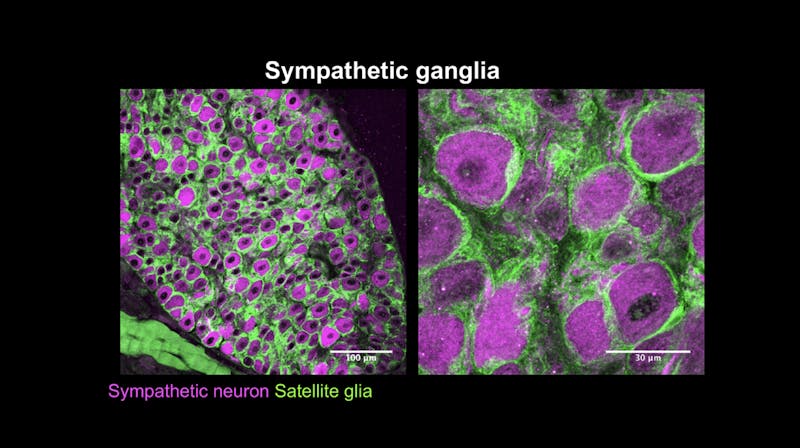
Along with neurons, the nervous system is made up of supporting cells known as glial cells. An emerging project in the Kuruvilla lab is exploring the role of a special type of peripheral glial cell, satellite glial cells (SGCs), in protecting sympathetic neurons. These SGCs are known to wrap around the cells of sympathetic ganglia, clusters of nerve cell bodies that act as sites of synapsing between sympathetic neurons. SGCs are also present in other ganglia of the peripheral nervous system such as the dorsal root ganglia of sensory neurons. These ganglia are crucial for the transmission of sensory signals to the central nervous system.
Kuruvilla’s team conducted single-cell RNA sequencing on both the sensory and sympathetic SGCs. Interestingly, they found distinct differences in the transcriptional profile of these two populations of SGCs. To explore the differences between these two cell populations further, Kuruvilla studied their relative permeability to outside molecules.
“It’s been thought that all the neurons outside the [central] nervous system have easy access to circulation,” Kuruvilla explained. “But this has been under-studied. So we asked, ‘do these neurons have access to circulation?’”
To test this question, Kuruvilla’s team injected a small fluorescent dextran tracer into mice and analyzed tissues after the tracer was allowed to circulate through the bloodstream. They reasoned that if the SGCs of the sympathetic nervous system were permeable, the tracer would leak through the SGCs and the tracer would be present inside the nerve cell bodies. However, they were surprised to see that the tracer was not present inside the nerve cell bodies of sympathetic ganglia.
“Basically, the tracer comes right smack against the boundary of the neuron and satellite glial cells, but they don’t get into the neurons,” Kuruvilla said. “So this really suggested… even if the tracer leaks out of the blood vessels, the satellite glial cells are acting as a physical barrier.”
However, when they conducted the same tracer experiment in sensory ganglia, they saw that the dextran tracer leaked into sensory nerves. Along with the RNA sequencing data, these results further suggested that sympathetic SGCs somehow differ in function compared to those of the sensory nervous system, acting as a barrier similar to the central nervous system’s blood-brain barrier. The lab has tested the permeability of SGCs to different molecules as well with similar results.
In addition to her work in the lab, Kuruvilla also holds an appointment as Vice Dean of Natural Sciences. This role adds many administrative duties in addition to research, which require precise management of her schedule.
“Mondays, Tuesdays and half-day Wednesday I’m in the Dean’s office. Thursdays and Fridays, I try to protect for my lab. I meet with my students and postdocs one-on-one every two weeks… I really see myself as a bridge between faculty and the Dean’s office.”
What Kuruvilla appreciates the most about the University’s research is its facilitation of collaboration.
“I think that the common interest in research at Hopkins breaks down all the barriers to collaboration, because people are truly curious and excited. So I think they just care about hearing a great idea, and then they work together to make things happen.”