
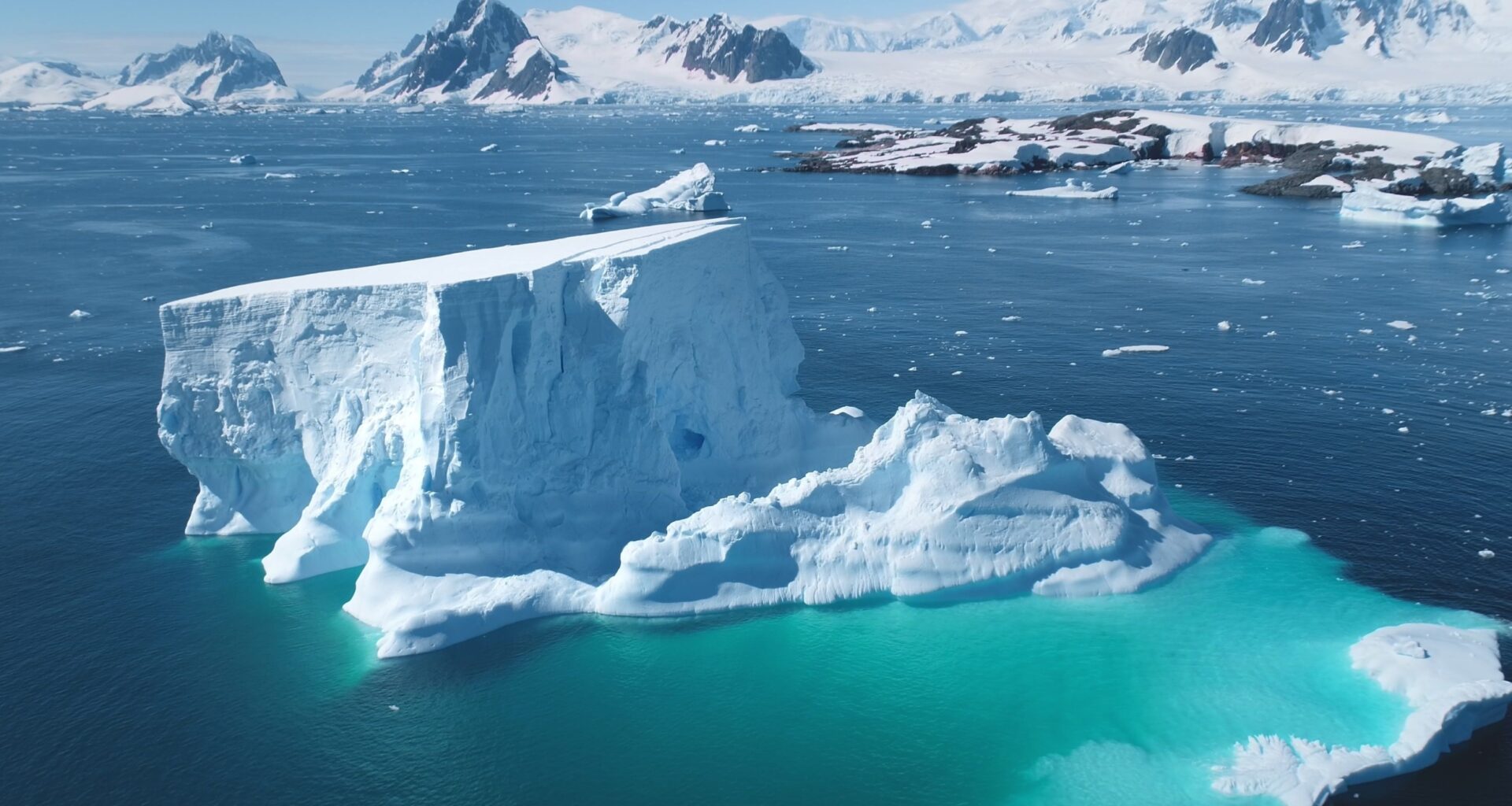
Sea ice may look like a solid frozen sheet, but it’s anything but simple. Beneath the surface, it’s filled with tiny pockets and channels of salty liquid – and whether those pathways connect or stay blocked can completely change how the ice behaves.
A new study shows that this hidden structure controls how water, nutrients, and gases move through the ice, with ripple effects for polar ecosystems and for how sea ice responds to a warming planet.

Researchers at the University of Utah zeroed in on granular sea ice – a rougher, more disordered form that’s becoming more common as polar regions warm.
Their goal was to figure out exactly when this type of ice becomes porous enough to let fluids move through it, and how that threshold compares to more familiar forms of sea ice.
When granular ice starts flowing
The researchers found that granular ice behaves very differently from columnar ice, which has a more orderly crystal structure.
In columnar ice, fluid begins to flow once brine makes up about 5 percent of the ice volume. In granular ice, that threshold is much higher, requiring closer to 10 percent before liquid pockets connect enough to allow flow.
“Going from five percent to 10 percent means that you need twice the porosity, twice the brine volume fraction to get flow,” said University of Utah mathematician Ken Golden, the study’s lead author.
That might sound like a small difference, but it is not. Granular ice needs about twice as much porosity before it shifts from acting like a barrier to functioning as a connected system.
How flow shapes ecosystems
This difference has real consequences because fluid movement through sea ice controls a wide range of processes, including melting.
It determines whether nutrients can reach algae living inside the ice and helps regulate the exchange of gases between the ocean and atmosphere. It also influences whether meltwater drains away or stays pooled on the surface.
“If algae are living in columnar ice versus living in granular ice, then there are quite different conditions under which they’ll get their food and nutrients,” Golden said.
That makes life much harder in granular ice. It’s much harder to preserve nutrients, and other organisms -such as viruses, bacteria, and nematodes – face the same challenge.
The many forms of sea ice
For years, scientists have known that sea ice is not just frozen seawater. It is more like a complex composite material, with pure ice forming the main structure and liquid brine trapped inside it.
“The geometry, the connectivity, and the volume fraction of these inclusions depend dramatically on temperature,” Golden said.
“The way that the fluid is arranged within the ice depends strongly on the polycrystalline structure. In other words, the conditions under which the ice is formed are the main distinction between columnar ice and granular ice.”
Columnar ice tends to form in calmer conditions, where crystals can grow in a more organized way. Granular ice is more likely to develop in rougher, more turbulent settings, which are common in parts of the Antarctic.
As the climate changes, sea ice is becoming thinner, younger, and, in many places, more granular. That means its internal plumbing is changing too.
The new study argues that this shift cannot be treated as a minor detail. The microscopic structure of sea ice can end up influencing much larger processes across the polar system.
How ice lets fluid move
The ability of sea ice to let fluid move through it – known as permeability – sits at the heart of the issue. If brine pockets are connected, seawater and dissolved nutrients can travel through the ice. If not, the ice behaves more like a wall.
That difference affects the base of the sea ice food web, because algae and other tiny organisms depend on these pathways to survive. It also influences larger-scale physical processes.
Granular ice has a very different permeability structure, which shapes how fluids move through it. This matters for nutrient replenishment, snow-ice production in Antarctica, and melt pond evolution in the Arctic.
When ice starts flowing
The timing of fluid movement is critical – determining when nutrients shut off or return, when melt ponds drain, and when seawater can percolate upward, flood the surface, and refreeze.
About a quarter of the Antarctic ice pack forms through this granular mode, and whether ice is granular or columnar can influence how much ice is produced.
Golden’s earlier work helped establish the “Rule of Fives” for columnar sea ice, where permeability begins at about 5 percent porosity – typically around 23°F (-5°C) with salinity near 5 parts per thousand. For granular ice, however, that rule no longer holds.
A harder path for CO2
Golden had suspected for years that granular ice would have a higher threshold. Over time, fieldwork suggested that this was likely true, especially as granular ice became more common in the Arctic.
The new paper grew out of measurements taken in the Antarctic during research aboard the Australian vessel Aurora Australis. Those observations showed that below the 10 percent porosity threshold, the brine pockets in granular ice remain too disconnected for flow.
That finding carries wider consequences. If gases move less easily through the ice, then exchanges between the ocean and atmosphere may be altered. If surface meltwater cannot drain as well, it may remain pooled on top for longer.
“In granular ice, it’s harder for CO2 to move through the ice,” Golden said. “There are different conditions under which you get transport up or transport down. That’s also important for microbial critters.”
More ponds, more melting
One of the clearest knock-on effects could involve melt ponds. These pools of water form on top of sea ice during warmer, melting periods.
If the ice below is permeable, some of that water can drain. If it is not, the ponds may remain in place and spread.
That matters because bright ice reflects sunlight well, while darker melt ponds absorb much more heat. The more standing water there is on the surface, the lower the ice albedo becomes. As a result, the ice absorbs more heat and experiences greater warming.
“The surface albedo might be very different because you might have 60 percent coverage versus 40 percent coverage depending on the ability to drain,” Golden said.
In simple terms, the growing spread of granular ice could make it harder for meltwater to escape, allowing more heat to be absorbed and potentially speeding up melting.
Thus, the future of sea ice may depend not only on how much of it remains, but also on what kind of ice it is. A shift in microstructure may seem like a tiny detail. In the polar world, though, it could shape everything from microbial life to the pace of ice loss.
The study is published in the journal Scientific Reports.
—–
Like what you read? Subscribe to our newsletter for engaging articles, exclusive content, and the latest updates.
Check us out on EarthSnap, a free app brought to you by Eric Ralls and Earth.com.
—–