
Black holes are famous for using their gravity to trap matter and light within their dark hearts. But scientists have now discovered the colossal strength of their firepower to shoot material outwards.
The jets of superheated particles that come thundering away from a black hole can carry the power of 10,000 suns and travel at half the speed of light, a groundbreaking study has found.
This has helped scientists in Oxford and Australia to confirm that the jets from supermassive black holes, which are likely to be even more powerful, must help to shape and give structure to the universe.
Black holes are often created when a massive star implodes at the end of its life. The inward pull of gravity during this implosion compresses the star’s atoms into an extremely densely packed point in space.
The gravitational power of this “singularity” is so strong that it creates a spherical region of space around it that appears totally black from the outside. Particles that cross the outer boundary of the black hole, known as its “event horizon”, can never escape.
To escape the Earth’s gravitational pull, you need to travel at about 25,000mph. To escape the pull of a black hole once you have fallen in, you would need to travel faster than the speed of light. As this is impossible, nothing that falls into a black hole will ever be seen again.
However, some material comes extremely close to falling into a black hole without quite being pulled in. This dust and gas orbits the black hole at very high speeds. It flattens out and generates enormous friction, causing it to heat up and create a giant glowing disc of matter.
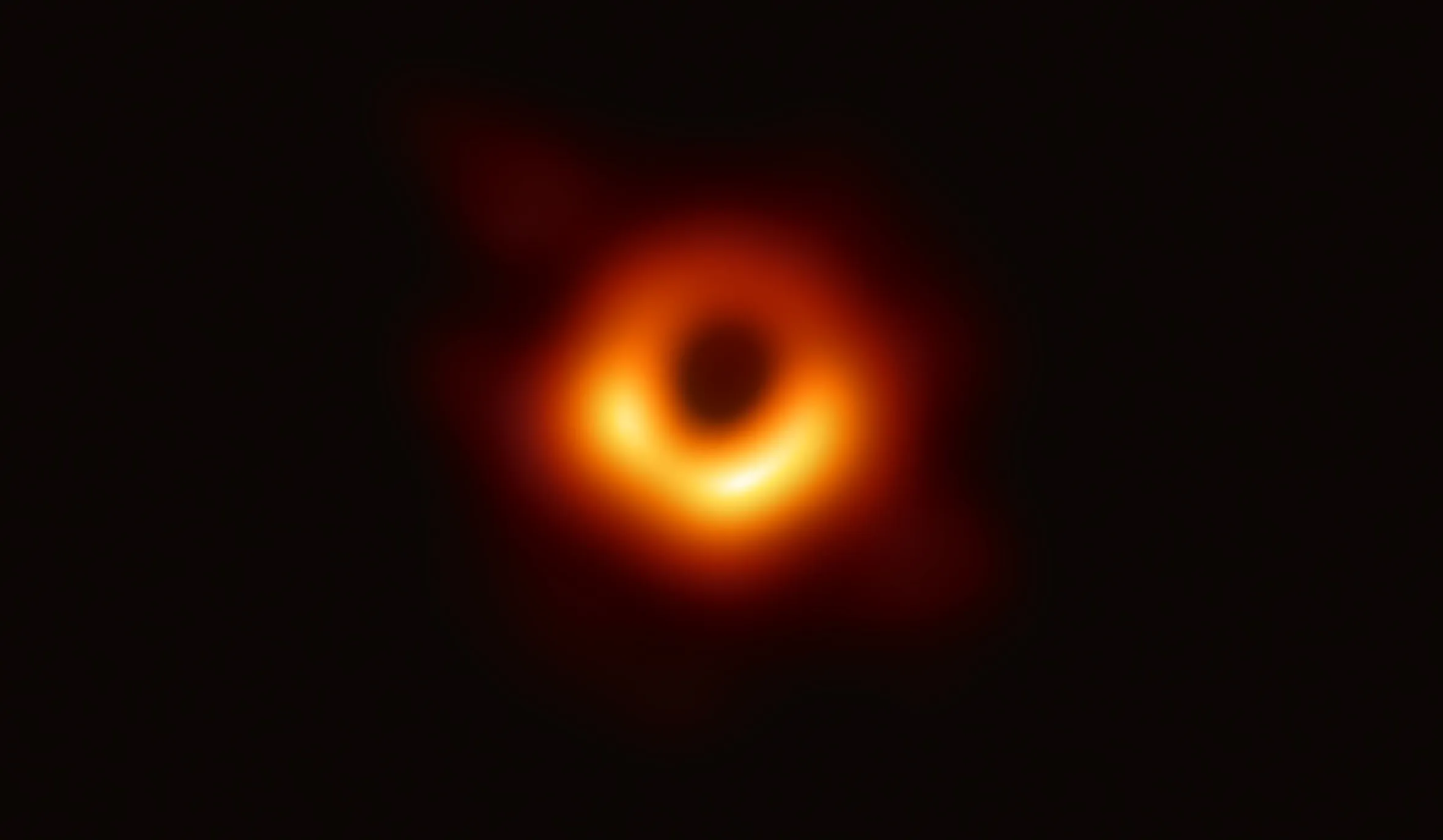 The first photograph of a black hole and its fiery halo, released in 2019EUROPEAN SOUTHERN OBSERVATORY/AFP
This spinning disc, orbiting around a black hole that is also spinning, is so hot that it rips atoms apart into a soup of charged particles that generate an incredibly powerful magnetic field which then becomes coiled and twisted.
This field creates two funnel-like jets of particles at the black hole’s north and south poles that thunder away from the black hole like streams of exhaust.
The black hole effectively acts like a colossal particle accelerator, firing jets of plasma away from its poles in streams that can travel thousands of light years through space.
In the case of supermassive black holes, these jets can even punch through neighbouring galaxies and clear vast areas of space.
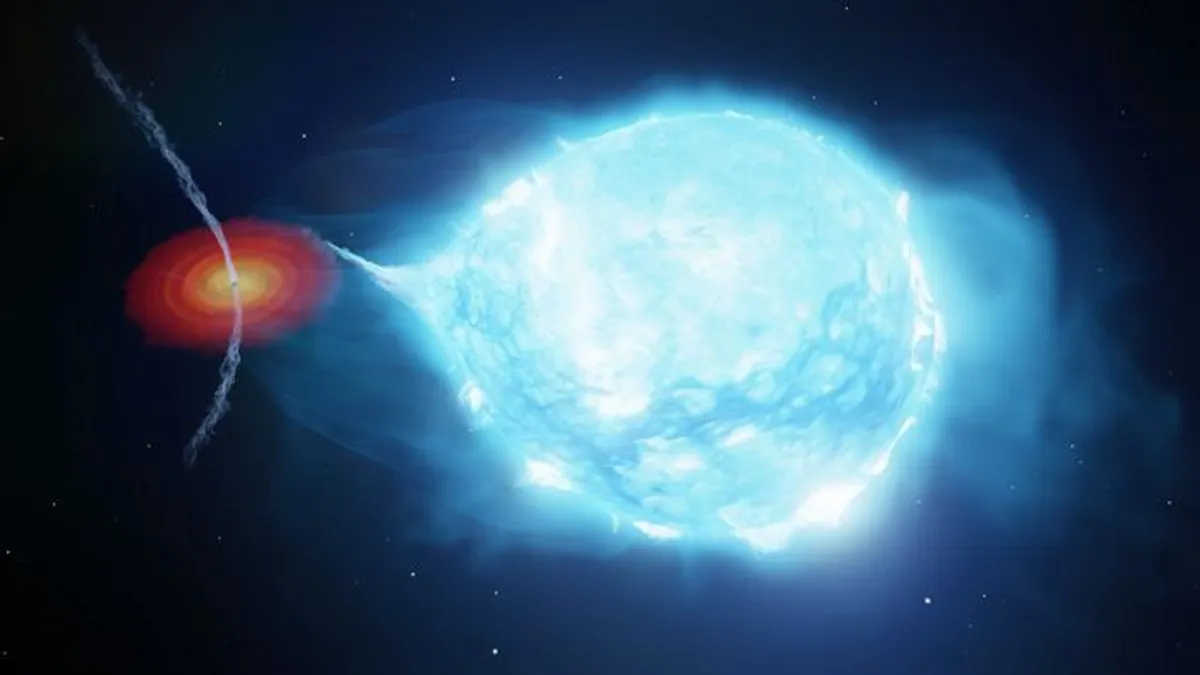
Using radio telescopes positioned across Earth, astronomers observed the jets from Cygnus X-1. It is a binary system made up of a black hole about 21 times the mass of our Sun and a supergiant star orbiting each other. The stellar wind generated by the star is so strong that it is able to bend the jets emanating from the black hole.
By analysing the bend and movement in these “dancing” jets, astronomers could calculate that they possess up to 10,000 times the power of our Sun and are moving at 93,000 miles per second, or 335 million mph.
This measurement will provide a benchmark by which thousands of other black hole jets can be measured, such as from the far bigger supermassive black holes found at the centre of galaxies including our own, which are millions of times the mass of our Sun.
“Black hole jets provide an important source of feedback to the surrounding environment and are critical to understanding the evolution of galaxies,” said Professor James Miller-Jones of Curtin University in Australia.
In fact, these jets are crucial to our understanding of how the “formation of large-scale structure in the universe” takes place, the study, published in the journal Nature Astronomy, notes.
“Understanding the impact of accreting supermassive black holes on the evolution of galaxies and cosmic structures is one of the key motivators for studying relativistic jets.
“Jets are observed to drive large-scale shocks, pollute interstellar gas with magnetic fields and cosmic rays, generate large-scale turbulence, and evacuate large-scale cavities of gas on scales of galaxy groups and clusters.”