
Fourteen of 20 New Zealand water polo clubs wrote to the sport’s national board on Wednesday, outlining their loss of trust and confidence in the governance and management of the sport.
They called on Howieson to step down.
Howieson initially wrote back to the clubs, saying she and the board were prepared to meet with them, and that they would address their concerns in a future response.
She made no commitment or agreement to step down in her initial response. She said a “sensible and measured approach” was required.
Water Polo NZ chair Alex Howieson.
The clubs’ letter – obtained by the NZ Herald – said they were prepared to make changes to the sport’s constitution if there was not an “orderly” board transition.
“Across recent club engagement [with 20 clubs], 14 clubs have indicated support for the resignation of the chair as the leader of the board, with 10 of those also expressing the view that the wider board should reflect on their positions,” said the letter.
“A small number of clubs either abstained (1), or are undertaking further internal committee consultation (1), while 4 have indicated a preference to await the outcome of the SIC review.”
The SIC is the Sport Integrity Commission, which has launched a formal investigation into claims of bullying and other allegations arising from a troubled senior women’s tour to Europe and Singapore last year.
There have been claims and counterclaims about the way Water Polo New Zealand handled the complaints and the athletes directly involved.
The Herald earlier obtained a 12-page letter written by several players which detailed some of the allegations against other players and coaches.
“I remember thinking this was the worst trip I [have] ever been on and that it was the worst experience of my life,” one of the athletes said in the letter.
A Herald investigation revealed the allegations involving the senior women’s team were a window into deeper, broader concerns about the state of the sport, with claims of selection favouritism, conflicts of interest, poor leadership, and – most seriously – fears for player welfare.
Many parents and others in the water polo community have been in touch with the Herald. Investigations are ongoing.
Do you know more? Please email Shayne Currie in confidence – shayne.currie@nzherald.co.nz
“Water polo is the most toxic sport in New Zealand,” a parent and businessperson told the Herald.
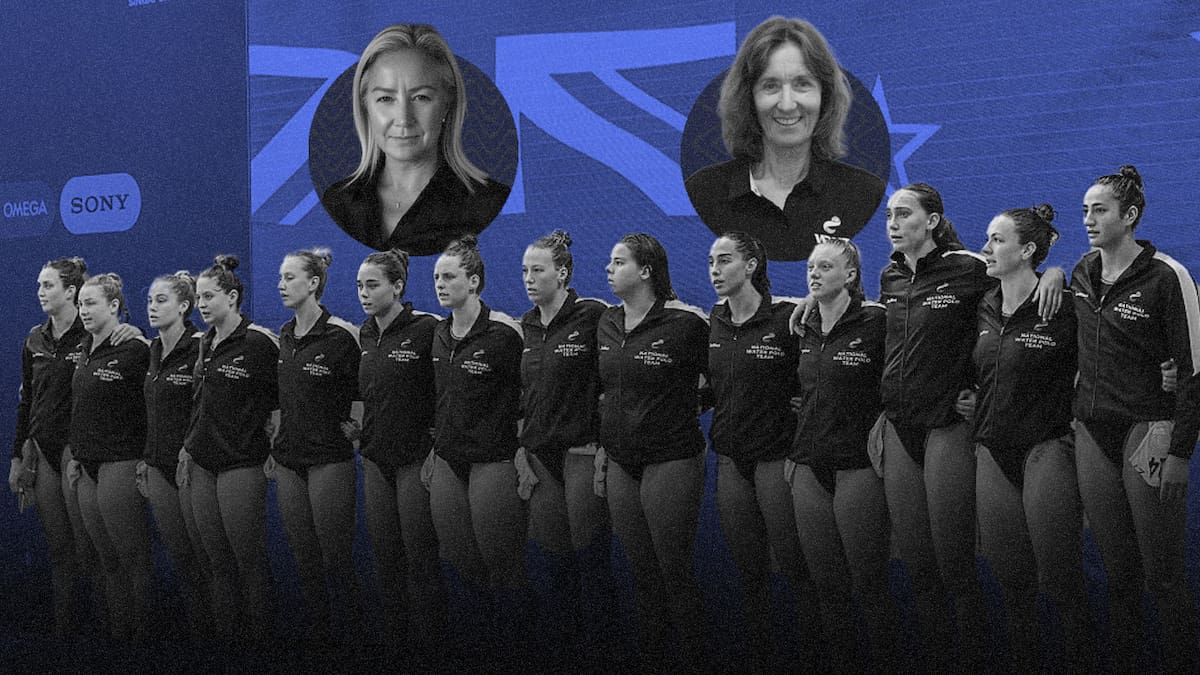
The New Zealand women’s water polo team – the White Caps – finished 10th at the World Aquatic Champs in Singapore last year but the tour has been beset by allegations of bullying and mistreatment. Photo montage / Oliver Rusden; Photos / Getty
Howieson declined to speak to the Herald today about her resignation, other than to indicate she was coming to the end of her cycle.
“I was up for … we have a cycle. I was up at the end of the cycle. That’s all I have to say. Thank you.”
Her resignation letter today said that she was committed to supporting “a smooth transition, including the handover of key priorities and context where helpful and will make myself available over the coming days to brief an interim chair and/or the board on current matters and assist with any practical steps needed to ensure continuity”.
She thanked the water polo community for its support, “and for the constructive way we have worked together”.
“I also want to acknowledge our staff, officials, coaches, volunteers, clubs, supporters, and partners for everything they do for water polo, and our athletes and their whānau who remain at the heart of the sport.
“I have every confidence in the future of Water Polo New Zealand and wish the board and the incoming chair well as they lead the organisation forward.”
She said it had been a “privilege” to serve as chair.
The 14 clubs’ position
The earlier letter from the 14 clubs to the board said there was a “clear direction of travel across the majority of clubs that change in leadership is required”.
“The outcome we are seeking is a board reset, beginning with the resignation of the current chair, to enable the appointment of new leadership capable of guiding the necessary governance, management, and structural changes.”
New Zealand and China water polo players battle it out during last year’s World Aquatic Championships in Singapore. Photo / Getty
The clubs said they had been “independently and collectively” reflecting on the state of the sport in recent months.
“While perspectives differ on specific issues, there is now clear alignment on the need for change across three core areas: governance, management accountability, and structural settings that support the long-term health of the sport.”
The loss of confidence and trust arose from a combination of factors, said the letter, including:
concerns regarding governanceprocess and policy adherence, capability, and independencelimited confidence in decision-making processes and their consistent and transparent applicationa lack of trust in the handling of complaintsongoing concerns relating to management effectiveness and transparency enabling board oversight.
There was also a “broader view that the current system is not operating in a way that gives stakeholders confidence in its fairness, transparency, or effectiveness”.
“These concerns are not new,” said the letter.
“What has changed is the level of alignment across clubs that they now require resolution.
“At its core, this situation reflects a breakdown in trust. Rebuilding that trust requires clear ownership, accountability, and a willingness to address underlying issues directly.”
The clubs requested a formal meeting between representatives and board members on Saturday.
They said the purpose of the requested meeting was “not to revisit whether change is required, but to agree how this transition can occur in an orderly, constructive, and timely manner”.
“We propose that this meeting take place as soon as reasonably practicable, and prior to the AGM, to allow this matter to be addressed in a considered and professional manner rather than in a public forum.”
The sport’s AGM will be held in May.
The clubs said their letter was not intended “to disregard the contribution or capability of current board members”.
“Where appropriate, existing directors may continue to contribute, subject to a refreshed governance structure and leadership.
“Alongside this, we expect a structured and transparent approach to addressing concerns regarding the effectiveness of current management.”
The clubs also said they would prepare a “formal constitutional pathway to enable change should it not be achieved through a constructive and timely transition process”.
This included lodging a member’s resolution to amend the sport’s constitution to allow for the removal of directors; meeting the required notice periods and voting thresholds, and proceeding to a member vote if necessary.
The clubs said they had a shared objective “to ensure that athletes, coaches, officials, and the wider community are not adversely affected during this period, and that the sport is positioned for long-term stability and success”.
The clubs that signed the letter are Canterbury, Harbour City, Hawke’s Bay, Hibiscus Coast, Manawatū, Marist, Mountfort, North Harbour, Otago, Sea Wolf (Auckland), Southland, Tairāwhiti, Waikato and Auckland Water Polo.
Alex Howieson’s earlier response
In an emailed response back to clubs this week, Howieson pushed back on a Saturday meeting.
“As you can appreciate, there is a lot of information to digest here and we agree it would be beneficial to meet in person.
“We believe this session will need to be facilitated. At this late notice for Saturday, we will not have the time to secure an independent, skilled person to assist us.
“We would propose 9 May or 16 May, before the AGM. We would propose a session of four hours to ensure all of us have the opportunity to discuss the situation in front of us.
“Between now and then, we will circulate a response to your letter. We are committed to continue to work together for the growth and development of Waterpolo NZ.
“As we know you agree, a sensible and measured approach is what is called for here, in a way where as leaders we address concerns from all parties.”
She thanked the clubs for “taking the time to write to us” and added: “I’m very glad we have the common goal of securing the future of Waterpolo in NZ”.
The senior NZ women’s water polo team at last year’s World Aquatics Championships in Singapore – the Sport Integrity Commission is investigating allegations of bullying following the tour. Photo / Getty
The Herald approached all 14 clubs today, but they either did not come back to us or said they would not comment on the letter.
Several said they expected the parties to collectively work on a solution for the best interests of the sport.
Until her resignation was announced, Howieson did not return messages or emails to the Herald today.
Only one of the seven other board members came back to the Herald – to say it was an internal matter and all correspondence would be through the chair.
Editor-at-Large Shayne Currie is one of New Zealand’s most experienced senior journalists and media leaders. He has held executive and senior editorial roles at NZME including Managing Editor, NZ Herald Editor and Herald on Sunday Editor and has a small shareholding in NZME.