
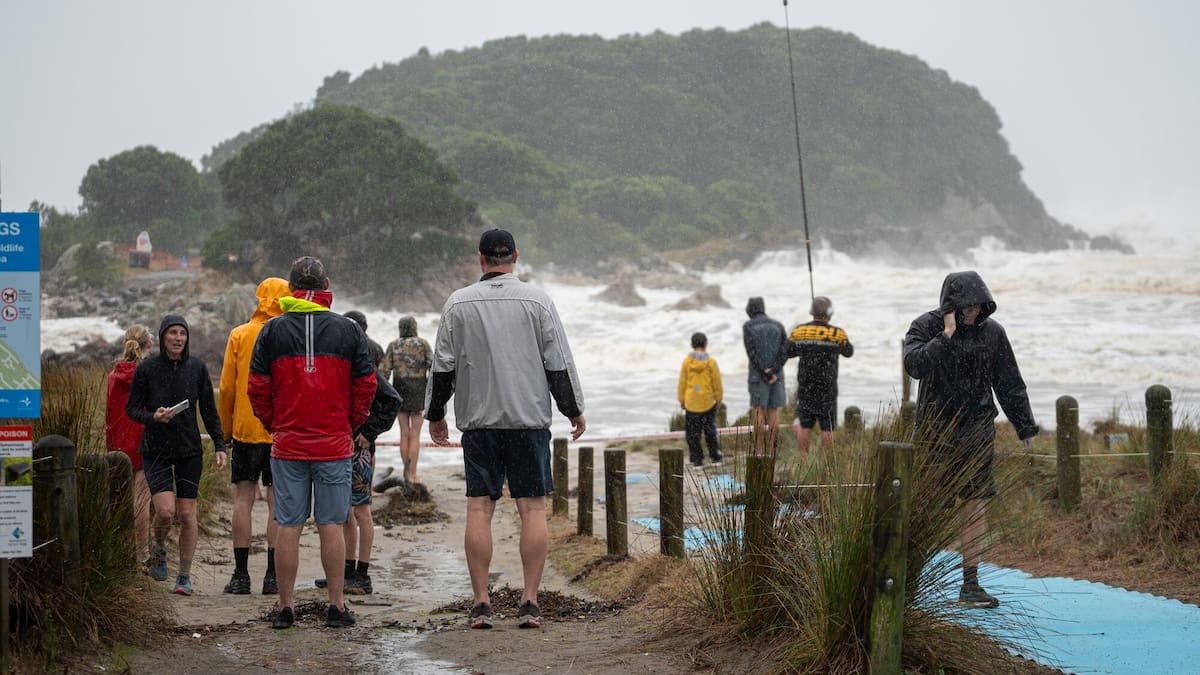
Even in these heightened alert levels, however, employment law offers no automatic rule allowing workers to stay home during emergencies — a reality that can leave people uncertain and anxious when storms strike.
Cyclone anxiety for worker
A Tauranga retail worker spent the weekend glued to weather updates, unsure whether her safety would be put at risk if she had been required to attend work on Sunday.
The worker, who NZME agreed not to name to protect her employment, said on Sunday morning she texted a work colleague and was told it was “business as usual”.
“I live alone with my cats, and as the wind picked up, I became really anxious about leaving home and quite concerned about travelling across town for my night shift.”
A tree down on the main street of Whakatāne, The Strand, as Cyclone Vaianu hits. Photo / Mike Scott
While weather conditions eased at times, the strengthening gusts of wind made the situation feel “unpredictable and ominous”, she said.
It was a “huge relief” when her manager sent a group text advising the staff that the store would shut for the rest of the day.
“My boss is a family man, and he would never jeopardise our safety and our families’ safety, but not everyone has such a supportive manager or employer,” she said.
“I’m lucky my boss values our safety, but not everyone is in that position.”
His message came shortly before a Civil Defence text alert urging businesses in low-lying areas to consider closing or ensuring staff and customers could shelter safely in place if needed.
She said the experience left her questioning what her legal rights would have been if she had refused to work because of feeling unsafe if the store had stayed open.
What the law says
Baywide Community Law Centre lawyer Russell Nye‑Wood said New Zealand’s employment law did not have prescribed rules telling every employer what they must do during adverse weather events.
Under the Employment Relations Act, however, the “duty of good faith” applied to these situations.
This duty required employers, employees and unions to deal with each other honestly, openly and constructively, and act in everyone’s “best interests”.
Under the Health and Safety at Work Act, employers must also ensure a safe environment.
Baywide Community Law lawyer Russell Nye-Wood. Photo / Russell Nye-Wood
Nye-Wood said a worker had the right to stop work or refuse to carry out work if they believed they would be exposed to a serious health and safety risk from an “immediate or imminent hazard”.
However, the worker must inform their employer of their safety concerns early, and both parties must act in good faith by making reasonable efforts to resolve the issue.
If the issue cannot be resolved, there is the ability to seek mediation.
Written workplace continuity or emergency management policies were important to “take the guesswork out of emergencies” both for workers and their employers, he said.
Employment lawyers urge caution
Tauranga employment lawyers Jeremy Sparrow and Stevie Shaw, of Holland Beckett, said a worker refusing to work as they believed they would be exposed to a serious risk from an “immediate or imminent hazard”, must try to resolve their concerns with the business or undertaking “as soon as possible”.
If issues remain unresolved, the worker may continue to refuse to work if they have reasonable grounds for believing the risk remains serious.
The legal threshold for refusing work lawfully was “high”, however, and case law was limited.
“We are only aware of one case where the Employment Relations Authority examined this in detail, which involved an employee refusing to attend work over concerns of catching Covid‑19, with the Authority finding the threshold was not met.”
Holland Beckett law firm partner Jeremy Sparrow. Photo / Supplied
This included the employee’s statements about the perceived risk not being consistent with the risk being serious, and that the employer had implemented multiple control measures to manage safety.
The lawyers said similar considerations would likely apply in severe weather events, but acknowledged the difficulty for workers in assessing legal risk in fast‑moving situations.
“For that reason, workers should exercise caution before refusing to work,” he said.
Potential consequences for employees who unlawfully refuse to work may include loss of pay and disciplinary action.
They emphasised that any disciplinary response must still be “fair and reasonable”.
For a contractor, if the refusal to work was not on reasonable grounds, they may not be paid for any periods they refused to work.
Depending on the wording of their specific contractor agreement, the business or undertaking may be entitled to terminate the agreement.
Union view
Workers First Union general secretary Dennis Maga said the union pushed to include emergency pay protection clauses in collective agreements wherever possible.
“The time to negotiate these protections is before a crisis hits,” he said.
Maga said the union would argue that a worker has the right to decline to attend work if a natural disaster makes their workplace or commute genuinely unsafe.
“The Health and Safety at Work Act supports that position.”
Workers First Union general secretary Dennis Maga. Photo / Mike Scott
On the issue of payment of wages, however, he said the legal picture was more complex.
“Under common law, if a worker is willing, ready and able to work but the employer cannot provide work due to flooding, closure or other reasons, the employer is generally obliged to pay normal wages.”
However, that obligation could be altered by a “force majeure” clause or other provisions in an employment agreement, Maga said.
“Force majeure clauses are designed for extraordinary events beyond anyone’s control, such as a cyclone destroying a worksite or road networks being closed under a state of emergency.”
He said if work was available, but the worker was not willing, ready or able to work, employers may not be obliged to pay wages.
“But we would argue a worker should not be financially disadvantaged for declining to perform unsafe work.”
Sandra Conchie is a senior journalist at the Bay of Plenty Times and Rotorua Daily Post who has been a journalist for 25 years. She mainly covers police, court and other justice stories, as well as general news. She has been a Canon Media Awards regional/community reporter of the year.