
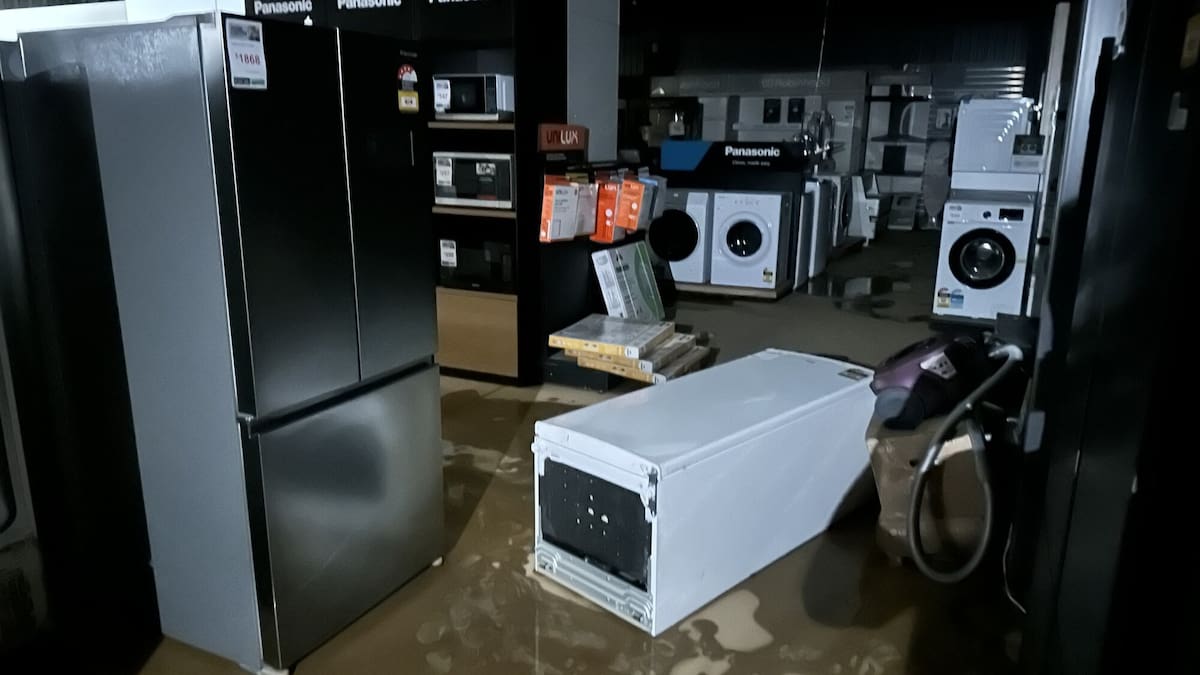
Walker found a “complete disaster” the morning after the deluge.
“The water must have hit at pace … we had large fridges knocked off their feet and sent careening across the store.”
Appliances were damaged following flooding on March 26. Photo / Folders
Because of water damage and humidity, it took more than a week for power to be restored.
“I think all stock is a write-off. I estimate that we’d be looking at close to a million dollars in cost.”
Walker observed the stopbank behind Bells Produce after the flood and believed it appeared “highly inadequate”.
He claimed one side of the stopbank appeared higher than the other.
Water damage left electronic appliances broken and power out. Photo / Folders
“The water coming over that stopbank must have created a wave, because it did so much damage.”
Folders had been growing, employing locals, supplying nationwide, and had opened a warehouse in Auckland.
“Now we’ve been kicked in the teeth quite hard, and it’s like starting again, it’s a complete rebuild,” Walker said.
Fridges were thrown by the force of floodwaters. Photo / Folders
He said Folders would likely be out of action for months.
For now, they would temporarily shift their operations to Auckland.
Walker knew the area was flood-prone but wondered if enough had been done to prevent flooding.
“I want some level of understanding of what and how the regional council is going to mitigate the risk of this ever happening again.”
Awanui River Working Group chairman Joe Carr said no scheme could guarantee total protection but he was confident the upgrades would offer greater protection to Kaitāia than before.
He said the scheme performed well overall and where overtopping had occurred, upgrades were incomplete. There was still potential for flooding in parts of North Park Drive in future.
Carr said the flood scheme was being upgraded as fast as resourcing, funding and practicality allowed.
Northland Regional Council mapping showed the area was flood-prone, with modelling indicating water could reach up to two metres deep in places.
The regional council did not accept responsibility for floodwaters overtopping stopbanks and damaging nearby businesses.
Hourly rainfall figures and river flows from March’s event showed record volumes of water, with flood flows of 413 cubic metres per second recorded.
“The storm produced flows well above the scheme’s overall one-in-100-year design level and in areas where overtopping occurred, scheme upgrade works are not yet complete,” Carr said.
Temporary flood protection works were under discussion, and temporary repairs had already been carried out.
Brodie Stone covers crime and emergency for the Northern Advocate. She has spent most of her life in Whangārei and is passionate about delving into issues that matter to Northlanders and beyond.