
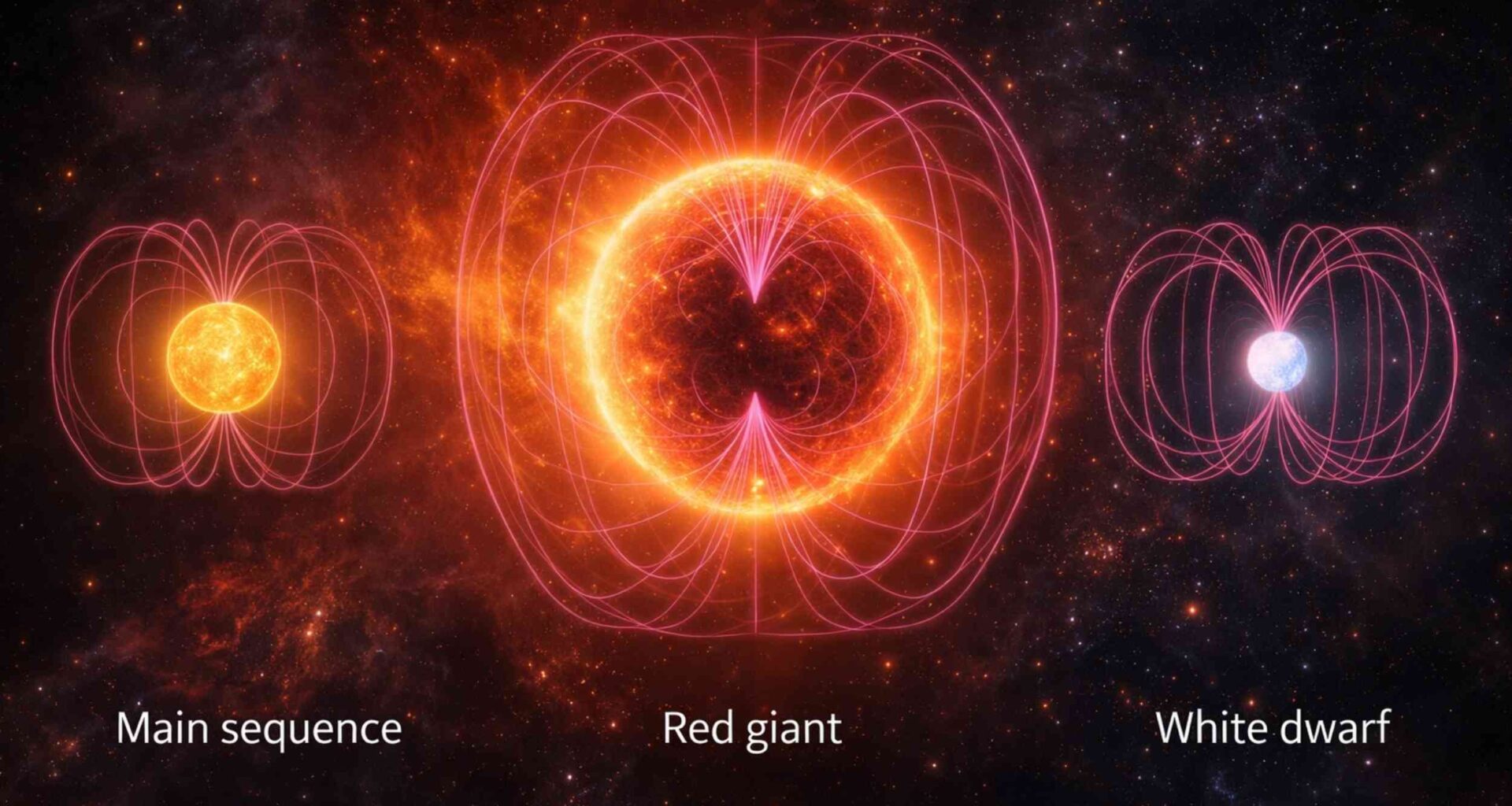
Researchers have found that magnetic fields buried deep inside stars can survive their entire lifetimes and later reappear on white dwarfs, the dense stellar cores left behind after stars exhaust their fuel.
That continuity links the hidden interiors of dying stars to the visible surfaces of stellar remnants, reshaping how stellar magnetism, the magnetic fields generated and sustained within stars, is understood across time.
Buried clues connect

Inside dying red giants, large aging stars that have expanded after exhausting core hydrogen, vibrations revealed magnetic fields buried far below the surface.
By linking those signals to later observations, Lukas Einramhof, Ph.D. student in astrophysics at the Institute of Science and Technology Austria, (ISTA), showed that the same fields can reemerge on white dwarf surfaces.
Those results hold only when magnetism extends across a broad interior region rather than remaining confined to a small central zone.
That constraint narrows the possible origins of stellar magnetism and sets up the deeper explanation that follows.
Starquakes and magnetism
Astronomers read those hidden layers through asteroseismology, the use of starquakes to probe a star’s interior, in red giants.
Those vibrations change when magnetism blocks some internal waves, letting researchers infer fields far below the visible surface.
Hundreds of low-luminosity red giants in a 2024 survey showed signs of buried core magnetism, giving the new model a firmer starting point.
“Because a white dwarf is the exposed core of a red giant that has shed its outer layers, these different observations essentially examine the same region of a star’s interior at different evolutionary stages,” said Einramhof.
A broader core
Field strength alone did not solve the puzzle, because the model needed magnetism to occupy more of the star.
In the red giants anchoring the calculations, inferred fields matched magnetic signals already seen in starquakes, natural oscillations in a star that reveal its internal structure.
That broader radiative zone, a stable layer where energy moves mostly as light, let weaker ancient fields remain relevant.
“However, this doesn’t mean the stars are more strongly magnetized, only that the magnetic fields must already reach a larger portion of their core,” Einramhof said.
Shells not centers
As the star swelled and reworked its inside, the magnetic field no longer stayed strongest at the center.
The simulations showed a shell-like layout, with the field compressed into a hollow layer near a zone of active fusion.
By the time white dwarf cooling began, that layer sat about 35 percent of the way out from the core.
That geometry matters because it can reach the surface after millions of years, instead of staying buried too long.
Old remnants answer
Old white dwarfs had posed the mystery for years, because magnetism appeared more often as these stellar remnants aged.
Nearby surveys showed white dwarfs rarely showed magnetism early, then increasingly did so after one to three billion years.
That delay fit a fossil field, a magnetic field preserved from youth, better than a signal created only at the end.
The model does not erase other ideas, but it gives ancient magnetism a stronger claim on the evidence.
Ruling out shortcuts
One popular route now looks too narrow, because fields born only in a young star’s churning core stayed buried.
By the red giant phase, those fields sat below the layer that starquakes can sense most clearly.
Those results ruled out a simple core dynamo, a field generator driven by moving charged gas, as the full answer.
It also failed to explain two very young magnetic white dwarfs, reminding astronomers that more than one route may exist.
Rewriting stellar aging
A durable inner field could do more than survive, because magnetism can redirect motion, heat, and matter inside stars.
When magnetic forces stir material across layers, fresh hydrogen can move inward and keep nuclear burning going longer.
For our own Sun, a 4.6-billion-year-old star, that possibility matters, because it will also pass through red giant and white dwarf stages.
Any forecast of stellar lifetimes, rotation, or internal mixing stays incomplete until astronomers know how common these hidden fields really are.
The Sun’s core
The Sun sits at the heart of that uncertainty, because nobody has yet measured whether its deep core is magnetic.
“We still don’t know whether the sun’s core is magnetic,” Einramhof said, framing the biggest unknown behind these stellar forecasts.
If strong fields pull hydrogen inward, the Sun could burn that fuel longer than standard models now assume.
A magnetic core could also alter rotation and internal mixing, so even a familiar star keeps one major secret.
What remains hidden
The model still leaves important loose ends, because nobody yet knows whether the shell-like field stays stable for billions of years.
It also left out some later episodes, including a short-lived churning core that forms during helium fusion.
Answering both problems will require 3D simulations, full computer models that track structure, and more magnetic measurements in young white dwarfs.
Those tests could show whether fossil fields are common, rare, or just one piece of a messier magnetic history.
Star magnetism across ages
From subtle vibrations inside aging stars to magnetism on their compact remnants, the evidence now points to a single long-lived internal process.
Future observations will decide how often stars keep that inheritance and when it breaks, reshaping forecasts for stars, remnants, and the Sun.
The study is published in Astronomy & Astrophysics.
—–
Like what you read? Subscribe to our newsletter for engaging articles, exclusive content, and the latest updates.
Check us out on EarthSnap, a free app brought to you by Eric Ralls and Earth.com.
—–