
The ‘T’ Space gallery, seen in March, anchors an arts and architecture campus that includes residencies, lectures, performances, tours and an extensive archive of architect Steven Holl’s work.
Susan Wides
RHINEBECK — Just a few miles outside the village, deep in the woods near Round Lake, a cluster of buildings offers an extraordinary look at the work of one of the world’s leading architects.

Since the mid-1990s, Steven Holl has retreated to the Hudson Valley from his offices in New York City and Beijing. Known for his imaginative, ecologically sensitive design of major museums, campuses, urban complexes and domestic spaces, Holl has created a quieter, more intimate body of work in the woods of Dutchess County.
Article continues below this ad
That vision took form in 2010 with the founding of the Steven Myron Holl Foundation and the opening of the ‘T’ Space gallery, a narrow, T-shaped building that now anchors a broader cultural campus. What began as a small exhibition space has grown into a multidisciplinary program that includes artist residencies, lectures, performances, tours and an extensive archive of Holl’s work dating to 1977. The foundation’s mission is “to stimulate critical and theoretical exchange of ideas” across architecture, art, design, music, poetry and ecology.
Over time, the campus has expanded both programmatically and physically.
In 2014, Holl purchased 28 acres of forested rock outcropping adjacent to Round Lake that had been slated for residential development. Before building anything, he invited poet and Bard College professor Robert Kelly to respond to the site. Kelly’s poem, “Phases of Earth,” called for sublimity, prompting Holl “to offer this land to heaven and see what comes.”
Make the Times Union a Preferred Source on Google to see more of our journalism when you search.
Add Preferred Source
The parcel, now known as T2 Reserve, includes three structures that reflect Holl’s experimental approach.
Article continues below this ad
Holl reimagined a former 1959 hunting shack as “Space T2,” a studio lit by seven angled skylights designed to channel natural light. Nearby sits the “Explorations of IN” guest house, a sculptural structure derived from intersecting geometric forms. Built from carved wood and recycled glass, it serves both as a residence for visiting artists and academics as well as a short-term rental (one of the best in America, according to Forbes) that financially supports the foundation.
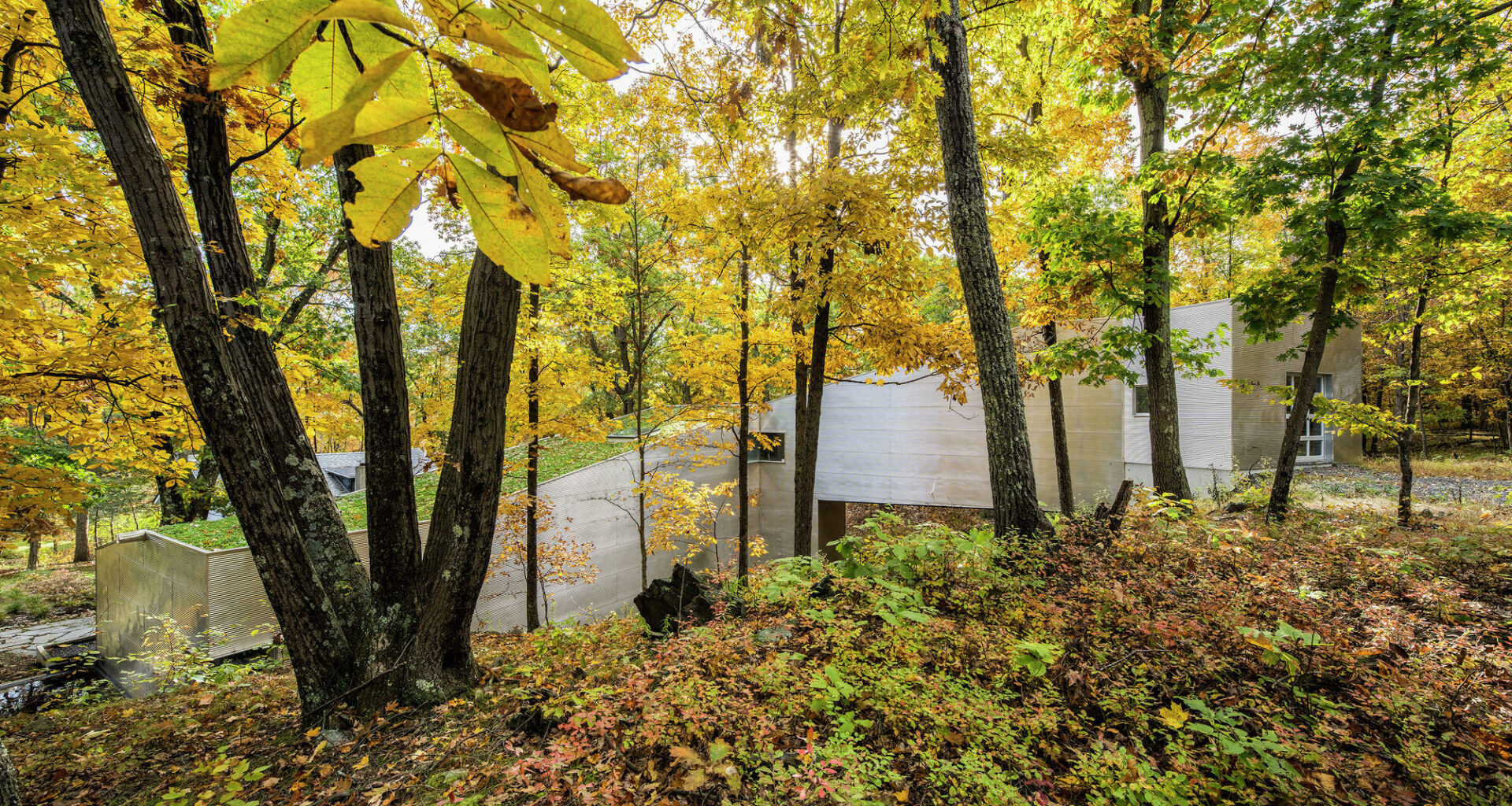
The buildings on the campus are designed to blend into and channel the natural environment.
Paul Warchol
The buildings on the campus are designed to blend into and channel the natural environment.
Paul Warchol
“Steven runs his office in much the same way one would run a school of architecture. He comes up with initial watercolors and sketches, which are built into models and drawings that are critiqued by the office, the same way you do in school. All voices are heard; it’s very democratic that way,” said Garrick Ambrose, an architect and former senior associate at Holl’s firm who curated the “Hudson Valley Homes” exhibition on view through May 3.
“There are material and spatial experiments happening around the office, a kind of laboratory of architectural ideas,” Ambrose added. “He has this notion that each project has an idea that drives the design.”
Article continues below this ad
Another key addition is the Architectural Archive and Research Building, a 1940 bungalow expanded in 2019 and 2023. Designed to minimize environmental impact, the structure uses geothermal heating and cooling, a green roof and solar panels to achieve net-zero emissions.
Inside, the archive holds more than 1,200 models, 4,400 books and 20,000 watercolors. There’s also furniture, correspondence and material samples documenting Holl’s process, from early concepts to finished works like a major expansion of the John F. Kennedy Center for the Performing Arts or the complex of towers interlinked around a public park in Beijing.
“His design approach is highly iterative rather than linear, and this makes it fascinating to see the evolution of a project from its initial concepts,” Ambrose said. “I’ve seen projects go through as many as 15 different schemes before arriving at the final direction.”
The Architectural Archive and Research Building holds more than 1,200 models, 4,400 books and 20,000 watercolors by Steven Holl. It also has a green roof.
Yoshio Futagawa, Susan Wides
The Architectural Archive and Research Building holds more than 1,200 models, 4,400 books and 20,000 watercolors by Steven Holl. It also has a green roof.
Yoshio Futagawa, Susan Wides
The Architectural Archive and Research Building at ‘T’ Space in Rhinebeck.
Yoshio Futagawa
The surrounding woodland remains largely untouched, an “experimental topological landscape” in Holl’s words. But the foundation has also taken active conservation steps. A 2023 ecological survey by Hudsonia documented more than 200 plant species on the property — about 80% native to New York — along with sensitive habitats and forest-interior bird species.
Article continues below this ad
“The Hudsonia work is helping us shift from an intuitive relationship to the land to a much more informed, long-term approach: protecting seed trees, supporting native species, and thinking carefully about climate resilience,” ‘T’ Space Curator and Director Susan Wides said.
Outdoor ideas, indoor art
Beyond its architecture, ‘T’ Space has become a significant venue for contemporary art in the Hudson Valley.
The gallery itself is a tall, narrow building designed to engage directly with its surroundings. Elevated on nine steel columns and wrapped in cedar slats, the structure filters light and forest views into the interior. Windows around and atop the building give the space a porous quality, drawing weather and light inside. As conditions shift, so does the mood of the gallery: On clear days, shafts of sun spotlight the works on the walls; on rainy days, ripples silently emanate against the ceiling panes, distorting the sight of the sky and trees above. The structure is as deferential to the environment as it can be while still offering shelter.
Article continues below this ad
Architect Steven Holl speaks to members of the press and guests during a preview of the REACH, an expansion project, at the Kennedy Center in Washington, D.C., on May 29, 2019.
Anna-Rose Gassot/AFP via Getty Images
“Steven’s idea was that when you come in, there’s always something around the corner, unlike a white cube, where you see everything all at once,” Wides said. “It’s amazing to bring these views that are from the natural world into the interior. The exchange is really special. It’s so simple, but it’s not so simple.”
The gallery was inaugurated in 2010 with an exhibition of paintings and sculptures by Jim Holl (brother to Steven and husband to Wides). He set a precedent in his imaginative engagement with the building, placing his metaphysical abstractions at odd heights inside and hanging sculpture from the exterior. Since then, ‘T’ Space has hosted more than 40 exhibitions featuring prominent artists such as Brice Marden, Martin Puryear, Carolee Schneemann and Ai Weiwei, alongside poetry readings and musical performances.
“Everyone deals with this space differently,” Wides said. “The shows transform the space, and the space informs the shows.”
Article continues below this ad
Wides is speaking from experience. She is also a fine art photographer whose work is in the collections of The Brooklyn Museum, International Center of Photography and many others. Her latest presentation, “Voice of Silence,” borrows its title from Kelly’s poetic response to the suite of photographs made along the Kaaterskill, Catskill and Plattekill creeks (all tributaries of the Hudson).
Susan Wides’ “Voice of Silence” is on view at ‘T’ Space through May 3.
Susan Wides
The images employ a formal device recurrent in Wides’ work: the coalescence of abstraction and figuration, achieved through the skillful arrangement of depth. Foliage out of focus in the foreground registers as a gradated field of color, and each print emits an emotional aura; beyond the blur of flora, crystalline droplets of rushing water are frozen in time.
Article continues below this ad
Bright, organic and musical, the show is presented alongside Peter Halley’s buoyantly hued wall paintings, originally installed for a 2024 exhibition and now a permanent feature of the gallery. The exhibition is ‘T’ Space at its best, bringing together photography, painting, architecture and poetry in joyful contemplation of the natural world.
‘T’ Space Rhinebeck
“Voice of Silence” and “Hudson Valley Homes” are on view through May 3.
Two exhibitions are planned for the summer and fall: a collaborative installation by artist Anne Lindberg and poet H.L. Hix, and a show of furniture made by artists and architects alongside sculpture by Margaret Saliske.
The galleries and archive are open to the public, with tours available by appointment.
Where: 60 Round Lake Road, Rhinebeck
Info: tspacerhinebeck.org