
There’s no formal doing of the numbers. Detractors desire that Luxon, faced with the fact that he’s lost or is losing his internal mandate, might just resign with dignity.
Of course, they would say that.
While there are plenty of people who want to be the National Party leader, no one wants to get their hands dirty. It’s not that these MPs are lazy, but they judge, correctly, that a bloody leadership battle wouldn’t just undermine the leadership of Luxon, it could taint the leadership of anyone who followed him.
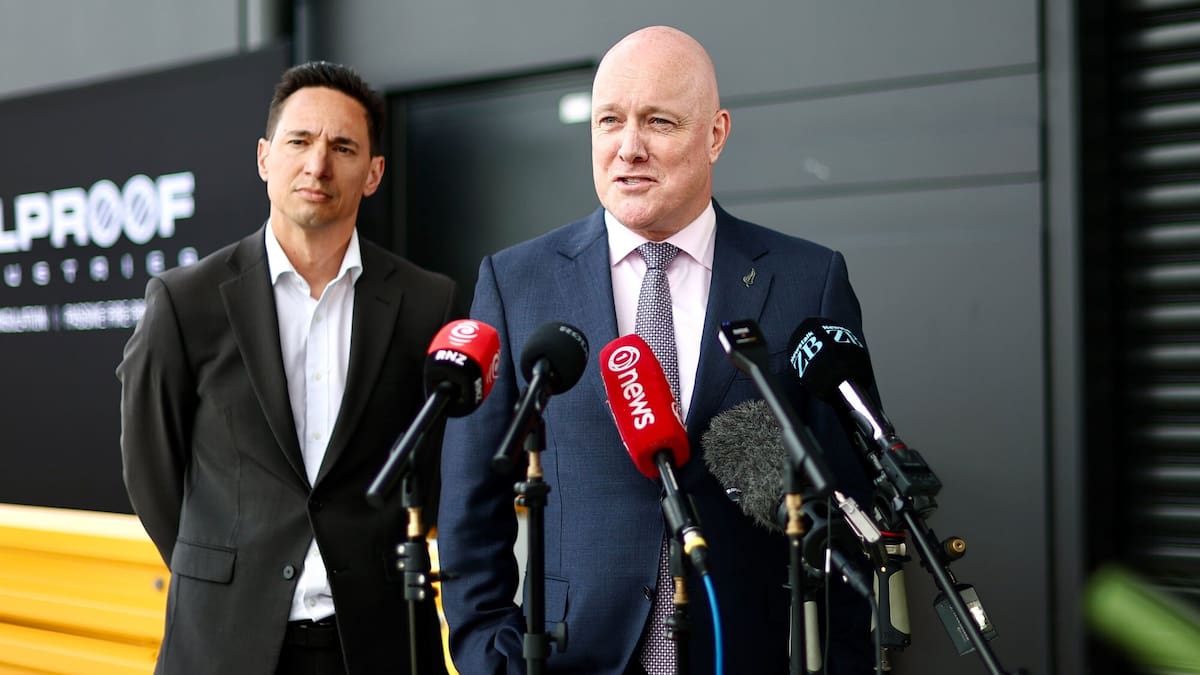
Prime Minister Christopher Luxon addressed questions about his leadership on Friday. Photo / Dean Purcell
If you’re to turn National around and fight a difficult election against the backdrop of economic headwinds, you need to start with as much political capital as possible. You probably don’t get that political capital by seizing the leadership in a messy, bloody contest. In fact, doing so may mean the next leaders begin the job with less political capital than Luxon.
That’s why the resignation aspect is so important.
But Luxon seems very unlikely to resign.
He lacks many things, but self-confidence is not one of them.
It is not in his nature to quit. The only way he would resign is if he were faced with concrete evidence he had lost not just a majority of caucus, but a clear, large majority.
He would resign then only because his only other option was to lose the leadership in a bloody, humiliating struggle. He’d be remembered as the leader who clung to power so long he had to be dragged out of the Beehive by his own MPs.
While it is possible that Luxon has lost the support of a majority of caucus (some MPs spoken to by the Herald and other media reckon this is true), it may also be true that no single candidate has the numbers to replace Luxon.
This makes it harder for any challenger to trigger a vote, because there is a decent chance they might lose it. Even people who fancy a change might not support a challenge if it’s led by the wrong person.
Again, that is why so much emphasis is being put on Luxon stepping aside. Once the status quo is no longer an option, it becomes far easier for Luxon’s challengers to shore up the numbers.
That’s also why there is no coup – and no formal challenge.
What is going on isn’t a case of swapping one person for another, but forcing Luxon to realise he can’t go on as it is.
Not only do MPs not collectively want to get their hands dirty. No one potential leader wants to be the one who does the rolling for fear that that person will not be the one who ends up as leader.
National MPs, keen watchers of Australian politics, will well remember that while Peter Dutton led the charge to roll Prime Minister Malcolm Turnbull in 2018, it was Treasurer Scott Morrison, the man who stood beside Turnbull saying “this is my leader and I’m ambitious for him”, who eventually walked away with the leadership only days later.
Luxon himself ended up as the leader after Simon Bridges’ attempt to roll Judith Collins ended up torching them both.
Scott Morrison pledging support for then-Prime Minister Malcolm Turnbull days before Turnbull was rolled and Morrison became leader. Photo / via Twitter
Could the avowals of loyalty from Nicola Willis, Morrison’s equivalent in the New Zealand system, be read the same way?
“The hand that wields the knife shall never wear the crown”, as the adage goes. It has a domestic corollary, which is that candidates don’t necessarily seek the leadership, but if it were to “pop out the back of the scrum” then it would be unsporting not to take it.
That’s also true of rumoured leadership contender Chris Bishop. He too isn’t doing the numbers and pledged loyalty to Luxon in interviews yesterday morning, but if the ball popped out from the scrum, it’s clear he’d try to get his hands on it.
Detractors continue to point towards Luxon’s poor performance in public, which diminishes the public’s confidence in a time of national crisis. After his roundly criticised first press conference on the Iran war, in which he struggled to articulate a position on whether the United States could carpet bomb Iran, Luxon has tended to front updates with other ministers.
Finance Minister Nicola Willis (right) has been out jogging in Washington DC with other Finance Ministers. Photo / Instagram
On Wednesday, with Willis in Washington DC, Luxon fronted the update alone. He was flummoxed when asked questions about a delayed shipment of fuel, saying he was “only aware of it in a cursory thing because [the Herald] brought it up [sic]”.
This was despite the delayed shipment being flagged in a press release before Luxon’s stand-up.
These repeated gaffes erode confidence.
So too did Luxon’s response to the Herald’s revelation, published on Friday morning, that party whip Stuart Smith tried to contact the PM before Easter with evidence of his flagging support in caucus, but that Luxon ghosted him.
Luxon’s office, for their part, said the PM “has a busy diary, but is always available to MPs” and managed to see Smith two weeks after Smith had tried to make contact, when he visited Smith’s electorate on Tuesday.
On Friday, at a stand-up, Luxon used the fact that he had seen Smith that Tuesday to deny that he had effectively “ghosted” Smith’s requests to talk about his flagging support.
“That’s just wrong, I saw Smith on Tuesday, I was travelling in North Canterbury with him all day,” Luxon said.
The original story noted the Tuesday visit, but was substantively about the fact that Smith could not contact Luxon the week before Easter, a fact not denied by Luxon.
The original Herald story cited three sources for this. On Friday a fourth source, from caucus, confirmed they knew Smith had gone to Luxon to flag his diminishing support with caucus and that Luxon had not met with him. That source reckoned a large number, perhaps a majority, of caucus knew about Smith’s effort to contact Luxon.
This MP believed the outcome of Stuart Smith’s meeting with Luxon should have been a caucus meeting where the issue of Luxon’s continued leadership was decided. There’s a good reason Luxon has avoided that meeting.
Testing leadership in caucus is the effective end of his premiership. He may survive a vote, but the fact he was forced to go to one in the first place will undermine his leadership.
National’s party whip, Stuart Smith. Photo / Mark Mitchell
These public denials of this fact may bolster Luxon’s position in the eyes of the public, but they weaken his position in the eyes of the caucus, who know the story to be true, in some cases because they were the MPs who put Smith up to it.
Luxon seems to have forgotten it’s the caucus who may have a say over his leadership before the public does.
Now, the PM will not just have to explain to MPs what he thinks of their flagging confidence in him and his decision not to meet the whip; he’ll be forced to explain why he so strongly denied something MPs know to be true.
What happens next?
The Herald has spoken to several MPs and a number of staff. There is a unanimous view that the first step is to see whether Luxon will go of his own accord.
It will become clear next week whether that happens and whether Smith does, in caucus, or in some other forum, present Luxon with evidence of caucus unhappiness. What will that lead to? No one knows at this stage.
If Luxon clears that hurdle, then the ball goes back to the detractors. If Luxon will not resign, do they have the guts to launch a formal challenge, getting their hands dirty in an effort to win power?
Maybe – but potentially in week two of the two-week sitting block.
If they decide not to, Luxon will survive, probably until the Budget, which will be delivered next month and which would be a politically dangerous time to roll a leader.
Cartoon / Guy Body
But should Luxon survive that far, he won’t be out of the woods. Jacinda Ardern established a precedent for a successful leadership change right up to the election campaign (Ardern, obviously, did this from opposition, a significant difference).
Luxon will be dogged by instability as long as he can’t improve his party’s polling, and there’s every chance that he can’t. He’s personally unpopular and facing down severe economic headwinds. There’s every chance he’s dogged by leadership speculation until the campaign actually gets underway.
This, no doubt, factors into the mind of waverers, who – seeing an inevitable coup at some stage – may decide “t’were well it were done quickly”, in the words of Macbeth, patron saint of regicides.
Ordinarily, the longer this destabilisation goes on, the worse it could get for the plotters. Destabilising without having the gumption to actually challenge the leadership just looks like someone putting personal ambition above what’s good for the party.
But this plot is quite different. It’s the front bench gathering around Luxon and the back bench that is agitating for change. They’re right to be agitating for change because on current numbers, many will be out of a job come November.
The person who looks like they’re putting themselves before the party isn’t any one plotter, it’s Luxon himself.