
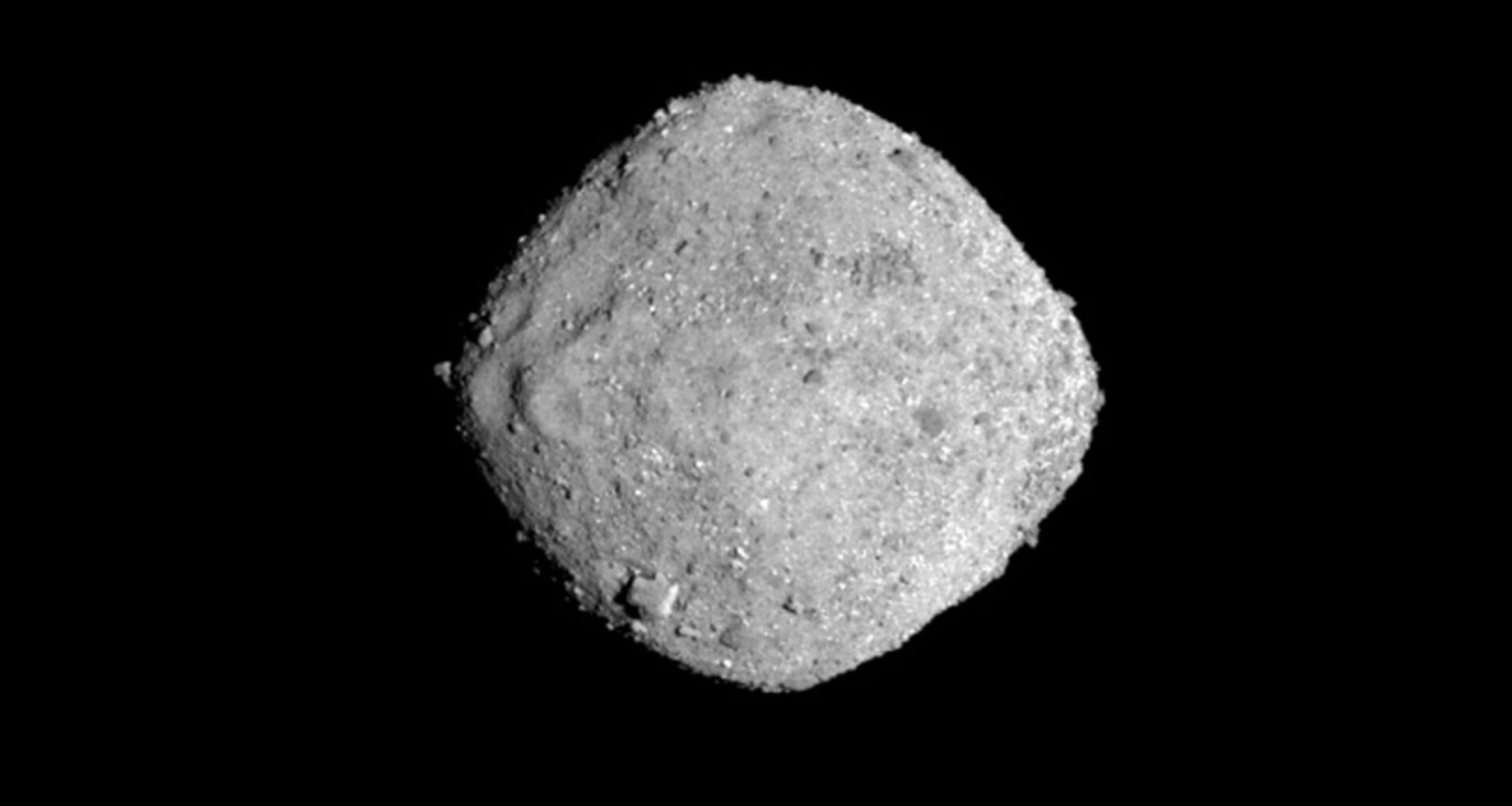
A new analysis has revealed that water once moved through a small asteroid called Bennu in narrow channels, carving its material into three sharply separated chemical zones.
That hidden pattern helps explain how fragile carbon-based material survived in some pockets while minerals formed in others, preserving a more detailed record of Bennu’s past.
Reading the nanometer scale

Inside the Bennu fragment called OREX-800066-3, certain boundaries appear at an almost unimaginably small scale, where neighboring patches hold very different chemistry.
The samples were analyzed by Professor Mehmet Yesiltas and colleagues at Stony Brook University.
The team matched the split pattern to water that had altered some areas and left others largely untouched.
Instead of blending into one chemically mixed material, the sample preserved distinct pockets that record different stages of Bennu’s history.
That sharp separation renders this finding significant and shows why the rest of Bennu’s chemistry needs to be read zone by zone.
A pristine clue from space
NASA’s OSIRIS-REx mission returned material from the asteroid Bennu to Earth on Sept. 24, 2023, giving scientists direct access to its original chemistry.
Unlike meteorites, the OSIRIS-REx sample did not need to survive a fiery atmospheric plunge before scientists could open it.
As a result, Earth’s air and moisture had fewer chances to rewrite chemistry once the grain was accessible to scientists.
With so few pristine asteroid samples on hand, every hidden pattern in this grain becomes harder to dismiss.
Chemistry divided into distinct regions
Across that fragment, researchers found three recurring zones instead of one that blended a mixture of rock and carbon-based material.
One part of the sample held simple carbon chains, while another was packed with mineral material that had formed in the presence of water.
A third area preserved a different kind of carbon-rich material that tends to break down when water exposure lasts too long.
Because these areas barely overlapped, the sample captured separate moments in its history instead of one fully mixed process.
Tracing pathways of ancient fluid
A clearer signal came from sulfur-linked material that showed up almost entirely in the mineral-rich areas.
In those spots, water had once moved through and left behind dissolved material as it settled.
In contrast, other areas kept their original chemistry because the water either missed them or passed through too lightly to cause any change.
From that route, one grain can preserve both mineral growth and fragile chemistry, as seen side by side.
Protecting prebiotic chemistry
Survival may be the most striking part of the result, because fragile nitrogen-rich chemistry often disappears during long contact with liquid water.
“These findings carry broader significance for planetary science and astrobiology,” said Yesiltas.
Keeping that chemistry intact matters because small bodies may have transported ingredients for other purposes without erasing them first.
A record etched in salt
Earlier Bennu studies had uncovered salts left by an ancient brine, salty water loaded with dissolved material.
Evaporation had already been shown, but the new map explains why some microscopic neighborhoods had different chemistry than the others.
Salt deposits fit a larger earlier asteroid that held liquid only in certain places and at certain times.
Seen together, the results suggest Bennu formed from material shaped in several watery environments instead of one simple, body-wide episode.
Hidden structure within a single grain
At about eight ten-millionths of an inch, or 20 nanometers, the sample stopped looking chemically average and started showing borders.
Broader scans can smooth out those borders, hiding the kind of local history that decides what survives and what forms.
Reading the grain point by point kept neighboring signals from blurring into one chemical average.
At that detail, one tiny OSIRIS-REx sample particle becomes a map of where water acted, and where it failed.
Asteroids altered by water
Japanese samples from asteroid Ryugu had already shown widespread water alteration, but Bennu now looks less chemically even at the smallest scales.
A Ryugu study linked its diverse organics to variable water processing, setting up a useful comparison.
Bennu shares that history of water and carbon-rich material, yet this grain keeps sharper boundaries between altered and protected zones.
Those differences could reflect how each larger source asteroid handled fluid movement, temperature, and breakup before the modern asteroids formed.
Carriers of prebiotic ingredients
What Bennu offers is not a story about life itself, but a record of chemistry that may have reached early Earth.
Carbon-rich asteroids likely delivered water and reactive molecules across the young solar system, and samples allowed scientists to test that idea directly.
“By extension, it may reveal how organics relevant to prebiotic chemistry may have been delivered to early Earth via carbonaceous asteroids and may have played a role in the chemical processes that might have eventually led to life,” said Yesiltas.
Even so, the sample cannot say whether those ingredients ever assembled into biology, and the researchers did not claim that.
A fuller map of asteroid water history
Bennu now reads as a body where water, minerals, and fragile carbon chemistry shared space without being mixed beyond recognition.
Further work on other grains, and comparisons with Ryugu, should show whether hidden channels were common or unusually well preserved.
The study is published in Proceedings of the National Academy of Sciences.
—–
Like what you read? Subscribe to our newsletter for engaging articles, exclusive content, and the latest updates.
Check us out on EarthSnap, a free app brought to you by Eric Ralls and Earth.com.
Image Credit: NASA
—–