
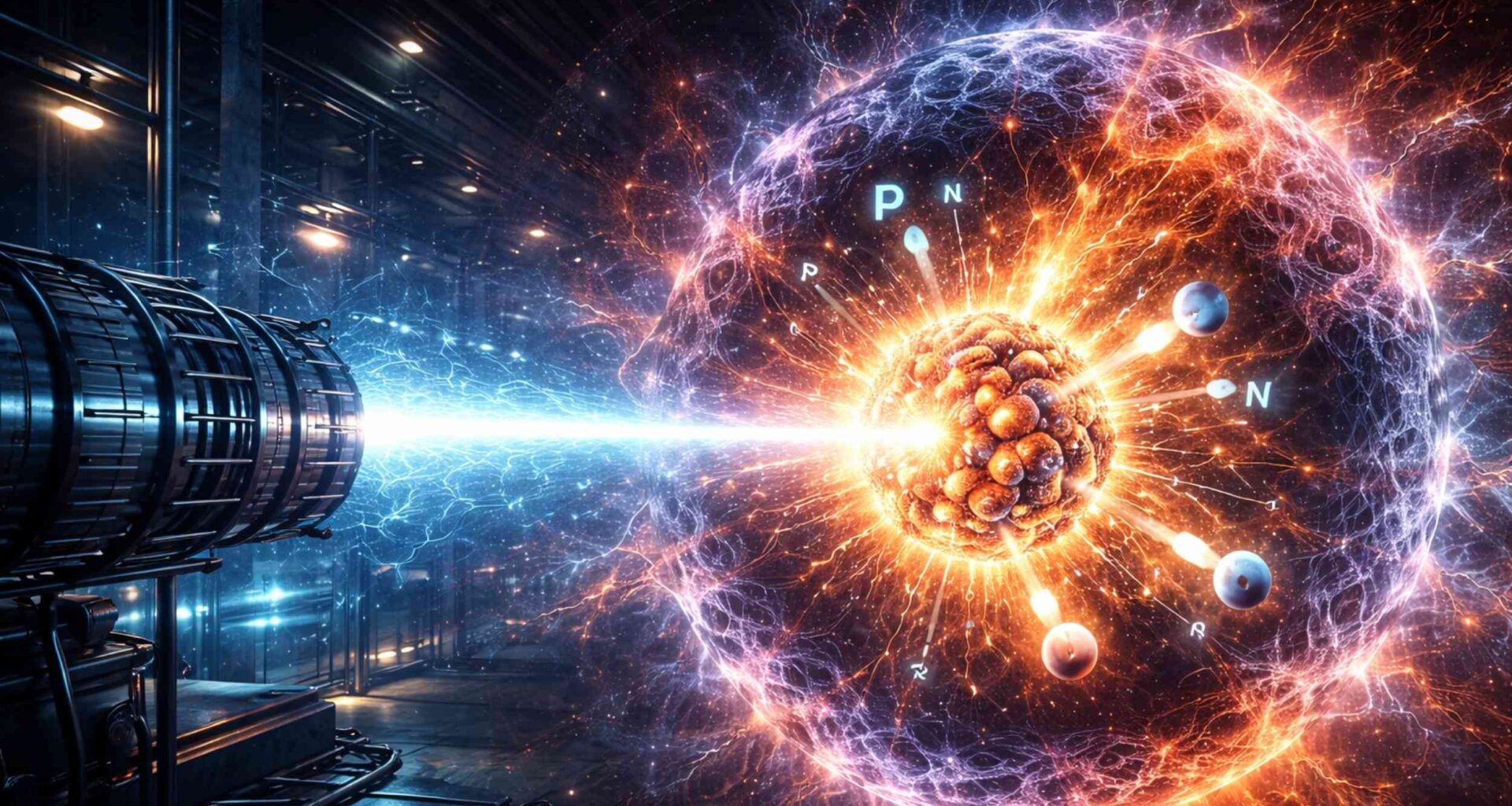
Scientists have directly measured the reaction that produces a rare, hard-to-explain form of selenium, capturing for the first time a rare step long thought to unfold inside exploding stars.
That finding tightens one of astrophysics’ oldest loose ends, even as it exposes a deeper gap in how scientists explain the birth of rare elements.
Inside the detector

Inside a hydrogen-filled chamber at Michigan State University’s Facility for Rare Isotope Beams (FRIB), a rare form of arsenic met the conditions needed to transform into a rare form of selenium.
Artemis Tsantiri and colleagues documented the transformation as arsenic-73 captured a proton and became selenium-74.
For years, the same step had remained one of the least certain parts of the story, because scientists had no direct measurement to pin it down.
Now that the reaction has been measured, the mystery has narrowed, and the remaining mismatch demands a broader explanation.
Why selenium stands out
Selenium-74 belongs to the small family of p-nuclei, proton-rich versions of elements that usual neutron-building routes skip.
Most heavy elements grow when nuclei absorb neutrons and later settle down by radioactive decay into stable forms.
The usual neutron-building script leaves selenium-74 out, making it the lightest member of a rare group scientists have argued over for decades.
Placed oddly on the chart of elements, selenium-74 makes any direct measurement unusually valuable, because the missing steps have been hard to test.
Heat inside supernovae
One favored explanation puts selenium-74 together inside a gamma process, a chain of light-driven nuclear breakups in superheated stars.
In that heat, powerful gamma rays knock neutrons and other particles off older nuclei, pushing matter toward proton-heavy forms.
Afterward, some of those unstable products change a proton into a neutron and survive as the unusual isotopes we observe.
Trouble starts because many of the nuclei along that route vanish quickly, which has kept crucial reaction rates mostly theoretical.
Building the beam
To run the experiment, the team had to make arsenic-73 itself, an unstable material rarely available for direct tests.
Chemists prepared the isotope, then engineers ionized it, accelerated it, and sent it toward hydrogen gas at the detector’s center.
FRIB could do that because its secondary accelerator can work on its own, not only as part of the main machine.
Working independently matters far beyond selenium, since other short-lived nuclei can now be prepared for experiments once written off.
Energy released in a flash
After proton capture, the new selenium-74 carried excess energy and quickly shed it as gamma light.
The gamma burst let the detector count how often the reaction happened, which gave the team a handle on the rate.
Astrophysicists care especially about the reverse destruction step, because blazing stellar photons can break selenium-74 apart during an explosion.
By measuring the forward reaction in the lab, the researchers could pin down that harder-to-catch reverse process in stars.
Narrowing down the strength
Before this result, standard calculations let the reaction’s strength wander across a very wide range of possible values.
One higher-energy measurement strongly anchored that spread, even though a lower-energy point still remained noisy.
When the team fed the constrained rate into supernova simulations, the uncertainty in selenium-74 abundance dropped by about half.
Cleaner numbers did not settle everything, but they removed a favorite excuse for why models had been disagreeing.
The mismatch remains
Even with cleaner data, Type II supernova models still make too much selenium-74 compared with the solar system record.
Instead, the mismatch probably sits partly in the stellar setup, such as temperature, density, or the starting mix of nuclei.
According to the researchers, nuclear physics alone could not erase that excess, a conclusion that forces attention back onto the explosion itself.
Removing one uncertainty so clearly made the remaining problems in supernova models harder to ignore.
Testing additional stellar reactions
More than 45 scientists from 20 institutions joined the effort, reflecting how difficult measurements with short-lived atoms still are.
“Even though the origin of the p-nuclei has been a topic of study for over 60 years, measurements of important reactions on short-lived isotopes are almost non-existent,” said Tsantiri.
He noted that experiments like this have only recently become feasible, thanks to advanced facilities such as FRIB.
The implications reach beyond this isotope, because the same tools can now test other stellar reactions once left to theory.
Future research directions
With this result in hand, researchers can attack neighboring reactions that shape other rare proton-rich elements.
Each direct measurement replaces a theoretical placeholder with data, which makes stellar origin stories less guesswork and more testable physics.
FRIB was built for exactly that kind of work, using short-lived nuclei that almost never sit around long enough to study.
As more of those reactions are measured, astronomers should get a firmer read on which explosions actually forged the rarest isotopes.
The experiment showed that one missing nuclear step could finally be measured on Earth, and that precision changed what models can claim.
Yet the leftover mismatch keeps the bigger mystery alive, pointing scientists toward better supernova conditions and more direct tests.The study is published in Physical Review Letters.
—–
Like what you read? Subscribe to our newsletter for engaging articles, exclusive content, and the latest updates.
Check us out on EarthSnap, a free app brought to you by Eric Ralls and Earth.com.
—–