
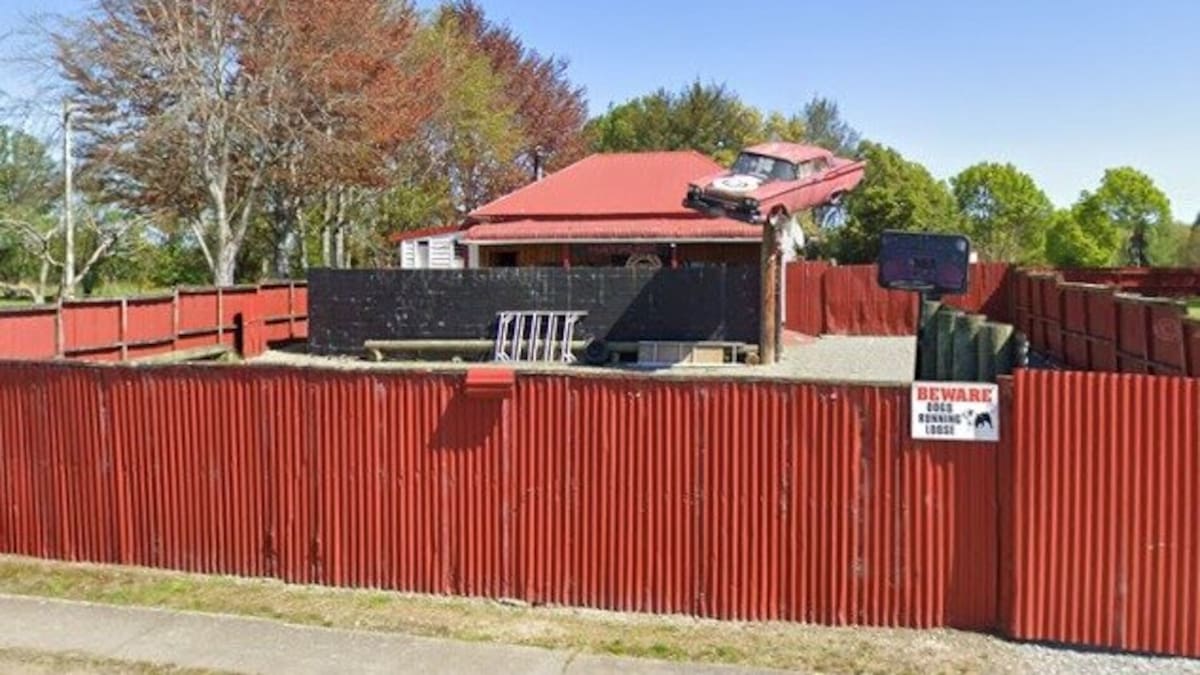
The Crown is seeking forfeiture of the Albion St property. A restraining order made against it under the Criminal Proceeds (Recovery) Act allows authorities to confiscate assets accumulated through significant criminal activity.
The property is registered in the name of Elers and, while the order is against his son, Turoirangi Atarea Harmer-Elers, the current chapter president of the Mataura Mongrel Mob, Elers has made a claim for relief.
The Crown alleges Harmer-Elers had control of the property between January and November 2022 when it was the scene of several beatings.
His father disputes it.
Police have told the court that the victims were assaulted at the property or at their homes before being kidnapped and taken to the pad.
Police execute search warrants at the property in June 2023. Photo / NZ Police
Harmer-Elers is serving a prison term of three years and four months for kidnapping and assault with intent to injure, relating to the beating of a gang member at the property in August 2022.
The violence was related to an internal gang feud, which prompted a spree of violent crimes that year, including drive-by shootings and assaults that left people critically injured.
Operation Pakari, the police response to the violence, resulted in the prosecution of six gang members, who received jail terms ranging from three years and four months to six years.
The property was for ‘everyone’
The Crown argues Elers knew the pad was being used for criminal activities, even after leaving it in the hands of his son and others when he left Mataura to live in the North Island in 2013.
Elers told the High Court this week that the property was for “everyone”.
But Thomas, for the Crown, was dubious.
“Are you saying it is some sort of social outreach?” she asked.
“That is from now on, it’s like a marae,” he responded.
Harmer-Elers also attended the hearing. He sat in the dock surrounded by security.
Elers said family, friends, other clubs, shearers, fruit pickers and after-hours workers had stayed at the property over the years.
Some seasonal workers would stay for the season.
There was no requirement that they be Mob members, Elers said, and many were children.
Thomas said the property was used as the gang’s pad and asked him what he wanted to use it for in the future.
“How I have always wanted, a place of togetherness, growth, learning,” he replied.
She asked him why he had returned to Mataura at the start of 2024.
Elers said it was his property and he wanted to be there, after what had happened.
Police raided the Mongrel Mob Matuara pad as part of an 18-month investigation into the gang. Photo / NZ Police
She asked him if he had said anything to Mob members about the use of the property.
Elers said he had notified family and members of “what it is going forward”.
He told the court he joined the Mob in the 1990s when he was in his late 20s.
He joined alongside his uncles and progressed through the ranks to president when he bought the property in 2002.
Thomas said he set it up as a gang headquarters and then set up his son to take over the role of “boss”.
“You know that property is a gang pad,” she suggested.
“No. It was a marae; it was open to everyone,” he replied.
Thomas said the property was being used as a gang pad while Elers was in the North Island, and others had covered rates and maintenance costs.
“Yes, it was a kaupapa,” he replied.
“You know the Mongrel Mob uses violence to keep people in line,” she said.
“Is that all the Mob?” he asked.
“The Mob as a general group uses violence,” she replied.
“I wouldn’t say all,” he said.
Thomas told the court that the property was clearly an instrument of crime and that, while Elers was the registered owner, his son had control of it.
Ex-president had ‘effective control’
Appearing for Elers, Fiona Guy Kidd, KC, said the sole qualifying offence for the restraining order was kidnapping.
“This is a singular event; it is important, a lot of cases are about ongoing matters. In this case, it is one offence,” she submitted.
“Mr Elers has made a claim for relief that he was not involved in the kidnapping.”
She said the fundamental question was whether Harmer-Elers had effective control of the property, which she submitted he didn’t.
“Exclusive use does not necessarily mean exclusive control; [Harmer-Elers] must have some form of legal interest in the property to have effective control.”
Harmer-Elers couldn’t sell the property, and it was Elers who owned it, in “all senses of the word”, she told the court.
“I suggest his son was a tenant.
“There was no communication to his father that he would do the kidnapping; there was no evidence of violence at the property before Mr Elers went up north.
“We are dealing with one criminal kidnapping, which was not known to him.”
Property wasn’t an ‘instrument’ for offending
Lawyer Oliver Troon, on behalf of Harmer-Elers, submitted it had to be established beyond a reasonable doubt that his client was in complete control of the property.
He said he had not found any similar cases in the same jurisdiction.
“It would be a heightened burden of proof in this jurisdiction.”
Justice Christine Gordon has reserved her decision. Photo / George Heard
Justice Gordon said it would be on the balance of probability.
“The applicant must strike the balance.”
Troon said the property wasn’t an “instrument” of the offending, and the ultimate decision for Justice Gordon was one of discretion.
“It was the home of Mr Elers,” he said.
“A single event at an address doesn’t justify forfeiture.”
Justice Gordon reserved her decision.
Al Williams is an Open Justice reporter for the New Zealand Herald, based in Christchurch. He has worked in daily and community titles in New Zealand and overseas for the last 16 years. Most recently, he was editor of the Hauraki-Coromandel Post, based in Whangamatā. He was previously deputy editor of the Cook Islands News.