
With its market capitalization approaching $5 trillion, Nvidia (NVDA +1.67%) stands at the forefront of the artificial intelligence (AI) revolution. According to a new analysis from Beth Kindig of the I/O Fund, Nvidia has a credible path to a $20 trillion valuation by 2030.
Kindig blends rigorous financial modeling with firsthand insight into the full AI stack, spotting secular shifts that create trillion-dollar winners. Her Nvidia outlook is supported beyond headline sales of graphics processing units (GPUs) and examines the deeper economics of AI infrastructure.
Image source: The Motley Fool.
Nvidia’s valuation reset is creating a compelling entry point
Unlike competitors such as Advanced Micro Devices or Broadcom, Nvidia currently trades significantly below its average three-year price-to-sales ratio (P/S). This discount is peculiar given consistent upward revisions in revenue and profit forecasts from CEO Jensen Huang. The easiest explanation is that investors remain skeptical about the company’s ability to capture incremental market share as AI infrastructure spending from hyperscalers accelerates.
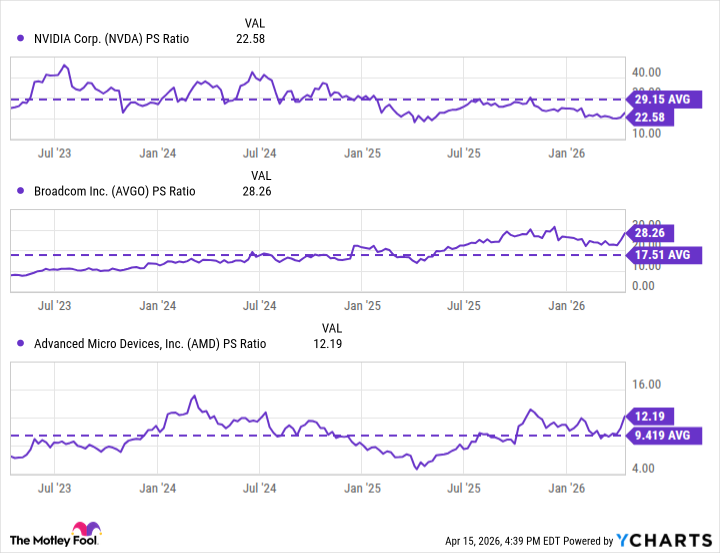
NVDA PS Ratio, data by YCharts.
In order to reach the $20 trillion forecast, Kindig applies Nvidia’s current P/S multiple of 22 to a projected annual future data-center target of $930 billion. Considering this is almost five times its trailing-12-month data center sales, her framework clearly reflects the company’s expanding role beyond GPUs and shift toward building end-to-end AI systems.
Nvidia’s revenue trajectory is well supported
In the near term, the revenue outlook is exceptionally clear. Huang recently guided toward $1 trillion in cumulative sales from the Blackwell and Rubin chip architectures through 2027.
Against this backdrop, analyst consensus estimates have been revised upward. Outlooks for fiscal 2028 sit at $480 billion, while fiscal 2031 projections have climbed to $758 billion, roughly double Wall Street’s expectations from a year ago.
These revisions reflect accelerating capital expenditure (capex) cycles across AI hyperscalers as well as further revenue diversification from networking and other platform services.
The AI inference explosion will unlock addressable market growth
The hidden multiplier for Nvidia’s expansion through the rest of the decade lies in inference — when an AI model refers back to information it already has to make assumptions. As LLM use volume scales up and agentic systems proliferate, demand shifts from simply training models to real-time, high-throughput intelligence. The inference era is programmed for systemwide efficiency rather than isolated chip performances.

Today’s Change
(1.67%) $3.32
Current Price
$201.67
Key Data Points
Market Cap
$4.9T
Day’s Range
$199.28 – $201.68
52wk Range
$95.04 – $212.19
Volume
5M
Avg Vol
177M
Gross Margin
71.07%
Dividend Yield
0.02%
Advances in power and processing efficiency from Nvidia’s next-generation architecture should yield premium pricing and unlock entirely new revenue streams. Even if custom silicon designs win incremental market share, the chipmaker’s ubiquity across evolving workloads — combined with its CUDA software system and evolving networking dominance — ensures that it maintains a prominent position within enterprise infrastructure budgets.
Smart investors understand that exploding inference demands do not erode the GPU market; rather, they multiply Nvidia’s overall addressable opportunity by fueling higher utilization and accelerating capex that are complemented by recurring software revenue.
In the AI infrastructure age, Nvidia’s ability to monetize tokens at scale while simultaneously delivering superior unit economics per megawatt serves as the foundation toward achieving a $20 trillion valuation.