
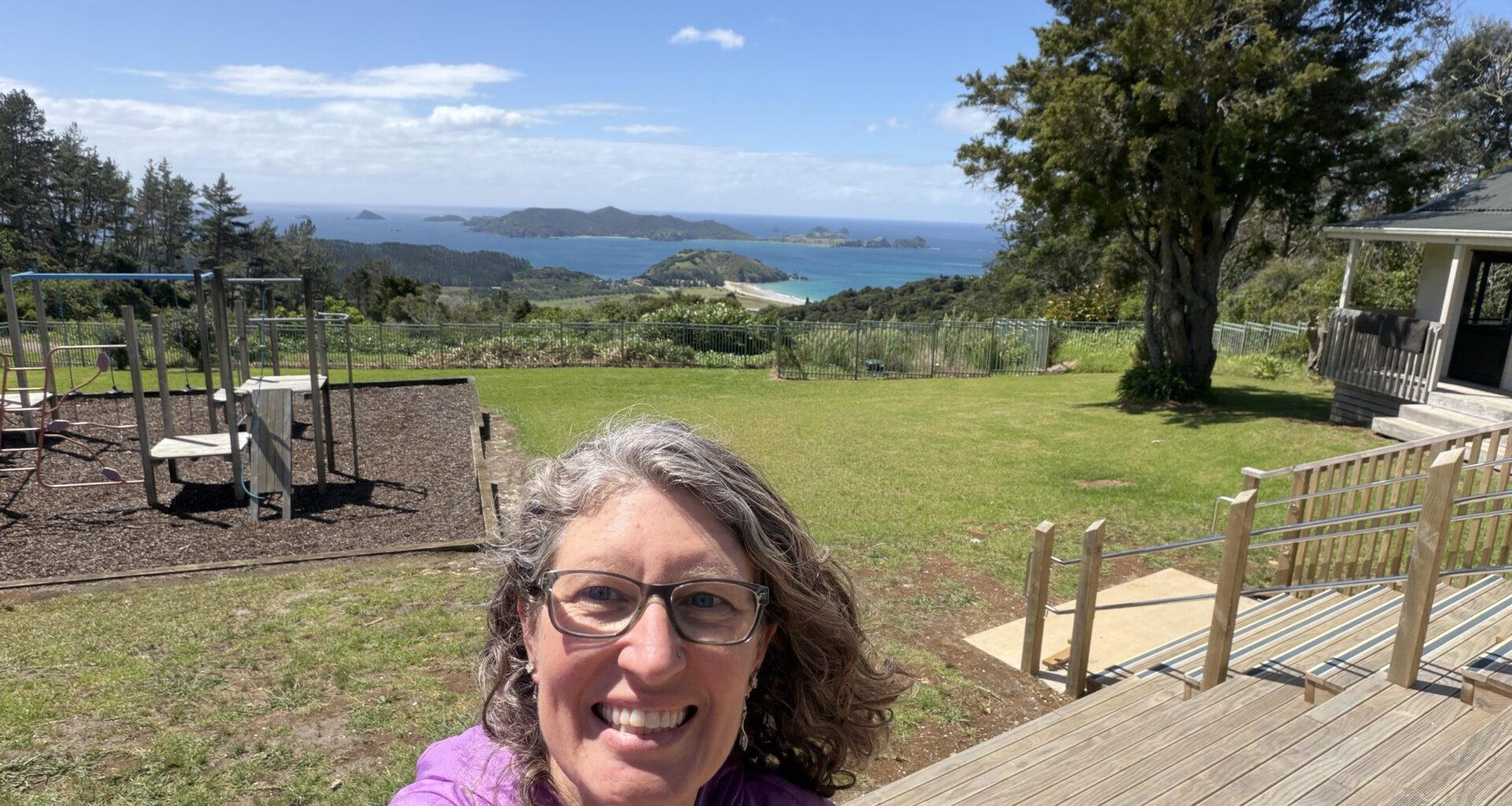
Katie Swick is back in her Union Elementary School kindergarten classroom after spending two weeks touring New Zealand and visiting the local schools there, returning last month.
Her journey began with a class at the University of Vermont: Experiencing New Zealand: Education and Indigenous Culture Integration, organized by UVM Professor Matt Chandler. In an email to The Bridge, he said why he thought this course was a good match for Vermont teachers.
“Vermont schools are becoming more diverse. My goal for this group of teachers was to see how identity can be integrated into the regular curriculum.” The Maori are the indigenous people of New Zealand and, according to Chandler, “the New Zealand curriculum mandates a certain level of the language and culture into grade level expectations.”
The relationship between the Maori and British immigrants goes back to 1840, when representatives of the British crown and a group of Maori leaders signed the Treaty of Waitangi, a covenant that promised to protect Maori lands and to offer the Maori people the rights and privileges of British subjects. The treaty was drafted in both English and Maori, but in the decades following it, the land rights of the Maori were largely ignored, the Maori language began to disappear, and the Maori people themselves were marginalized.
In the 1970s a “Maori Renaissance” led by Maori activists drew new attention to the treaty, the culture, and the language. In the 1900s a child might be punished for speaking Maori in school. Now it’s the official language of the country along with English. Street signs are gradually appearing in both Maori and English (although this movement faces some pushback). Phrases such as “kia ora” (“Hello”) and “la kite ano” (“See you later”) are dropped into casual conversations and the country itself is sometimes referred to by its Maori name, Aerotoa.
When Swick and her fellow teachers arrived at Balmoral School in Auckland, the first school on their list, they were greeted with a “haka,” a traditional Maori performance, now often used as a welcoming ceremony.
“All 900 children began to sing for us,” Swick says. “It brought us to tears … We’d been practicing introducing ourselves in the language of the indigenous people of New Zealand and in a traditional way. We began by saying the name of a mountain that was special to us as well as a body of water. We said the name of our place, Vermont, then our family name, our partners and children. Finally we said our own name. We also sang the Vermont state song.”
A similar celebration was held at each of the three other schools the group visited.
The Vermont teachers found other differences in the schools of New Zealand. At the primary level, there are no special education services unless a child is blind, deaf, or has no way of communicating. This is offset by the fact that each classroom of about 20 children has two adults. There are no special classes. Classroom teachers are responsible for music, art, and, if the school has its own pool, water safety.
Swick was intrigued by the limited supervision on playgrounds in New Zealand. At Balmoral, hundreds of children were on the school campus for 30 or 40 minutes twice a day, she said, climbing trees, climbing fences, climbing play structures, and playing games like rugby. Toys for play were available and some schools also offer materials to build with. The children might go anywhere on the fenced-in campus and do pretty much whatever they wanted with only five adults monitoring them.
The casual acceptance of risk was startling to Swick. She said, “This kid came up holding a dead rat. One of the student jobs was to empty the rat traps and toss the rats away. The only thing the teacher said was, ‘Make sure you wash your hands afterwards.’”
In any case, Swick intends to weave other things she learned in New Zealand into her classroom routines. Maori culture, with its connection to the land and an emphasis on the family and family stories, can foster a sense of belonging. Swick hopes to bring that feeling into her classroom.
“I’d like to focus more on community,” she says.