
And now Motion Sickness has announced more expansion – from starting out in a Dunedin flat 12 years ago to now commanding its own upscale premises in Grey Lynn, Auckland, the company expects to be hiring more staff and moving into Australia within the next 12 months.
The backbone of all that, says founder and executive creative director Sam Stuchbury, is human creativity.
As many of the bigger global agencies proudly embrace the efficiencies and apparent effectiveness of AI, Motion Sickness is heading the other way.
Sam Stuchbury, founder and executive creative director of Motion Sickness.
This week, it’s launching a campaign for its own business – reiterating that it’s people who make the best and most brilliant ads.
“We want to invest in people, humans – we see that as a big differentiator for us,” says Stuchbury.
“There are a lot of conversations about AI, but I think the wrong conversation has been happening a little bit.
“It’s not necessarily about the technology or the data or the algorithm. It’s remembering that there’s a human being on the other end of it, and I think people forget that sometimes.”
So what is he saying here? No AI at all in the creation of marketing and creative ideas?
“We’re definitely not ignoring AI. We have clients who use it, and there are some opportunities within research. But … the origin of an idea and the ideas that make [campaigns] stick and that people connect with – they are human for us.
“We’re not generating ideas from AI. We’re not using it to craft it either. We’re really big about craft and making.
“A future for us is not underpinned by AI, as an advertising agency, it’s underpinned by capital investment in humans.”
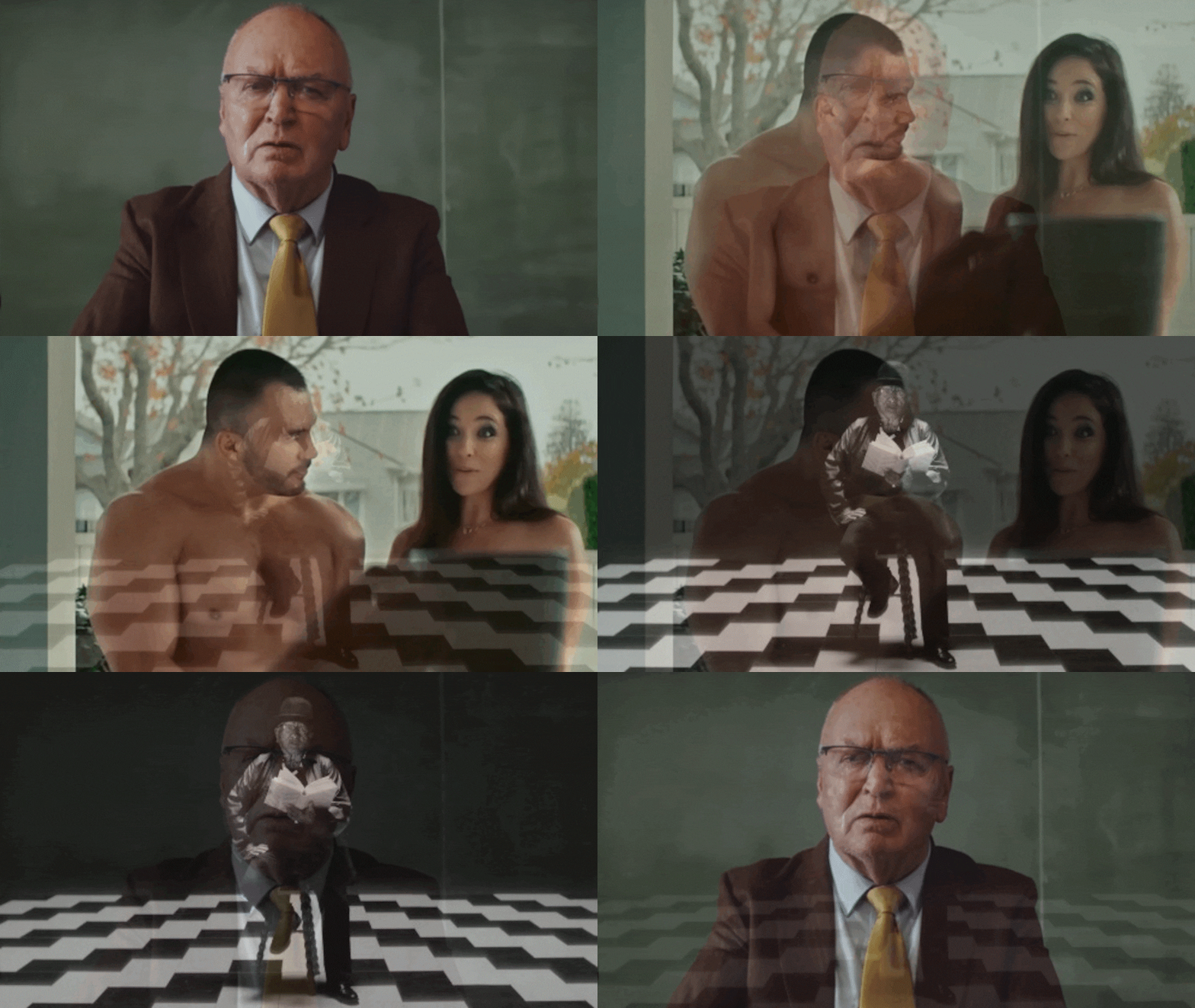
Two porn stars arrive at the front door of a young boy and his mother, with news that he’s been watching them online, in an advertising awareness campaign for the Department of Internal Affairs.
And before anyone accuses Stuchbury of being King Canute – fighting a rising, modern-day tide of slop – his business does have both the clients and recognition to back up his position.
Last month, Motion Sickness was awarded agency of the year at the Axis Awards – the first time in 13 years that an independent New Zealand agency had won the top prize.
The Māori Roll Call campaign and another for Karangahape Rd in Auckland – including an idea that customers could use K Rd receipts as “legal tender” for more K Rd purchases – were at the heart of their award-winning entry.
It’s also made its mark on the global stage.
Motion Sickness’s herpes awareness and destigmatisation campaign for the New Zealand Herpes Foundation won the agency two Grand Prix awards at the 2025 Cannes Lions event.
The campaign – “Make New Zealand the Best Place in the World to Have Herpes” – starred the likes of Henry, Sir Wayne “Buck” Shelford, boxer Mea Motu and Sir Ashley Bloomfield.
Boxer Mea Motu, former rugby coach Sir Graham Henry and comedian Angella Dravid were among those who featured in a campaign aimed at reducing the stigma around herpes.
In the Cannes Lions’ 2025 global creativity report, Motion Sickness was named the leading agency across New Zealand, Australia, and the Pacific region. It was also ranked among the top five independent agencies globally.
“Four or five years ago … we would roll our eyes at people entering awards all the time,” says Stuchbury.
“But … to be honest, the reason it’s so valuable is that it just builds our brand and gives that external validation.”
About a third of the company’s business now stems from international clients, including Shine Lawyers in Australia and – rather ironically – Kiwi-founded, Silicon Valley-based AI contract review firm Ivo.
Motion Sickness has almost doubled its staffing in a year, from 18 to 33 and aims to have 37 by the end of 2026. Separately, it plans to open a Sydney office, with four or five staff initially, within 12 months.
Not bad for a business that started out in a rental.
“We went from a flat in Dunedin, to a villa in Mt Eden, to a loft in Newmarket, then to a studio on Cross St,” Stuchbury said in late 2024, as the company moved into its then new headquarters in Maidstone St, Grey Lynn.
Kiwi ad agency Motion Sickness’ Grey Lynn headquarters – a far cry from the Dunedin flat where it launched.
“To be totally transparent, I think we went into the business, at the start, quite blind,” he tells Media Insider today.
“We never really had a business plan or knew what it would turn into, but what we did follow was our creative instinct. We knew what a good idea was and that’s been our North Star as we’ve grown.
“We’ve definitely learned a lot along the way. We didn’t work at other agencies ever, which I think maybe was a blessing.
“When we started we thought it was a massive disadvantage, because we didn’t know how to do anything. But I think, upon reflection, even today, like the way we approach and come up with an idea, [there are] few levels of bureaucracy and layers we have in the business.
“I think it allows us to be a lot more efficient and get to the idea quicker.
“I think if I had to spend 10 years in a traditional agency, I probably would have brought a lot of that with me when I started the business.”
With some audacious goals to grow further, and represent some of the world’s biggest brands, Stuchbury brings it back to his team of free-spirited thinkers.
Its provocative AI campaign this week will see the release of “blood oath” kits to clients, potential clients and others to sign up to the principle of human creativity, literally in blood.
Motion Sickness’s “blood oath” kits that encourage people to sign up – with their own blood – to the principle of human creativity.
“The best ideas usually begin as a mess,” said Stuchbury. “They can be awkward, instinctive, overambitious or hard to explain. That’s often the part people respond to. That spark has taken us further than any neat process ever could.”
And he makes a final point: “We don’t want to be the pig-headed people saying, ‘AI is bad, we’re good’. We’re just offering this up because we think there’s another way.”
Editor-at-Large Shayne Currie is one of New Zealand’s most experienced senior journalists and media leaders. He has held executive and senior editorial roles at NZME including Managing Editor, NZ Herald Editor and Herald on Sunday Editor and has a small shareholding in NZME.