
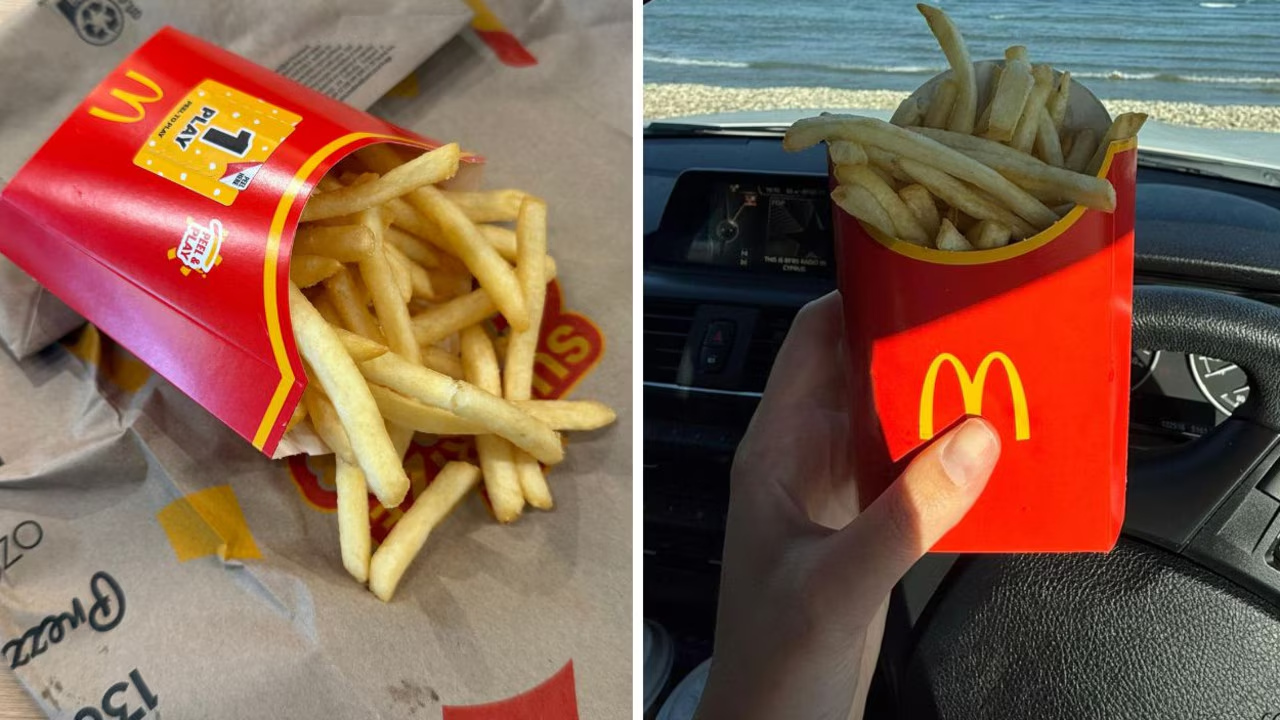
It’s a known IVF superstition, yet the lack of scientific evidence behind eating McDonald’s fries immediately after an embryo transfer doesn’t stop hopeful parents from doing it – just ask Tanya Hennessy.
The Australian comedian, who rose to viral fame with her “realistic make-up tutorial” in 2017, endured a gruelling seven-year battle with infertility.
After undergoing six rounds of IVF, a painful and emotionally challenging fertility treatment that has no guarantee of success, the now 40-year-old finally welcomed her much-longed for daughter Scottie in December last year.
But before she and husband Tom Poole held their “miracle” bub, there were agonising failed transfers, followed by moments of desperation and hope, emotions that can lead people to try things they’d never have imagined before.
“I was crazy about like, no fragrances, no candles, nothing in the microwave, I was on Clexane (a blood thinner), and supplements … I was on everything under the sun,” she told news.com.au.
“You’ll try anything, even some of the more obscure methods to bring ‘good luck’.
“Every time I had a transfer, you’d have Macca’s fries. I did it every single time, without fail.”
But as Hennessy explained, she had “no idea” if it actually worked, before adding: “It’s just a thing, 100 per cent a thing people do during IVF.”
In actual fact there is no research that shows McDonald’s fries improve IVF success rates.
But that doesn’t mean it’s not worth doing.
Pulling into the drive-through for a cheeky large portion of “lucky fries” on your way home from what is often an intense weeks-long process of needles, surgery, and if you’re fortunate – an embryo transfer – has become a ritual beloved by many stuck in the dark depths of infertility.
It’s believed the cult tradition began in one of the many fertility forums across the world, where it was suggested that salty fries could help prevent Ovarian Hyperstimulation Syndrome (OHSS), a condition in which the ovaries swell and become painful.
It can cause nausea, vomiting and extreme bloating and is commonly caused during the stimulation phase of an IVF cycle.
The post-transfer act became so widely known, many doctors and experts have spoken out to warn hopeful parents of the lack of science behind it, but as Hennessy explained – for many IVF patients, the act is a form of escapism after a difficult journey.
“For me, I was just because during IVF you feel like you can’t have anything,” she said.
“I’d gone on the Keto diet to help with my fertility, so I was off everything, but after a transfer I was like, ‘f**k it, I’m eating these chips’.
“You know deep down it doesn’t quote unquote, ‘make it stick’.
“But it’s a moment of normality on a path that is just awful, and so I see why so many women do it.”
She’s not alone. While there is no exact statistic on how many women eat McDonald’s fries after an IVF embryo transfer, it has become a highly popular, viral social media trend.
On TikTok and Instagram, there are hundreds of photos and videos showing the “good luck” ritual, also known as “fertility fries” or “transfer fries”.
Even when Hennessy fell pregnant, the fragility of the her journey to motherhood made it difficult for her to enjoy the experience.
“It just felt like, because of all these extra things, ‘oh God, she’s been held in there by an absolute miracle,” she shared.
“I don’t even have any pictures of the embryo or many of her ultrasound pictures because I just didn’t want to get too attached.
“If I could go back and give myself any information, I would be like, ‘take photos take everything, don’t protect yourself too much’.
“Because I feel like I missed out on a lot, and it sucks because I’m looking back through all my photos and I’m like I don’t have any bloody videos of these ultrasounds because I was so scared she wouldn’t come and I’d have to delete them again.”
Once Scottie safely arrived on Christmas Day, Hennessy understandably still struggled to relax into motherhood.
“I think every person who’s had a baby, and even if you haven’t I reckon you can understand, but I was just you so paranoid about her breathing,” the best selling author, dual ACRA award-winning radio announcer, TV presenter, podcast host and content creator told news.com.au.
“I feel like I woke her up a lot tickling her ear just to get her to move because I was so paranoid she wasn’t breathing.
“Because I was so unprepared, because I hadn’t allowed myself to believe that the pregnancy was really happening, I hadn’t bought a baby monitor, so I couldn’t relax. Everything is so scary.”
Thankfully, the new mum has found a solution to Scottie’s once terrifying sleep times, investing in a CuboAi Sleep Safety Bundle, which includes the Smart Baby Monitor 3 and the Sleep Sensor Pad, so she doesn’t have to constantly peer into the bassinet to know she’s OK.
“She’s four months now, and if she goes down for a nap, I’m not checking as much anymore because I choose a monitor,” she said.
“But before I had the CuboAi, I was like checking on her constantly.
“You can’t help but worry about everything, ‘is she full?’, ‘is she okay?’, ‘does she have hair between her toes?’
“Sleep is the one time they’re not with you, and to have a monitor that’s on your phone that is crystal clear, so you can see quickly and know she’s okay, it’s one thing that alleviates that tight chest.”