
Unlock the Editor’s Digest for free
Roula Khalaf, Editor of the FT, selects her favourite stories in this weekly newsletter.
The EU is postponing a ban on imports stemming from deforestation for a second time, after pressure from the US and other trading partners.
Jessika Roswall, the environment commissioner, confirmed an earlier report by the Financial Times on the delay. She blamed technical problems for the new one-year postponement, saying the registration system could collapse when the law took effect at the end of the year.
“There’s a lot of information coming from industry in a short period of time,” she told reporters, with a “risk of overload”.
“That is why we need this extra time to see how we can solve that.”
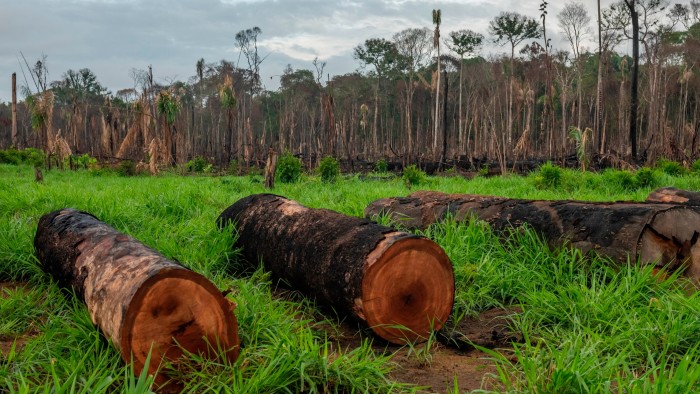
The law aims to stop European consumers from contributing to the climate crisis when purchasing products made by felling forests. It would ban imports including coffee, cocoa, rubber, wood and palm oil if the producers were unable to prove they were not grown in deforested areas.
Several member states had complained that companies were not ready to comply with the legislation. Roswall denied that the US or other trade counterparts had influenced the decision.
The law was first proposed in 2021 as part of the EU’s ambitious Green Deal climate law, which was watered down after farmers’ protests, concerns about the bloc’s flagging economy and a focus on defence investments in the wake of Russia’s war in Ukraine.
Last December, the European Commission postponed its implementation by 12 months to the end of this year.
The new proposal requires agreement from a majority of EU member states and the European parliament.
The US has condemned the legislation, as have commodity producers such as Brazil and Indonesia, which have just agreed trade deals with the EU.
According to a trade deal the EU struck with the Trump administration this summer, Brussels agreed to “work to address the concerns of US producers and exporters” over the deforestation law. The EU also recognised that “production of the relevant commodities within the territory of the United States poses negligible risk to global deforestation”.
The American Loggers Council said this month the EU law was “coming apart at the seams” and was a “misguided” attempt to prevent global deforestation.
India has also raised the issue with EU officials during their trade talks.
Developing countries argue the law could lock out millions of smallholders from the EU market, as they lack the resources and technical knowledge to comply.
The commission has sought to quell concerns over its implementation by publishing an 81-page guidance that sets out how companies should collect geolocation data for their products.
It has also set up its own deforestation observatory based on European satellite imagery, although trading partners such as Australia have contested the data being used.
Poland, one of the most vocal member states against the EU’s green legislation, this month called for a two-year delay.
“The current model imposes disproportionate burdens, especially in countries such as Poland, where the risk of deforestation is negligible,” according to a Polish government position paper.
Recommended

Warsaw, along with Washington and several EU capitals, has been lobbying for a “zero-risk” category in which many member states would be included.
They are also pushing for small producers to be exempt from reporting and that due diligence obligations should only be imposed on the operator placing products on the EU market, rather than on the entire supply chain.
Roswall declined to rule out either option, but added: “We just keep fighting deforestation. It’s a really important issue for the world and for the EU. But also . . . we tried to do simplification.”
Industry is split over the law.
Cocoa and rubber companies including Nestlé, Unilever, Michelin and Pirelli have all issued statements against delaying the law, while forestry lobbies, farmers and magazine publishers have called for it to be simplified and postponed.
Swedish Enterprise, an employers’ association with 60,000 members, said it was in favour of limiting the law’s “complex” due diligence requirements “to the operator first placing the product on the EU market”.
Climate Capital
Where climate change meets business, markets and politics. Explore the FT’s coverage here.
Are you curious about the FT’s environmental sustainability commitments? Find out more about our science-based targets here