
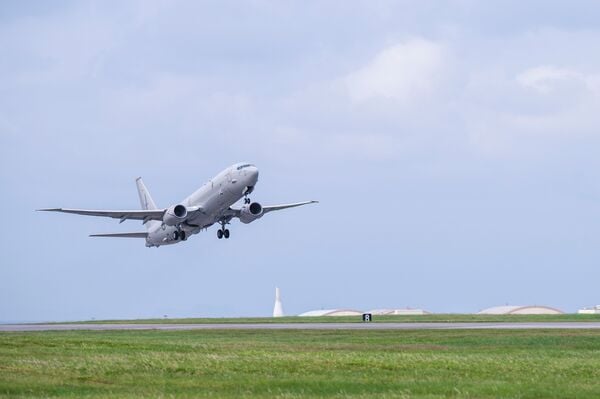

A Royal New Zealand Air Force Boeing P-8A Poseidon takes off from Kadena Air Base in November 2025, during a deployment to monitor North Korean sanctions evasions at sea. (USAF/Senior Airman Luis E Rios Calderon)
Tensions have flared between China and New Zealand over the operations of a Royal New Zealand Air Force (RNZAF) P-8A maritime patrol aircraft in north Asia.
On 17 April, a Chinese Ministry of Foreign Affairs (MoFA) spokesperson accused the crew of an RNZAF P-8A of conducting “close-in reconnaissance” and “harassment in the Yellow Sea [West Sea] and East China Sea”. The incident damaged “China’s security interests” and disrupted “civil aviation operations”, the spokesperson said.
According to the New Zealand Defence Force (NZDF) on 18 April, the Poseidon, which was operating from Kadena Air Base on Okinawa in Japan, was conducting maritime surveillance in support of UN Security Council Resolutions (UNSCR) sanctions on North Korea.
“These activities are not directed at China but rather aim to monitor evasions of UN sanctions on North Korea, which do occur in the Yellow Sea and East China Sea,” the NZDF said.
The sanctions on North Korea are intended to persuade Pyongyang to denuclearise and abandon its ballistic missile capabilities.
In response to China’s claim that the activities of the P-8A affected civil air traffic, the NZDF said that it has reviewed the aircraft’s flight path. “We have no data which indicates [that the Poseidon] disrupted civil aviation,” the NZDF added.
Without providing specifics, a Chinese Ministry of Defense (MND) spokesperson said the Poseidon’s crew “disregarded China’s warnings” and that the People’s Liberation Army (PLA) took “professional and forceful measures to respond and handle the situation”.
Go beyond the headlines — with direct links to interconnected entities
Get full access to validated equipment, military capabilities, and market insights.