

The bill set to replace the Resource Management Act opens the door to repeats of the Waikato Regional Council’s massive Coromandel trawl ban, the fishing industry says.
The Waikato Regional Council’s coastal management plan, notified towards the end of last year, restricts bottom fishing, such as trawling, Danish seine and dredging only along select benthic access areas – mirroring those in the Hauraki Gulf trawl corridor shelved by the Government.
The Environmental Defence Society, which pushed for the Coromandel restrictions, reckons the fishing industry is being disingenuous and “dramatically overstates” the impact it will have.
The Waikato Regional Council’s restrictions squeaked in before a change was made to the soon-to-be-replaced Resource Management Act “to clarify and constrain the extent to which regional councils can make rules to control fishing for biodiversity and marine protection purposes”.
That includes a requirement for any such rule to be in place before the plan goes out for submissions and a decision-making role for the director-general of primary industries to prevent those rules from being notified if they would have an undue adverse effect on fishing.
This essentially allows the Ministry of Primary Industries to veto any changes being made by local government.
As the Resource Management Act currently stands, there is a legal test that the ministry cannot agree to a plan’s fishing rule if it would have an undue impact on fisheries interests.
That isn’t in the new bills, but there is still a requirement for the ministry to approve the changes based on an assessment of the impact of any rules impacting fishing.
According to a submission from Seafood New Zealand on the Planning Bill (one of two pieces of legislation replacing the RMA), the law as drafted opens the door for more of this type of intervention, rather than prohibiting it.
The organisation, which represents commercial fishing interests, believes all controls on fishing, including marine reserves, can and should be managed through the Fisheries Act, and that use of planning laws creates duplicated responsibilities.
Other fishing groups, including the Leigh Commercial Fishermen’s Association, made similar points, and it is a view shared by the current oceans and fisheries minister.
Seafood New Zealand’s submission says that, as proposed, the law weakens recognition of fishing rights, increases regulatory risk and cost, and embeds inefficient duplication between the resource management system and the Fisheries Act.
The organisation’s inshore general manager Tiff Bock tells Newsroom that unlike the Resource Management Act, there is no requirement to assess the effects on fishing.
“Essentially, if there was a significant adverse effect, if you’re going to put the whole industry out of business, it’s kind of irrelevant.
“You’re not forced to consider it in the making of the rule, which, as you can understand, it’s not something we really want.”
She says this goes against the Planning Bill’s stated aim of supporting and recognising property rights, “We’ve kind of gone backwards in the fishing space.”
Bock acknowledges there is a view that while all the tools are available through the Fisheries Act, they aren’t being used as effectively as they could be. Some would argue many of these tools aren’t being used at all.
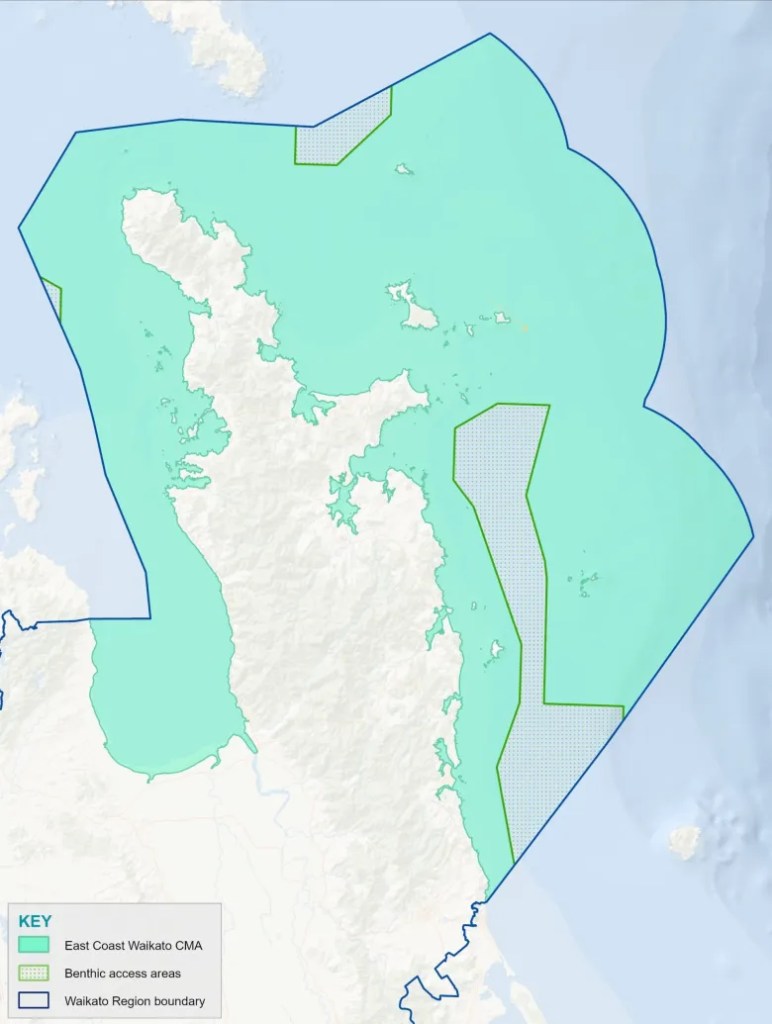 The solid green area would be closed to bottom trawling, dredging and Danish seine fishing under the council’s proposed plan. Photo: Supplied
She says this lack of trust in the tools provided for in the act leads people to pursue other avenues
The Coromandel Trawl ban is a good example of this – the trawl corridors it uses are lifted directly from a wider Hauraki Gulf plan that was intended to be enacted under fisheries law but was shelved by the current administration.
“What they proposed was literally lifted out of a Fisheries New Zealand proposal, which hasn’t been implemented, it doesn’t mean it can’t be, doesn’t mean it won’t be. It just hasn’t been.
“We really are trying to manage fishing through an act that was not designed for it,” Bock says.
She says it would be better to use the Fisheries Act to its fullest extent rather than use a series of different laws.
The issue of the Fisheries Act being equipped to deal with such changes was raised during the hearing for the Coromandel ban.
At the time, Environmental Defence Society chief operating officer Shay Schlaepfer made the point that the tools weren’t being used and hadn’t been for a very long time.
“The most recent iteration of the potential for that to occur was this consultation, which has sat idle, so really, it is a consequence of inaction, and it has got to the point now that the evidence is just so blatantly obvious that someone has to do something.”
Speaking to Newsroom, Environmental Defence Society reform director Greg Severinsen says the industry submissions “dramatically overstate the potential impact” the bill would have on fishing property rights.
“The key takeaway is that the bills are pretty much unchanged from settings that we’ve got at the moment from the RMA as amended recently.”
This means it preserves the idea that fishing can be dealt with through local government planning processes, “That seems to be the big complaint from Seafood NZ and others. Really just an opportunity to complain about the RMA rather than these bills saying they’re protecting property rights and then doing the opposite.”
He acknowledges the removal of a specific legal test for the Ministry of Primary Industry’s veto power in making an assessment of whether a plan impacts on fishing.
“That is an accurate complaint. I don’t think it’s a good complaint, but I think the reason for that is they’re just wanting to cut down the sheer size of the primary legislation and wanting to put some of that stuff in secondary regulation.”
“I think a lot has been read into the absence of that test. I mean, the concurrence role is still there. That’s gatekeeping what can go into regional plans.”