

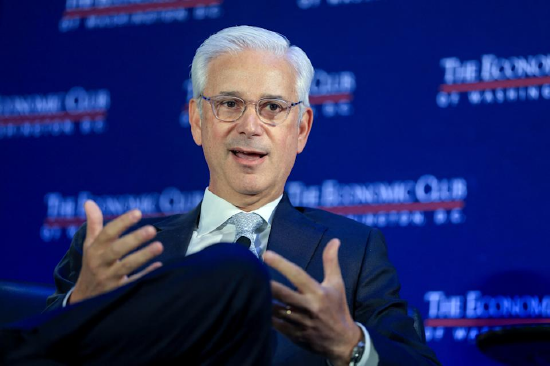
Charles Scharf, CEO of Wells Fargo & Co, stated on Monday that the U.S. economy remains resilient overall, but he acknowledged that market sentiment among American consumers and businesses is currently very low.
Scharf, speaking at the Economic Club of Washington, said, ‘Based on all the data we have observed, the U.S. economy remains extremely strong.’ He also noted that due to various uncertainties brought about by the U.S.-Iran conflict, there is a significant divergence between public perception and the actual economic fundamentals.
Scharf remarked, ‘The real economy is still operating smoothly, and major companies themselves are in very solid financial condition, which reflects positive fundamentals. But when you ask people how they feel, everyone seems anxious.’
 He also pointed out that due to rising gasoline prices, consumers have started cutting back and adjusting their spending. On the whole, the current economic situation remains stable, though early signs of potential negative impacts are beginning to emerge.
President Trump stated earlier this Monday in an interview that it is highly unlikely the U.S. will extend the two-week temporary ceasefire agreement with Iran, which is set to expire on Wednesday night. Trump said that until a final agreement is reached, the blockade of the Strait of Hormuz will continue, a situation that has already triggered a global oil supply crisis.
Scharf added, ‘Once the conflict ends and the strait resumes normal navigation, oil production capacity will gradually recover within a reasonable timeframe. While this situation will impact areas such as consumer spending, the overall damage will be limited. However, if the conflict persists for a prolonged period, it could cause more severe damage to the economy.’
Last week, Wells Fargo & Co and other leading U.S. banks reported significant growth in first-quarter profits. Data from this San Francisco-based bank and its peers showed that consumer spending at America’s four largest banks grew robustly by 5% to 9%. During analyst conference calls, Scharf and other banking executives conveyed optimistic signals, stating that the overall U.S. economy and consumer spending remain resilient.
Compared to smaller specialized credit institutions, large U.S. banks lend less to low-income groups. Additionally, these banks primarily assess customer financial health based on consumer spending data and unemployment rates, without considering other aspects of household financial stress.
The optimism expressed by banking institutions contrasts sharply with the widespread pessimism among the general public. The latest consumer confidence index released by the University of Michigan shows that American consumer confidence this month has dropped to its lowest point in the index’s 74-year history.
During the same interview, when asked about the Federal Reserve’s independence, Scharf voiced support for the Fed remaining free from external interference, emphasizing the critical importance of its independence. Furthermore, he downplayed market concerns about risks in the private credit industry, arguing that the sector’s size is not yet large enough to trigger systemic financial risks.
The two major viewpoints above are consistent with the previous statements made by JPMorgan CEO Jamie Dimon.