
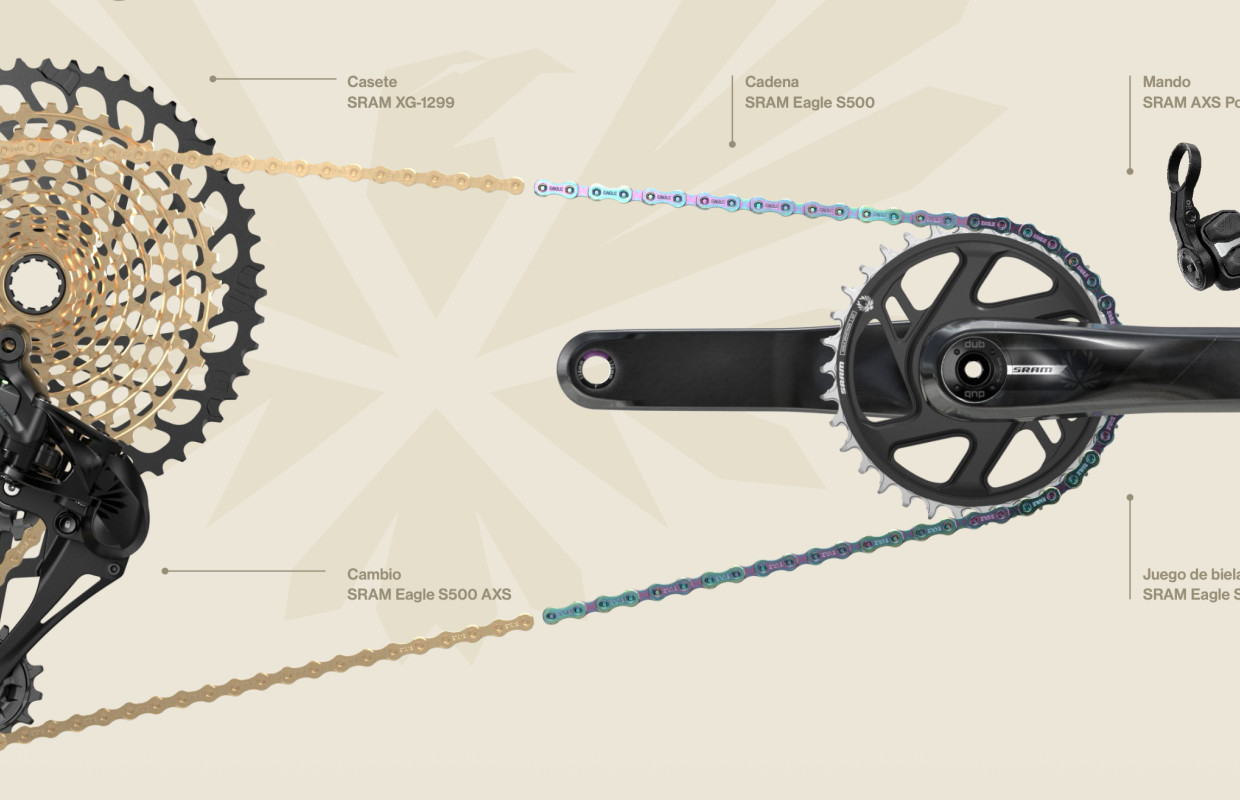
SRAM completely reorganizes its Eagle range with the new family that reduces the catalog to three levels and, at the same time, introduces a new Half Mount system for the rear derailleur.
The new Eagle S-Series is born as a direct evolution of the mechanical and AXS Eagle ecosystem, but with a much clearer approach. Where up to nine different groups coexisted before, everything is now concentrated into three platforms. A technical reorganization that aims to maintain compatibility, improve durability, and adapt to bikes that do not use UDH interface without a hanger.
According to the brand’s own approach, the S100 series replaces SX and NX, the S200 series takes the place of GX, X01, and XX1 mechanicals, and the S500 AXS series becomes the entry point to electronic shifting within the Eagle ecosystem.
Equivalences between the new S Series and the previous ones
New Half Mount system: a middle ground between the classic hanger and the Transmission
The most interesting change is not in the groups themselves, but in the new mounting system introduced by SRAM.
The so-called Half Mount does not eliminate the hanger as the Full Mount system of Transmission does, but it does modify how the derailleur is attached to the frame. Instead of relying solely on the hanger, it adds an additional support point through the UDH axle, reinforcing the structure against lateral impacts.
This has a direct consequence in real use. The precision of the shifting no longer depends so much on possible minimal deformations of the hanger, one of the most common problems in conventional drivetrains. Still, it maintains classic elements like limit screws and B-gap adjustment, clearly positioning it as a hybrid solution and not as a replacement for the Transmission.
It is also important to understand its limitation. This system is only available in the S100 and still requires a UDH interface on the frame, so it is not universal within the range.
Total compatibility within the Eagle ecosystem
One of the technical pillars of this new series is that SRAM does not break with the past. All the S-Series maintains full compatibility with the Eagle ecosystem, allowing for the mixing of old and new components without issues.
This includes compatibility between cassettes, chains, and shifters, with the only relevant exception being the S100, whose derailleur is limited to developments of up to 50 teeth on the large sprocket. In contrast, S200 and S500 work without restrictions with 10-50 and 10-52 cassettes.
Additionally, SRAM makes it clear that this range is not interchangeable with Transmission, as both systems use different pull ratios and completely different architectures.
The three-level structure is not just a matter of price, but of mechanical behavior and technical solutions.
The S100 positions itself as a robust group aimed at intensive use and especially designed for e-MTB. Here, a rear derailleur appears with a revised design to improve durability and a chain retention system based on a drag spring, simpler but very reliable in demanding conditions. Its development range reaches 500%, sufficient for most mountain uses.
In the S200, we already find a clear leap in performance. The derailleur incorporates Type 3 clutch, which improves chain stability on descents and reduces noise. Additionally, it accommodates both 500% and 520% range cassettes (10-50T and 10-52T), which expands its versatility on long climbs or more demanding setups.
The S500 AXS introduces the electronic component without changing the base of the Eagle system. Here, the key is the Overload Clutch, the mechanism that decouples the internal motor in case of impact to prevent damage and automatically returns the derailleur to its position. This system, inherited from higher ranges, allows for maintaining precision even in aggressive use.
Another important point in S500 is its total compatibility with AXS road and MTB shifters, which opens real hybrid configurations for gravel or mixed setups.
More mounting options and focus on durability
SRAM has introduced changes that directly respond to current usage trends, such as the expansion of crank lengths, with options that go down to 155 mm in both S100 and S200. This reflects the growing adoption of short cranks in MTB and e-MTB.
There are also changes in cassettes and maintenance. The new PG-1210 replaces the previous equivalent model and maintains compatibility with HG hubs, while mid-range and high-end cassettes continue to rely on XD hubs and open structures that improve mud evacuation.
Overall, the S-Series does not introduce an isolated revolution, but rather a series of adjustments aimed at extending the useful life of the system, facilitating maintenance, and improving shifting consistency in real conditions.
SRAM Eagle S100: specifications and prices
Rear derailleur with Half Mount system compatible with UDH
Maximum range 500% (10-50 or 11-50)
Drag Spring retention system
Aluminum cranks with steel X-Sync 2 chainring
Lengths from 175 mm to 155 mm
PG-1210 cassette compatible with HG hub
Rear derailleur: €75
PG-1210 cassette: €95
Cranks with chainring: €75
Chain: €35
Shifter: €35
SRAM Eagle S200: specifications and prices
Derailleur with Type 3 clutch
Compatible with 10-50 and 10-52 cassettes (500% and 520%)
DUB cranks with 6061 axle
Lengths from 175 mm to 155 mm
XG-1275 cassette with Full Pin technology and XD hub
Rear derailleur: €145
XG-1275 cassette: €240
Cranks (without chainring): €90
Chain: €45
Shifter: €45
SRAM Eagle S500 AXS: specifications and prices
Wireless AXS electronic derailleur
Overload Clutch impact protection system
Compatible with 10-50 and 10-52 cassettes
Carbon cranks with aluminum X-Sync 2 chainring
XG-1299 cassette with X-Dome design
Chain available in Gold and Rainbow finishes
Rear derailleur: €425
XG-1299 cassette: €595
Carbon cranks: €400
Chain: €110
S500 Eagle AXS upgrade kit (rear derailleur with protector, battery, POD shifter, and USB-C charger): €655