
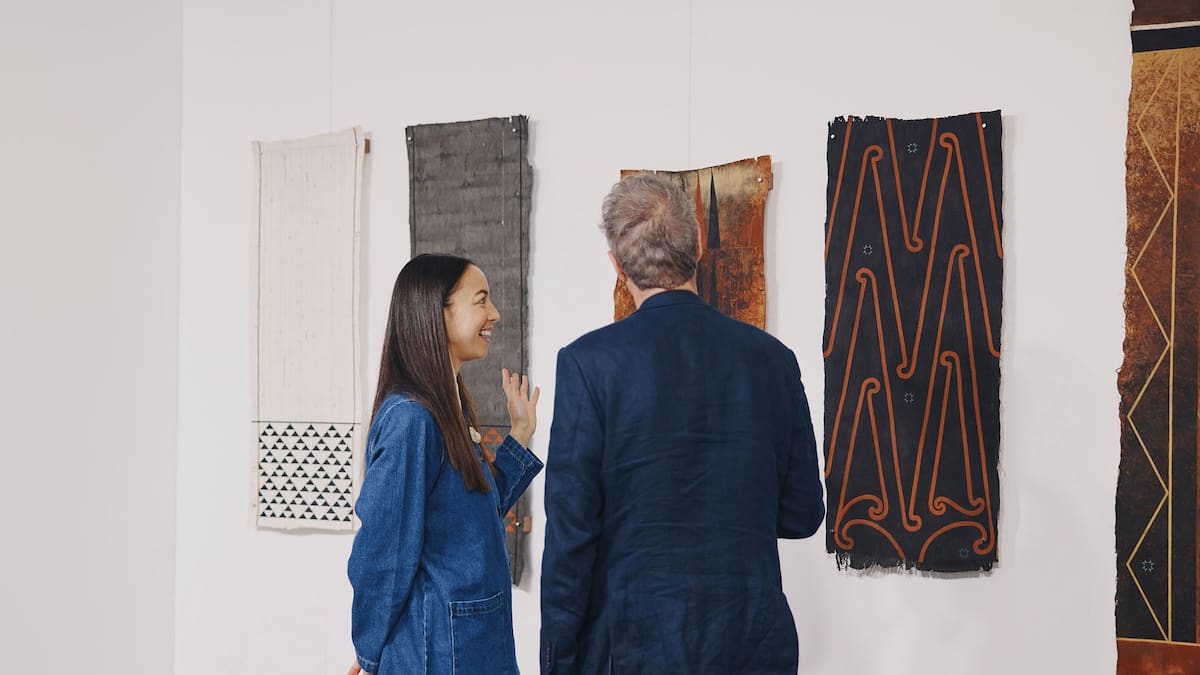
Where do you begin if you’re starting an art collection from scratch? Viva spoke to two industry experts for practical advice on navigating the art world, and collecting with confidence.
Anna Dickie
Writer and editor focused on contemporary art
She might be reticent to call herself an art
collector, but “happily obsessive” is okay with Anna Dickie, an Auckland-based writer and editor specialising in contemporary art.
Over the years, her home has been hung with pieces by Fiona Pardington, Simon Denny and Isaac Julien, but that hasn’t stopped her imagining a collection that will one day consist of (would-be collectors take note!) Paul Pfeiffer, a Tracey Emin, a small Egon Schiele, a Tracey Moffatt, Ana Mendieta, Haegue Yang, Toyin Ojih Odutola, Philip Guston, and from NZ, Edith Amituanai, Hotere, McCahon, Kate Newby, a Yona Lee, a Julia Morison, a Judy Millar, and at least four lithographs by Jeffrey Harris.
“I’ve been building this imaginary collection for a long time,” she jokes.
Art collector Anna Dickie at home in Herne Bay. Photos / Babiche Martens.
Until recently, Dickie directed content for online art platform Ocula, working closely with artists, curators and collectors across the Asia-Pacific region and interviewing leading figures in the art world.
She continues to write and work alongside local arts organisations, including McCahon House.
With a master’s in history of art and art-world practice from Christie’s in London, she brings a thoughtful, global perspective to collecting and the wider art world.
Visitors to the Aotearoa Art Fair (April 30-May 3) can hear Dickie speak as part of the talk How to start an art collecting group (and why you should) (May 1). Her art group Artichoke, founded in London in 2010, has amassed a portfolio of works she’s “genuinely proud of” from Francis Upritchard to Shane Cotton and Kelcy Taratoa.
“Being part of an art group is a brilliant way to build confidence while easing into collecting,” she says. “Buying together suddenly gives you access to works you might never have dared to choose, or afford, on your own, and we’re very glad we bought our pieces when we did.”
Aotearoa Art Fair 2025. Photo / Luke Foley-Martin
Her advice ahead of an art fair is to do your research first.
“Note the galleries and artists you’re drawn to, check what they’re bringing, and, if you’re really organised, call ahead to place a hold on works – then use the fair to confirm those choices and scout new artists.
“If you’re still working out your taste, wander the whole fair first, photograph what resonates, then loop back for a slower second look and conversations with gallerists and artists – some of the most rewarding works don’t shout from the booth, they whisper. And if a piece keeps strolling through your mind long after you’ve left, take that as your cue: stop dithering and make the leap.”
When it comes to artists and works on display that might suit early collectors buying as a group, “a few jump out straight away”.
Shannon Te Ao’s tama, 2024.
“For collecting groups willing to venture beyond painting, Shannon Te Ao is a great place to start; his three-channel video and sound work for Aotearoa New Zealand’s 2024 Gwangju Biennale Pavilion was unforgettable. I’m also coveting Joe Sheehan’s meticulous carved sculptures, Zhu Ohmu’s bulbous hand-coiled ceramics, and Yona Lee’s cool steel installations.
“On the painting front, Richard Lewer’s darkly comic, scratchy Air Force One feels sharply of the moment, while a largish black-and-white canvas by the late Mark Braunias, with its uncanny biomorphic creature, has piqued my curiosity. Ruth Ige’s blue-toned scenes, Milli Jannides’s milky, half-remembered worlds, and Grace Wright’s cacophony of colour all warrant some attention too.”
Ruth Ige, Twins (Immortals), 2025, McLeavey Gallery.
For anyone navigating the purchase of their first “big piece”, Dickie’s advice is to not think of it that way.
“While you test the waters, it’s okay to start small. Or go large, and don’t look back. It’s likely your taste will evolve, and the first piece you buy may not be the favourite one down the track, but hopefully it will be part of your story and make your collection far more interesting.”
To educate yourself as a collector, “look at as much art as you can – in museums, galleries and people’s homes – ask questions, and keep testing your early assumptions against new perspectives”.
“When life gets busy, lean on books, podcasts, magazines and social media to fill the gaps; every artwork you encounter and every bit of knowledge you pick up adds a layer, and over time patterns and connections start to emerge.”
Early collectors looking to identify emerging artists or works that will appreciate would be wise to follow galleries, artists and institutions over time. This is essential, advises Dickie. Accolades like awards, residencies, new gallery representation and acquisitions all reveal where “knowledgeable insiders are casting their votes”.
“It helps you see where genuine consensus is forming, rather than relying only on your own taste. Nick Simunovic, a long-time director at Gagosian in Hong Kong, once described looking for a ‘perfect storm’ of popular and critical support when choosing artists; my version of that test is simply: do I like the work, do other people respond to it, and do institutions and writers rate it? If the answer is yes to all three, that is usually a strong signal to pay attention.”
Rosie Bristed
Director of Astor Bristed Gallery in Arrowtown
Rosie Bristed, director of Astor Bristed Gallery in Arrowtown
Founded in 2021, Astor Bristed is a contemporary gallery on Arrowtown’s Main Street representing a mix of emerging and established, predominantly New Zealand, artists.
Director Rosie Bristed says the exhibiting artists reflect her tastes and preferences and those of the local community, and have included Tia Ansell, Meg Gallagher, Kerrie Hughes and John Walshe, among others.
Bristed has just closed the gallery and will reopen in July, a seasonal model she says is typical in Arrowtown, but before then, Astor Bristed will debut at the Aotearoa Art Fair.
Fergus Robertson’s Dolor 2026
On display will be Christchurch-based painter Fergus Robertson, known for his high-definition, meticulously detailed still lifes depicting flowers arranged in vases and vessels, framed in hand-welded steel.
While the florals are striking, the vessels – from pottery to glass by makers including Hoglund Art Glass, Matt Horne and Aaron Scythe – carry their own history and significance. Bristed says there’s often a “wild story” behind how these pieces were acquired, from chance finds in gardens to unexpected gifts.
Ashleigh Zimmerman, Hue, 2025, Kurutai Gallery
Other artists exhibiting at the fair to take note of include Ashleigh Zimmerman’s “delicate and precise” ceramics, Hariata Ropata-Tangahoe’s awe-inspiring, spiritual paintings and Mark Maurangi Carrol’s works, which draw you in with their sense of narrative and “make you want to know more”.
For first-time collectors, Bristed says it’s better to drop the “buyer” mindset and focus instead on immersion, discovery and seeing what naturally stands out.
“[A] fair is a good place to just be immersed in art and get a feel for what you do and don’t like. Personally, I like to go alone. It’s like shopping or anything else that you want to do at your own pace.
“When you’re trying to grow your confidence in your own taste, it’s so easy to be swayed by your friends or other people.”
Instead, she says to work on honing your own interpretation of works you like.
For those unsure how to trust their own taste, Bristed says confidence comes from simply getting started. Rather than over-researching or buying with investment in mind, she encourages collectors to choose works they genuinely connect with.
Taste will evolve over time, she says, but buying what you love gives you something to fall back on, rather than relying on uncertain returns.
“It’s like anything, are you going to love that thing for life? Maybe, maybe not. But you’re buying it for now because you love it, and you can always sell it. Switch it up if that changes.”
When it comes to spotting artists with staying power, Bristed looks for persistence and self-awareness. Careers aren’t built overnight, and the artists who last are those who can evolve their practice while developing a recognisable visual language over time.
Trying to pick future value is tricky, she says, because the art market is unpredictable (the same thing that makes it exciting). Instead, she looks for artists with a clear point of difference.
“It’s something that makes the work recognisably theirs ahead of the signature,” she says, whether that’s a palette, texture or recurring idea that carries across their practice.
“It’s a high expectation for a brand-new, entry-level collector to seek work that will hold its value. It’s better to start by learning what things you actually want to live alongside; this is more rewarding than any financial gain.”
Claudia Kogachi, And Just Like That!, 2024, Gow Langsford, Galleries
If you’re not sure where to start, visit a gallery representing artists who speak to you. Bristed describes galleries as a kind of filter, grouping artists under a shared point of view so collectors can build trust and confidence over time. It’s not the only path, but it remains one of the most reliable ways artists and collectors gain momentum.
Once you’ve found a gallery you trust, it’s worth having an open conversation about budget.
“All collectors should feel confident asking about payment options,” says Bristed. “It’s a normal business discussion.”
Mark Maurangi Carrol, Become the warm flowers (kapa rima), 2025, Nasha Gallery
Many galleries are willing to structure payments to make a work more attainable. New Zealand-based My Art offers interest-free loans to would-be collectors buying art in Aotearoa and Australia, 25% of whom are buying their first piece.
When it comes to mediums that are a good entry point for new collectors, Bristed says go small.
“Keep it smaller so you can trial how it makes you feel without feeling like you’ve over-committed. Small works are easy to place or move around the home.”
Figurative painter and sculptor Gavin Chai and contemporary painter Elliot Love are both Tāmaki Makaurau artists working in smaller formats, says Bristed.
A final piece of advice for someone collecting their first piece of art?
“I think it’s good to love a piece, but sometimes it’s the ones that you feel a little bit of friction with that go on to be the most rewarding. You love it, but there’s something curious about it.”
The Aotearoa Art Fair comes to Auckland’s Viaduct Events Centre from April 30 to May 3. More than 60 galleries representing more than 200 artists will be on display – from established names like Bill Hammond, Sally Gibori, Lisa Reihana and Anselm Reyle, to emerging artists – offering a rare chance to see and purchase a wide range of contemporary work in one place. aaf.co.nz
More on art & design