
Black holes have long been associated with paradoxes and limits in known physics, particularly when it comes to how they interact with their environment. One such interaction involves tidal force, gravitational effects exerted by nearby objects, which are typically used to probe the internal structure of celestial bodies.
For decades, scientists have relied on a quantity known as the tidal Love number to describe how an object deforms under these forces. While planets, stars, and even neutron stars display measurable responses, black holes have stood apart with a value fixed at zero, suggesting no deformation at all.
A Zero-Value Rule That Defined Black Holes
The concept of Love numbers dates back to 1909, when British mathematician Augustus Edward Hough Love introduced it to study how Earth deforms under the gravitational pull of the Moon and the Sun. Today, the same framework is applied to a wide range of astrophysical objects.
According to the study published in Physical Review D, black holes have consistently exhibited a vanishing tidal Love number within general relativity. This means they show no conservative response to static tidal fields, unlike other compact objects that typically present nonzero values.
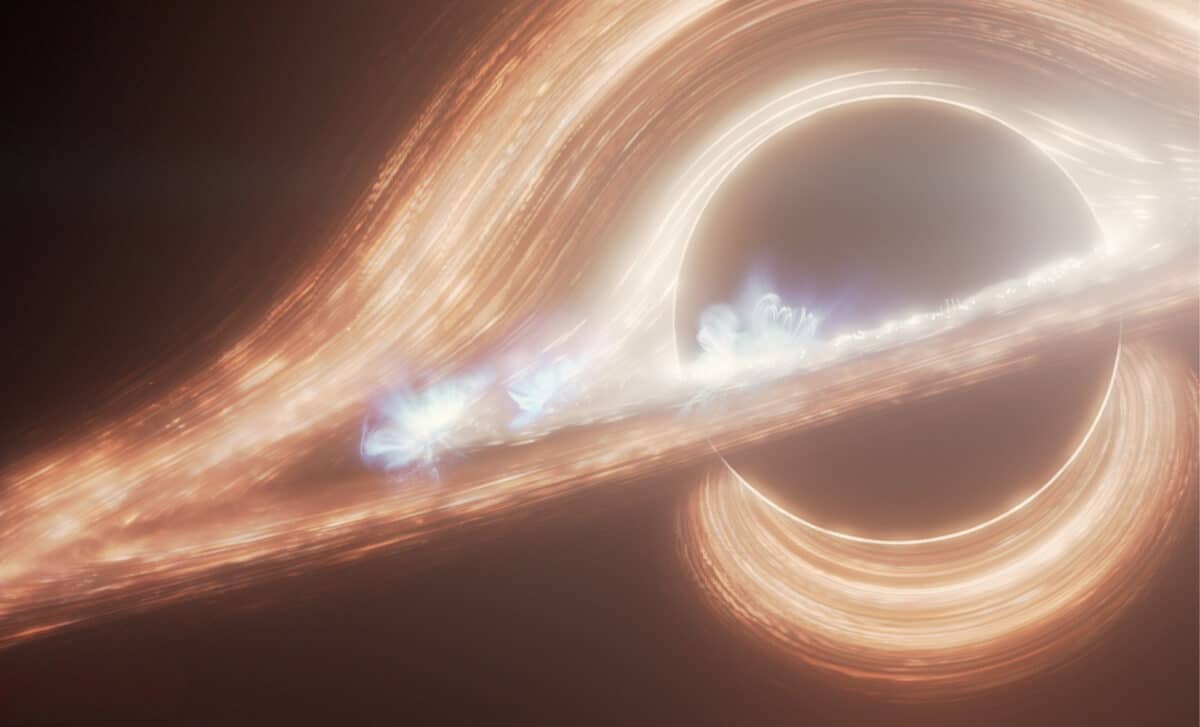 This artist’s concept portrays the supermassive black hole at the center of the Milky Way galaxy, known as Sagittarius A* (A-star). It’s surrounded by a swirling accretion disk of hot gas – © NASA, ESA, CSA, Ralf Crawford (STScI)
The study notes that this behavior contrasts sharply with neutron stars and similar dense objects, and even with black holes placed in more complex environments. Situations involving surrounding matter, modified gravity theories, or higher-dimensional models already hinted at exceptions where Love numbers could deviate from zero.
A Shift from Bosonic to Fermionic Fields
The new research approaches the problem from a different angle by focusing on fermionic fields rather than the bosonic sources usually considered. Traditionally, Love numbers are derived using bosonic perturbations such as gravitational waves, electromagnetic fields, or scalar fields.
In this case, researchers examined Kerr black holes, rotating, uncharged black holes described by Einstein’s theory of relativity, through the lens of fermionic sources like the massless Dirac field. This field is often compared to neutrino-like particles within quantum field theory.
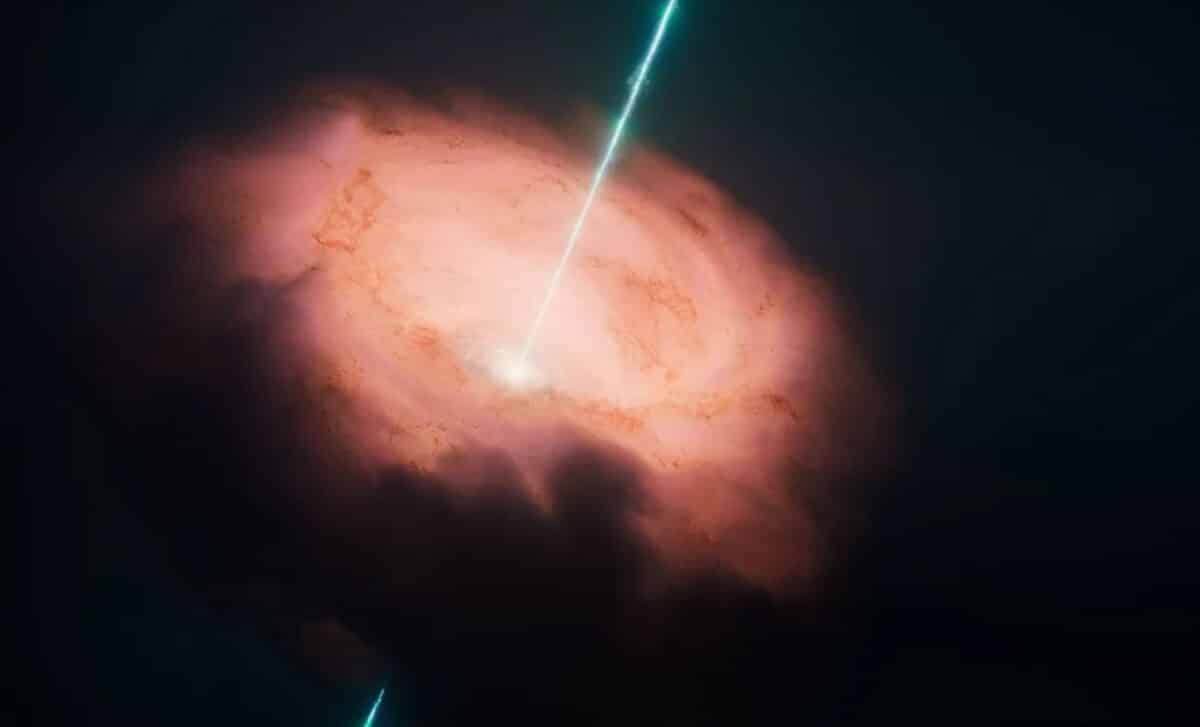 An artist’s rendition of a black hole, along with its swirling accretion disk, bright corona and jet – © NASA, ESA, CSA, Ralf Crawford (STScI)
According to the authors, the distinction lies in mathematical symmetries known as ladder symmetries. These symmetries enforce a zero solution for bosonic perturbations. Fermionic fields, on the other hand, do not follow this constraint, as their lowest multipole moment allows for what the study describes as a “regular decaying solution.”
Toward the Idea of Fermionic “Hair”
This departure from the zero-value rule raises the possibility that black holes could possess what physicists call “hair,” a term used to describe additional observable properties beyond mass, charge, and angular momentum. In this context, the study suggests the existence of fermionic hair.
The idea is conceptually similar to electroweak hair, a theoretical framework involving clouds of W and Z bosons from which black holes might extract energy and angular momentum. The presence of fermionic fields could therefore introduce new layers of structure around black holes.
As reported by Popular Mechanics, the authors emphasize that their findings highlight a distinctive role for fermions in potentially bypassing established theorems. They write that the work “opens new directions to probe the interplay between fundamental fields, black-hole structure, and strong-gravity phenomenology,” pointing to fresh avenues for investigating some of the universe’s most enigmatic objects.
These results, if confirmed, would not overturn existing physics outright, but they would complicate a picture once considered settled, adding yet another layer to the enduring mystery of black holes.