
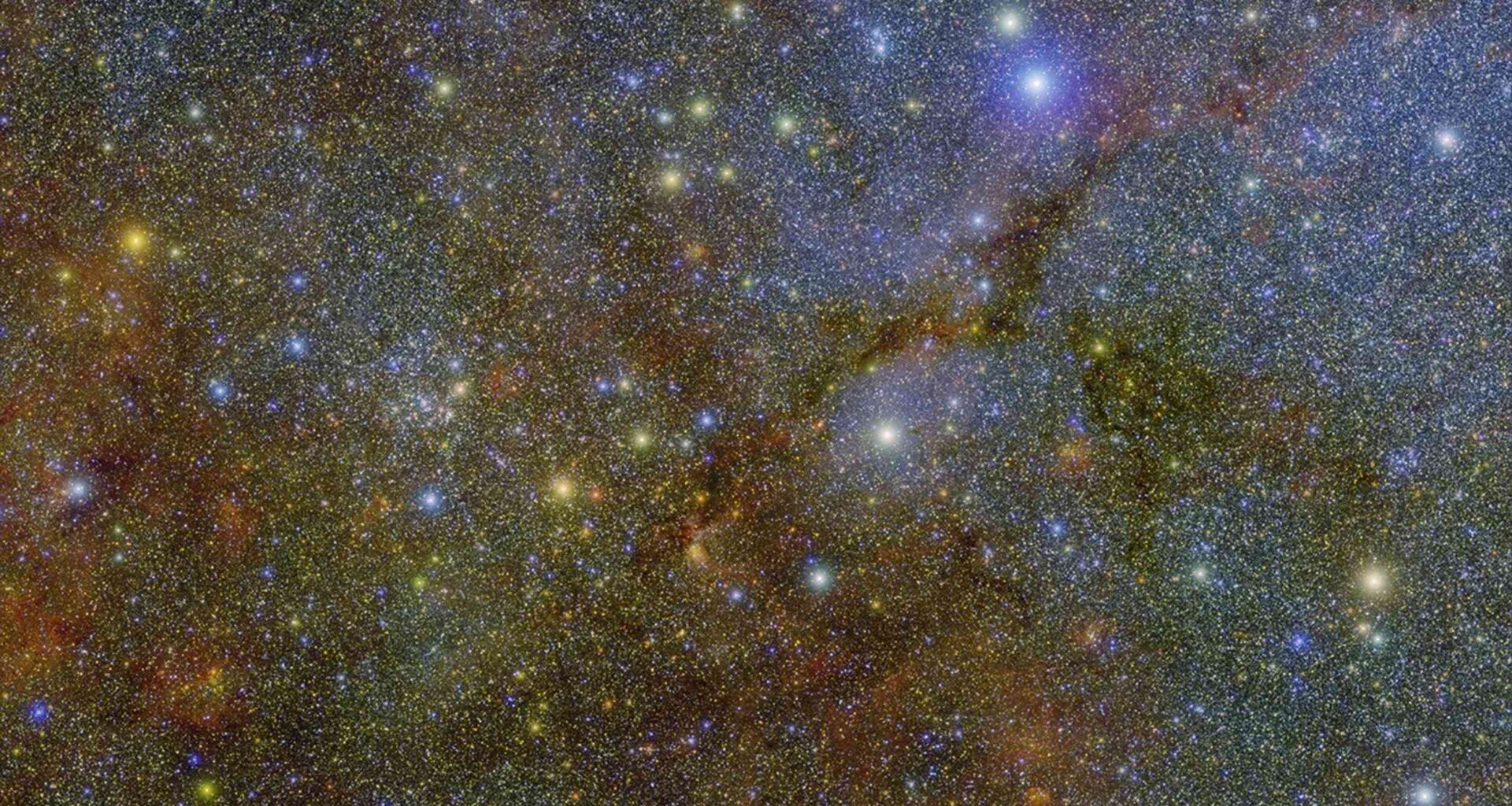
A new study has found that large-scale maps of frozen water and other simple molecules can now reveal hidden structure inside a massive star-forming region in our galaxy.
That new view shows exactly where these frozen materials survive, changing how scientists track the earliest ingredients of planets.
Inside the clouds

Across Cygnus X, a vast star-forming region in the Milky Way about 4,600 light-years away, the newly mapped ice bands appeared directly on the dark, dusty lanes already known for blocking starlight.
Joseph Hora, an astronomer at the Harvard-Smithsonian Center for Astrophysics (CfA), analyzed the data. He linked the strongest ice signals to the cloudiest zones.
Instead of showing up only as narrow shadows in front of bright stars, the ice spread across whole cloud faces.
That wider view set a clear limit on where the frozen material endures and pointed to why the next explanation has to focus on how those clouds protect it.
Why ice stays
Deep inside these clouds, ultraviolet radiation – high-energy starlight that breaks chemical bonds – had a harder time reaching coated grains.
There, water and carbon dioxide likely built up on dust particles no larger than grains in candle smoke.
Closer to newborn stars, stronger light heated exposed surfaces and knocked fragile ice chemistry out of balance. So the densest dust and the deepest ice lined up cleanly in the new maps.
A skywide survey
Launched on March 11, 2025, SPHEREx scanned the sky in 102 infrared colors and began a series of four full-sky surveys.
Each color captured a different slice of infrared light, letting the mission separate ice, dust, and glowing organic material.
Where the James Webb Space Telescope (JWST) had already mapped icy molecules in rich detail over much smaller patches of sky, SPHEREx traded close-up sharpness for reach, turning scattered detections into a map that could expose regional patterns.
More than water
Water was only part of the picture, because the maps traced carbon dioxide and polycyclic aromatic hydrocarbons – carbon-rich molecules lit by starlight.
Orange emission from those molecules often wrapped around regions where blue ice went dark, marking hotter, exposed edges.
Even side by side, neighboring clouds were not chemically uniform, and the maps caught those differences in plain view.
It also hinted that one mission could follow both sheltered chemistry and active radiation fronts without changing instruments.
Clouds change locally
Behind the broad ice lanes, individual stars still mattered because their light pierced the clouds along narrow, measurable paths.
“We expected to detect these ices in front of individual bright stars: The light from a star acts like a spotlight, revealing any ice in the space between us and that star,” said Joseph.
Spectra from those sightlines showed that water, carbon dioxide, and carbon monoxide did not strengthen in lockstep from place to place.
Small changes in shielding, temperature, or local radiation apparently pushed each molecule along a slightly different chemical path.
North American clue
In the North American and Pelican Nebula complex, about 2,600 light-years away, researchers measured 231 background sources.
Many sightlines favored water ice, while a smaller set showed stronger carbon dioxide, revealing neighborhoods with different histories.
Some patches were probably denser or better shielded, and others may have faced harsher light from nearby massive stars.
Those contrasts kept the story from becoming too neat, because one cloud complex could hold several chemical environments at once.
Other signals appear
Ice was not the mission’s only target, because the same data also picked up glowing molecular hydrogen, pairs of bonded hydrogen atoms.
In a region called DR 21, that emission followed fast-moving gas instead of the frozen material seen along nearby dense clouds.
Elsewhere, bright hydrogen lines outlined H II regions – gas stripped of electrons by hot young stars – inside broader shells.
That extra information let one survey connect cold chemistry, heated dust, and energetic outflows inside the same neighborhood.
Seeds for worlds
Recent work linked molecules later seen in planetary atmospheres to a cold pre-stellar inventory preserved in dark clouds.
“SPHEREx can see the spatial distribution of the ices they contain in incredible detail,” said Hora.
Seen that way, the map became more than a snapshot of one cloud, because it traced supplies future systems may inherit.
It did not tell scientists which newborn worlds will keep those molecules, but it narrowed where the raw stock is stored.
Data becomes public
NASA has started placing SPHEREx observations in a public archive, with wider all-sky releases planned after one year.
Because the mission will sweep the sky four times, later maps should lose artifacts and fill in spectra that still look sparse.
Beyond icy clouds, the same archive opens doors to studies of galaxies, stars, and dusty planet nurseries.
A mission built to scan everything may end up changing which corners of the universe astronomers study next.
Next phase of mapping
Cygnus X now emerges as a chemical landscape, with frozen reservoirs and glowing rims spread across clearly separated regions.
As SPHEREx adds three more sky maps, researchers should see cleaner patterns, stronger spectra, and a firmer link between clouds and worlds.
The study is published in The Astrophysical Journal.
—–
Like what you read? Subscribe to our newsletter for engaging articles, exclusive content, and the latest updates.
Check us out on EarthSnap, a free app brought to you by Eric Ralls and Earth.com.
—–