
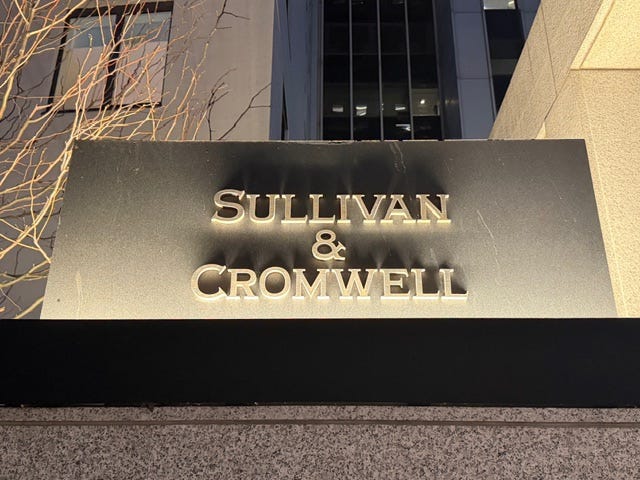
 Outside the New York headquarters of Sullivan & Cromwell (photo by David Lat).
Tonight brings huge news out of Sullivan & Cromwell. We can now add S&C, truly one of the world’s most prestigious and profitable firms, to the AI “Hall of Shame”: the list of law firms that have submitted court filings containing AI-generated “hallucinations.”
On Saturday, April 18, Andrew Dietderich, founder and co-head of SullCrom’s global restructuring group, sent a letter to Chief Judge Martin Glenn of U.S. Bankruptcy Court (S.D.N.Y.). In his missive, Dietderich apologized profusely for a motion filed by S&C in a bankruptcy case that contained “inaccurate citations and other errors,” which he helpfully listed for Chief Judge Glenn in a three-page attachment (because there were that many—the three pages were single-spaced).
As you’d expect, this AI screw-up by S&C has been covered by, well, everyone—including Above the Law, Bloomberg Law, Business Insider, Law360, and Reuters. I don’t have much to add to the copious coverage; I’ll just point out two ironies.
First, as noted by Joe Patrice of Above the Law, Sullivan & Cromwell is the law firm that… advises OpenAI on the “safe and ethical deployment” of artificial intelligence (a representation S&C touts on its website). Physician, heal thyself?
Second, as Dietderich explained in his letter to Chief Judge Glenn, the AI errors were called to his attention by… Boies Schiller Flexner. Why is it ironic that BSF, one of the nation’s leading litigation firms, caught these mistakes? Because until now, Boies Schiller was the reigning champion of “Elite Law Firms Guilty of AI Fails.” (In addition to the AI snafu chronicled in that story, which took place last year, BSF subsequently failed to catch AI-generated errors in a filing by co-counsel in a different case.)
When I covered BSF’s AI error last year, I gave props to then-partner John Kucera: he “fully and freely admitted the errors, and he didn’t throw any colleagues under the bus.” I’ll say the same here about Andy Dietderich. He’s a senior partner at S&C, having joined the firm almost 30 years ago; he leads its restructuring practice, which he founded; and he’s a giant of the bankruptcy bar, Chambers Band 1. Nobody was paying him $2,500 an hour to do legal research; this screw-up was clearly the handiwork of an associate (or perhaps I should say former associate). But Dietderich signed the letter solo, and he didn’t point the finger at anyone else.
So that’s my compliment for S&C. Here’s my criticism: considering how much time has passed since the earliest AI errors—Avianca-gate took place three years ago next month—mistakes are less and less excusable (to the extent that they ever were). After all, as noted by Joe Patrice, there are tech tools out there—some of them powered by AI (a third irony?)—that are designed to catch AI hallucinations. Patrice gave a shoutout to RealityCheck by BriefCatch (and as a board member of BriefCatch, I feel it’s my fiduciary duty to include shameless plugs for the company whenever I can).
I’ll conclude my complaints about S&C here—because people in glass houses shouldn’t throw stones. As some of you might recall, earlier this year I had an AI oopsie of my own (see the update to my SCOTUS tariffs ruling write-up). I’ll simply repeat my two signature quips, urging you to extend grace when it comes to AI fails:
“In the future, everyone will be world-famous for 15 minutes… for an AI screw-up.”
“The next time you hear about an epic AI fail, instead of (or at least after) laughing your ass off, perhaps have the humility to say this to yourself: ‘There but for the grace of God go (A)I.’”
Or, if you prefer, here are some bon mots from Claude, which it generated after I fed it my two sayings and asked for more along the same lines:
“An AI making things up with total confidence isn’t a bug. It’s a mirror.”
“An AI confidently gives wrong answers. A human confidently gives wrong answers. One of them gets a performance review.” (And only one of them gets fired from a $225,000-a-year job.)
“Garbage in, garbage out—but now the garbage speaks in complete sentences and cites its sources.”
Not bad, eh? As I keep telling my husband Zach, who views AI with deep skepticism, it’s actually great—as long as you use it responsibly.